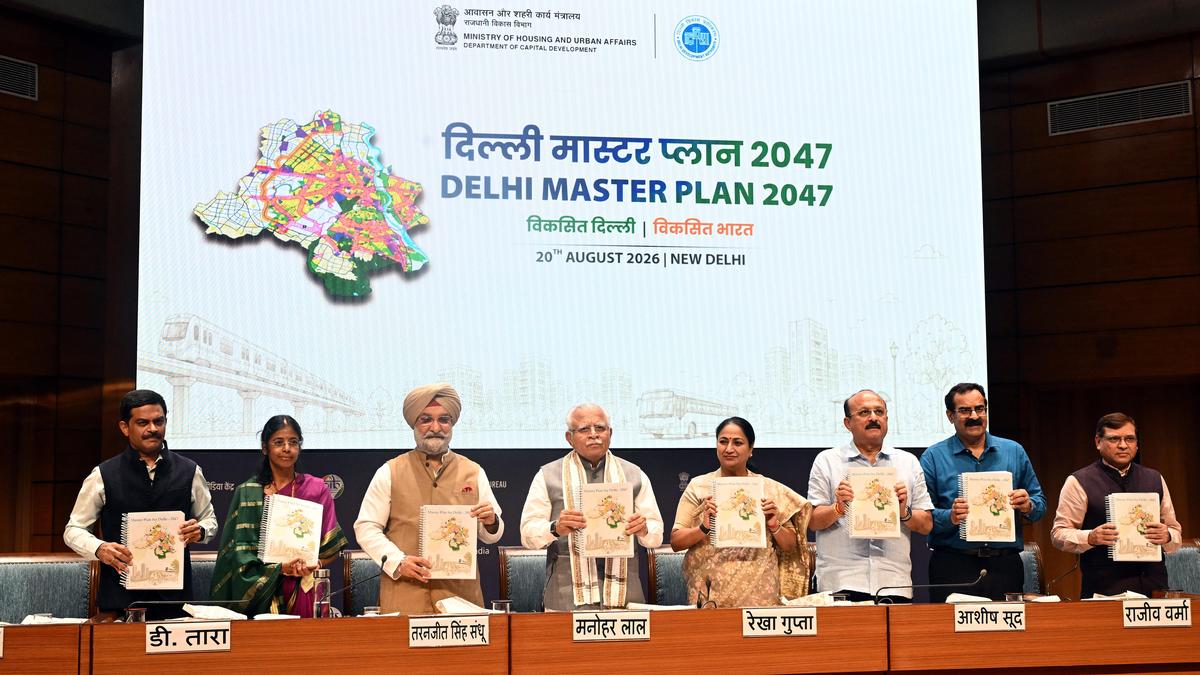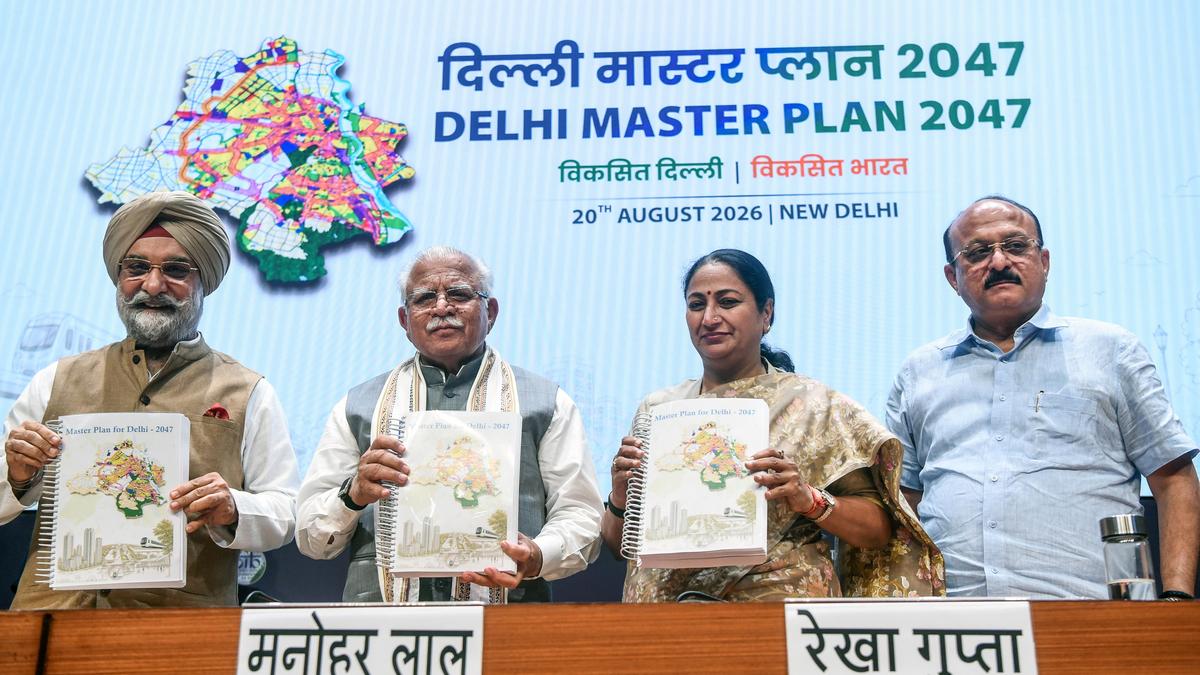
The provision, introduced in the Master Plan for Delhi-2047, which was notified on Thursday, is aimed at taking forward the land pooling policy in areas where owners have not been able to voluntarily come together, a senior Delhi Development Authority (DDA) official said.
| Photo Credit: ANI
Areas in Delhi could soon be notified under town planning schemes (TPS), requiring landowners to mandatorily pool their land for planned development, including roads, parks and other public infrastructure. The provision, introduced in the Master Plan for Delhi-2047, which was notified on Thursday, is aimed at taking forward the land pooling policy in areas where owners have not been able to voluntarily come together, a senior Delhi Development Authority (DDA) official said on Friday.According to the official, the new model will not replace the existing consortium model for land pooling. Instead, it will give the DDA another way to assemble land in smaller pockets of less than 20 hectares that do not form a consortium.“The master plan roads of 30 metres and above in high-density corridors and low-density areas will be constructed through TPS,” the official said. “If a landowner has one acre and 50% of it is required for a road, the floor area ratio permissible on the one acre can be allowed on the remaining portion,” he said.The DDA’s land pooling policy covers 105 villages across six zones, and the authority estimates that the areas could eventually unlock land for about 12 lakh homes.Once an area is notified as a TPS — TPS-1, TPS-2 and so on — participation by landowners will be mandatory, the official said.“Their plots will be reconstituted after portions are set aside for roads, open spaces, social infrastructure and other services. The features of the land pooling policy concerning outcomes and benefits to landowners will remain the same across the models,” he added.On a large scaleThe move comes as the DDA tries to make its land pooling policy work at scale. The authority stopped acquiring land in 2013 and introduced land pooling under the Master Plan for Delhi-2021, shifting to a system in which private landowners pool their land while the DDA assumes an active role as a facilitator rather than a developer.Under the existing consortium model, landowners with adjoining plots of 20 hectares or more come together to form a consortium. Forty per cent of the pooled land is given to the DDA for roads, parks and other public infrastructure, while the owners retain 60% for residential and commercial development.However, voluntary participation has been a hurdle. Landowners representing at least 70% of the land in a sector have to come together before a consortium proposal can be processed. Disagreements, particularly in sectors spread across two or three villages, have delayed the process.“Farmers coming together on their own to form a consortium can develop the land on a 60:40 basis. But if participation is voluntary, there will always be some who do not join. Then it becomes difficult to develop the entire area or carry out public infrastructure work,” the official said.Thus, the authority has done away with the mandatory consortium requirement, allowing individual landowners with at least 20 hectares to approach the DDA directly.Third mode in worksA third mode of land pooling is also being worked out.“The detailed regulations for the entire land pooling policy will come in the next few months with the approval of the Ministry of Housing and Urban Affairs. They will explain TPS and the other modes as well,” the official said.The DDA has examined models followed in Tamil Nadu, Andhra Pradesh, Mumbai and Ahmedabad. It is also processing amendments to the DD Act to provide for mandatory pooling through TPS.“The amendment is to make pooling mandatory. At present, the DD Act primarily mentions land acquisition, so we want to clearly provide for the Town Planning Scheme as well,” the official said.Under the consortium model, 15 proposals are already in the pipeline, while one project has been sanctioned.“The ultimate benefit to the farmer and the DDA will be the same. The difference is in how the land is brought together,” the official said, adding that the revenue outcome for the authority would also remain the same across the models. Published - August 22, 2026 01:03 am IST