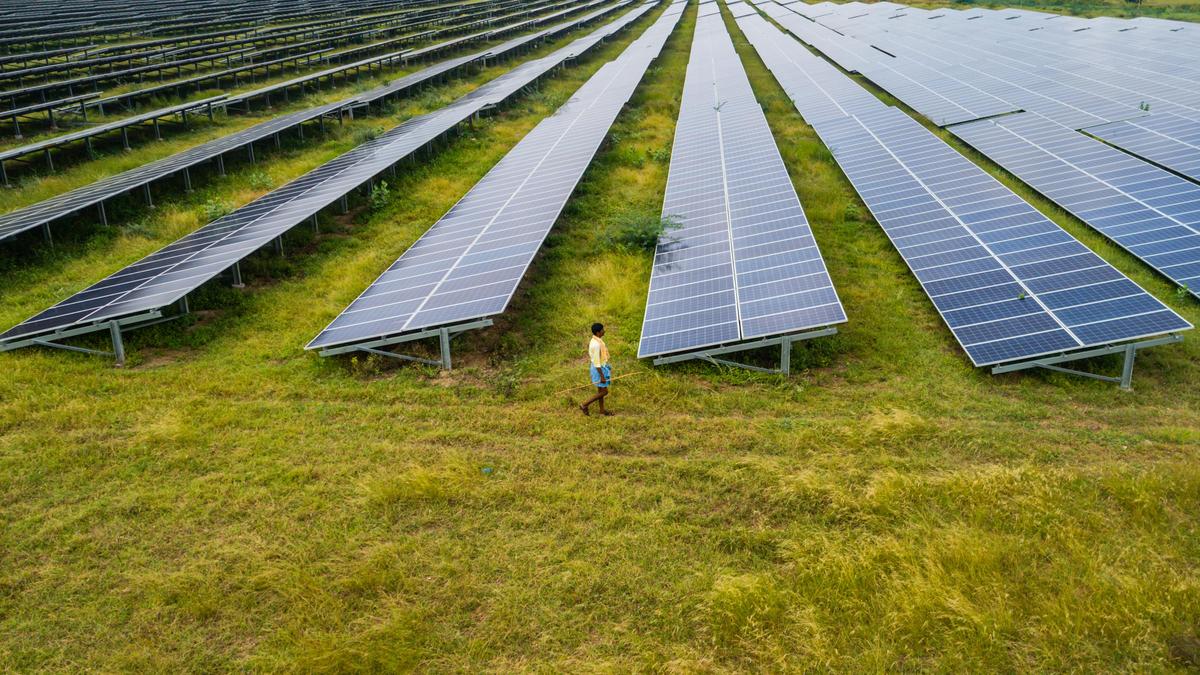
India’s solar manufacturing sector remains heavily dependent on imports for upstream inputs such as polysilicon with only limited domestic wafer capacity
| Photo Credit:
Getty Images
The Ministry of New & Renewable Energy (MNRE) is planning to introduce capex-based subsidy support to push up domestic manufacturing of Polysilicon — the primary base for producing solar cells and modules — for which India is completely dependent on imports.The plans for a subsidy push comes as the world’s third largest renewable energy market aims to have a 30 gigawatt (GW) polysilicon capacity by the end of this decade.“There is a PLI which has happened with a polysilicon component (PLI 2). Some capacity will come in as part of the PLI. Since not a very huge capacity came in there, we are planning another scheme which will provide some kind of subsidy for polysilicon. What is that? How much? That we are working out right now; the details I will not be in a position to share, but that is going on; that work is going on,” Santosh Sarangi, Secretary for New & Renewable Energy, said.Speaking with the media on sidelines of the Bloomberg New Energy Finance (BNEF) Summit, the Secretary pointed out that polysilicon production is a capital intensive activity with high production cost. A polysilicon plant along with metallurgical grade silicate is around ₹850 crore per gigawatt (GW).“To ensure India’s energy security and ensure that India’s manufacturing resilience is maintained, any capacity of 30 GW and above should be good for the Indian context. So, we would look at at least 30 GW capacity addition by 2030,” Sarangi said.India’s solar manufacturing sector remains heavily dependent on imports for upstream inputs such as polysilicon with only limited domestic wafer capacity.China continues to dominate global PV manufacturing, with over 85 per cent of global supply capacity and a highly integrated presence across polysilicon, wafers, cells and modules. Its scale advantage, early policy push, low-cost finance, tax incentives, R&D support, skilling programmes and 23 free trade agreements have allowed Chinese manufacturers to build cost leadership and strong export competitiveness.To bring down India’s upstream import dependence, the Niti Aayog has suggested that the government should provide long-term policy clarity; consider future basic basic customs duty (BCD) on polysilicon and wafers; extend ALMM to wafers; incentivise polysilicon-to-module integrated manufacturing; encourage alternative sourcing and strategic partnerships.Without sharing any details, the MNRE Secretary said India requires a much larger capacity, and the government is working on a scheme which will support manufacturing of polysilicon.Prices of Vanadium Redox Flow Batteries (VRFB), which is being considered as an alternative to lithium-ion batteries, could fall as the demand grows, Sarangi anticipated.“In the vanadium flow batteries, again I mentioned that NTPC Green Energy has placed an order for 100 megawatts, and there are domestic manufacturers who are working and ensuring supply of that capacity,” he added.Published on August 21, 2026