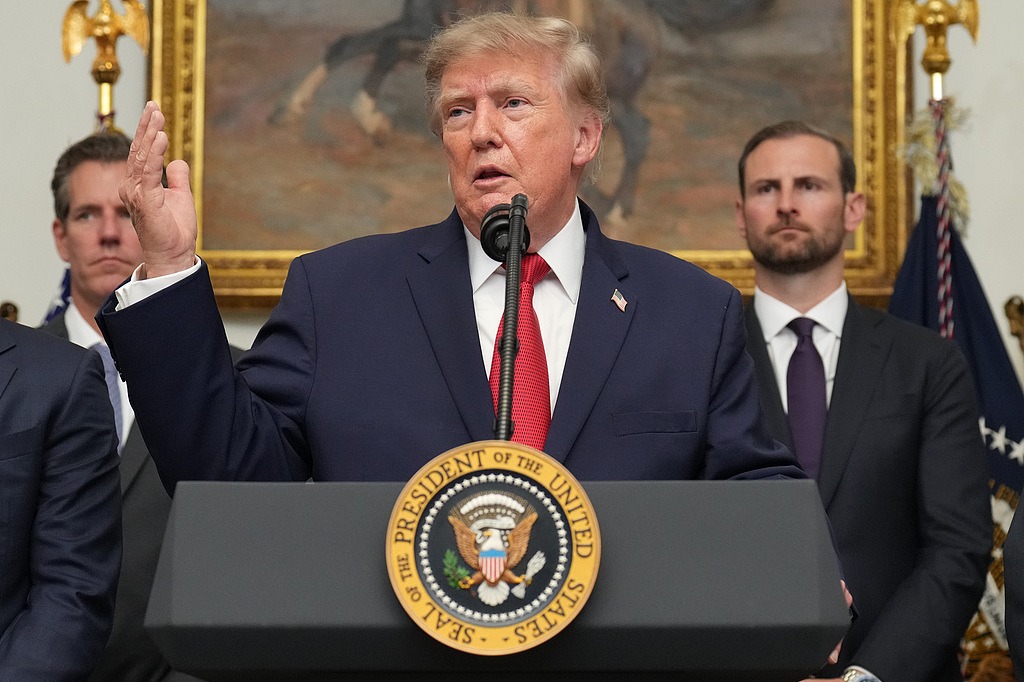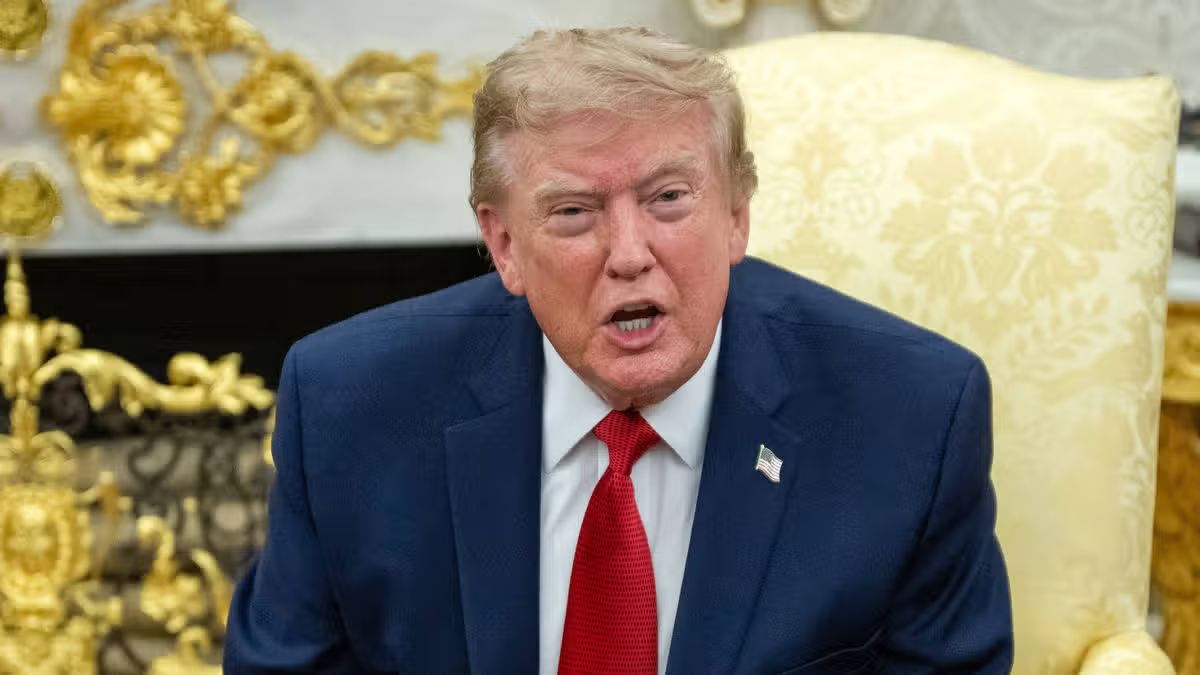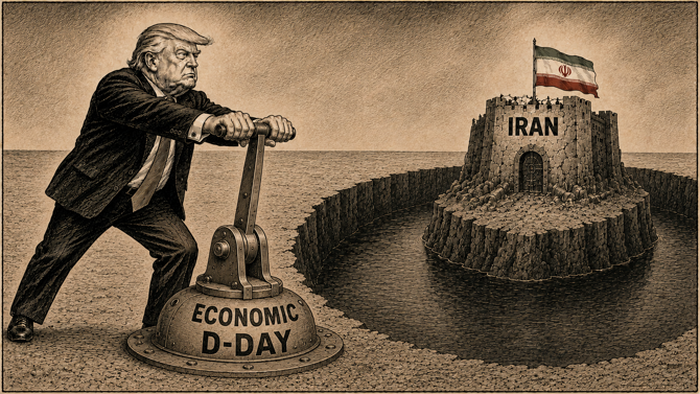
United States President Donald Trump has threatened a crushing financial campaign against Iran, which he has referred to as “economic D-Day”, as the war on Tehran continues to drag on.But on Thursday, the first casualty appeared to be US markets.Recommended Stories list of 3 itemslist 1 of 3US Treasury secretary says new economic measures will ‘collapse’ Iranlist 2 of 3Walmart sees sales drop as US consumer spending retreatslist 3 of 3Houthis and government trade attacks as Yemen slides back to full-scale warend of listAs US crude oil nudged up from its Wednesday closing price of $86.20 per barrel to $86.70, the US stock market made its worst losses in three weeks. Meanwhile, the US announced its total debt has surpassed a record $40 trillion this week.Here’s what Trump has threatened and what the result has been so far.What did Trump threaten?In a post on Truth Social on Wednesday, Trump said Iran had “failed to take” the opportunity to make a deal, and would face “economic warfare and isolation on an unprecedented scale”.He also threatened new sanctions against any country that does business with Iran.“ANY country that allows its financial institutions, businesses, airports, or government entities to provide any type of lifeline to Iran will itself face TREMENDOUS Economic Consequences,” he wrote.On Thursday, Treasury Secretary Scott Bessent told CNBC again that this new “economic warfare” could include more secondary sanctions on other nations and companies that conduct business with Iran.The latest Trump administration rhetoric comes as the critical Strait of Hormuz in the Gulf remains closed to shipping, upending global energy and financial markets. Before the war, some 20 percent of global oil and natural gas supplies were shipped through this waterway.The war is increasingly becoming unpopular within the US as the costs of petrol and other living expenses rise.On Wednesday, Tehran dismissed Trump’s threats, with Foreign Minister Abbas Araghchi calling the so-called “economic D-Day” a “diversion from America’s own crisis”.How have US markets reacted to Trump’s ‘economic warfare’ announcement?The US and Israel’s war on Iran has paralysed the Strait of Hormuz, the only route to the open ocean through which Gulf oil producers can ship their exports. Before the war, some 130 ships passed through the strait each day. Now barely a handful get through. This has hugely unsettled the global energy and financial markets.Following Trump’s economic threats against Iran on Wednesday, global crude oil prices rose to nearly a one-month high on Thursday morning with Brent crude – the global benchmark – topping $93 a barrel. On Friday morning, the price of Brent remained at $93.28 a barrel.In the US, US crude oil climbed to $86.70 per barrel on Thursday. On Friday morning, it was trading at about $86.20.Meanwhile, US stock markets made their worst losses in three weeks.The Dow Jones Industrial Average shed 703.84 points, or 1.32 percent, closing at 52,759.21 on Thursday evening. The S&P 500 lost 0.87 percent, closing at 7,641.16.On Friday morning, US indices showed signs of stabilising.Frederic Schneider, a nonresident senior fellow at the Middle East Council on Global Affairs, noted that the 30-year US Treasury yield pushed above 5.25 percent, close to a two-decade high after Trump’s announcement. This indicates that the price of US bonds is falling as investors avoid them, signalling a lack of confidence in the US.Bessent announced an emergency move to double the Treasury’s buybacks of long-dated debt to at least $4bn, but this did not calm the market.“This is a strong signal, as the world’s most powerful treasury had to reach for extraordinary measures and failed to calm the market,” Schneider told Al Jazeera.“Long-dated Treasuries have faced a ‘buyers’ strike’ since June, driven by a widening federal deficit, a wave of AI-related corporate borrowing, and now an oil-price inflation premium layered on top,” he added.Is the US also facing wider economic pressure?Yes. Analysts say both Iran and the US have been feeling the economic pressure of Washington’s war on Tehran.Schneider told Al Jazeera: “The ‘economic war’ keeps the Strait of Hormuz shut, which keeps oil [prices] elevated. The US Energy Information Administration does not expect Gulf output to recover to near pre-conflict levels until early 2027, and the shortage is fanning American inflation, which feeds into the bond market, which is where the real damage is now showing.”He added that the war has shone a light on the US’s vulnerabilities, despite having its own oil industry capable of providing for its needs.“The US is technically energy self-sufficient, but it is not insulated. Petrol prices and cost of living in general are a core topic in a midterm election year. But the Federal Reserve cannot cut rates to support a slowing economy without fuelling the very inflation the oil shock is generating,” he said.Furthermore, this week a US Department of the Treasury update revealed that total US debt has surpassed $40 trillion for the first time in history – two years before expected, as a result of the costs of the war and Trump’s lowering of corporate taxes.Schneider noted that the US also needs to consider its allies’ economies.“The Gulf states and the East Asian economies are the hardest hit by this war, and they are also among the largest holders of US assets,” he said.On Wednesday night, Trump also warned that any country whose “financial institutions, businesses, airports, or government entities” aid Tehran will face “TREMENDOUS Economic Consequences”.Hours earlier, the UAE, a longtime trade hub for Iran, announced an indefinite embargo after accusing Iran of firing missiles at its territory, a move analysts called significant given Iran’s reliance on Emirati financial access.“As the Gulf draws down reserves and reconsiders where it deploys its sovereign wealth, and as Japan strains under its own currency pressures, the marginal buyers of American debt are pulling back at precisely the moment Washington most needs them,” he added.What does all this mean for Trump?The war on Iran, which the Trump administration can’t seem to bring to an end, is increasingly unpopular in the US.Now, there are just a few weeks to go before pivotal midterm elections in November determine whether his Republican Party can keep control of Congress.US Senator Mark Warner, vice chairman of the Senate Intelligence Committee, criticised ongoing US involvement in the conflict with Iran in a post on X on Thursday.“When will Trump walk away from this disastrous and deadly war?” he asked.On Friday, Trump told a rally of supporters that paying “a tiny little bit more for your gasoline” is worth the cost of ensuring “a very evil country”, meaning Iran, cannot have a nuclear weapon.However, peace talks between the US and Iran, which would cover Iran’s nuclear capabilities, have yet to get seriously under way as the crisis in the Strait of Hormuz continues. Iran is currently negotiating a deal with Oman over the future management of the strait, which was open and free to all commercial shipping before the US launched strikes on Tehran on February 28.Iran says it will not talk directly to the US on this matter and will not engage in talks until the matter of Hormuz is completely settled, as well as other conditions it has set for talks. Experts say there is little hope of a successful end in sight.Furthermore, despite Trump’s claim that US forces are in “total control” of the Strait of Hormuz, data analysed by Al Jazeera and Kpler, the maritime intelligence agency, suggests that ship operators may currently be more fearful of falling foul of the Iranian blockade of the strait than they are of the US naval blockade in the same area.Trump’s approval rating in the US has now fallen to its lowest level in his presidency, with an overwhelming majority of Americans concerned that the US-Israel war on Iran will last a very long time.Consumers have seen fuel prices rise dramatically since the war began in February, with the cost of gasoline [petrol] up nearly a third compared with a year ago, according to the American Automobile Association.Just 33 percent of respondents approved of Trump’s job performance, according to the Reuters/Ipsos poll. The approval rating matches the lows seen in December 2017 during his first term.Trump, who campaigned on a promise to keep inflation in check and avoid long-lasting wars, initially pledged that the conflict with Iran would take just a few weeks.
Trump’s ‘economic D-Day’ claims first victim: Not Iran, but US markets
The US and Israel's war on Iran has upended global financial and energy markets.
1,377 words~6 min read