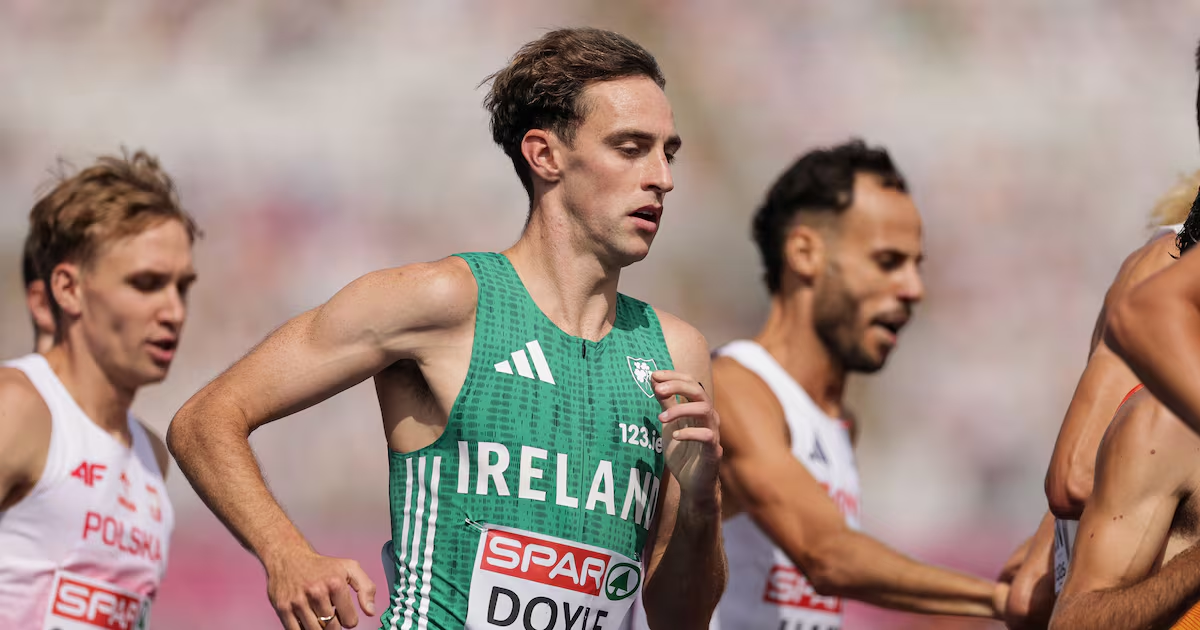
Cathal Doyle was still reeling after his gut-punching exit from the 1,500m at the European Championships when he was sent a copy of an article from The Sunday Times. An article bearing the headline “Reality of athletics: it pays more to be crap runner and good on socials” highlighted the thin breadline that most elite athletes are surviving on these days.British sprinter Toby Harries won a silver medal with the British mixed 4x400m relay on the opening day of the championships in Birmingham, later adding another in the men’s 4x400m. He also won an Olympic relay bronze in Paris. None of those feats earned him a single cent in prize money. Lamenting the situation whereby shoe sponsorship deals have become more likely to go to social media fitness influencers than elite athletes, Harries said: “You’re better off being world class at social media and a bit of a crap athlete than being a world-class athlete and crap [at] social media”.Doyle could readily identify with this. A four-time Irish 1,500m champion, the Dublin athlete had gone to Birmingham determined to produce the sort of run that might earn him a performance bonus from his shoe contract with Nike, possibly even an increase on his annual Sport Ireland grant of €18,000.Instead, with just under 600m to go in his 1,500m heat, Doyle was tripped and fell, losing critical ground just as the front-runners accelerated. Despite getting up to finish, then enduring a two-hour appeal by Athletics Ireland to have him reinstated, he watched last Saturday’s final from the stand – with the “head-melting” thoughts of what might have been.“It just shows, once you’re in a final, anything can happen,” Doyle says, one of those things being Andrew Coscoran’s thrilling run to snatch bronze in the last 100m. “The only positive for me was knowing I’ve beaten all three medal winners over the last year or two. You have to look at it that way, try to keep it going for another while.”Andrew Coscoran reacts to clinching the bronze medal in the 1500m final at European Athletics Championship earlier this month. Photograph: Mike Egerton/PA Wire Like Coscoran, Doyle has made considerable sacrifices over the years. At 28, he’s been based in Brighton the last two years, coached by John Bigg. His Paris Olympic performance – where he won his 1,500m repechage but missed out on the final by less than a second – helped to earn him his first Sport Ireland international-class grant of €18,000. His initial delight at getting this support was slightly dampened when discovering this money would also be taxed, despite all of it coming from taxpayers’ money in the first place.“This is only my second year getting funding, but I think getting taxed on a Government grant is complete bullshit. We already pay tax on everything else, as normal. For me, it’s less than €1,500 a month, and you’re paying for rent, for training camps and still trying to keep something aside to pay the tax on it. It’s not a huge amount, well below minimum wage anyway.“It would almost be better if they just took the tax out first. It’s a nothing amount for Revenue, but it would make a massive difference for the athlete. Sport Ireland are very supportive, and I’m very grateful to be getting my 18k. If I didn’t have that I’d be really struggling.”Doyle is also aware most athletes have multiple income streams, including from social media: “But I think you have to be an athlete like Keely Hodgkinson, or else some bang-average club runner. It’s no good being the middle man. I’m running 3:32 for 1,500m, not many people can relate to that. But they can relate to the everyday runner trying to break 20 minutes for 5km.”And then there is Mark English, who became the first Irish man to win a European gold medal in any athletics event with his 800m victory and is also a qualified doctor. At 33, English was also the oldest man in the final by six years, and the oldest man ever to win a European 800m title.Mark English wins the 800m final at the European Athletics Championship earlier this month. Photograph: Mike Egerton/PA Wire “What is interesting about Mark is that he’s put his medical career on a complete hold, while all his peers that he qualified with have already moved on,” says David Matthews, the former Irish 800m runner and RTÉ athletics commentator. “I’ve no doubt Mark will catch up in his medical career once he finishes with athletics. At the same time, I’m sure some of his peers in the medical profession would give anything to be crossing the finish line, arms aloft, and becoming European 800m champion.”Matthews understands all too well the financial realities of athletics. He retired from international running after his second Olympics in Sydney 2000, aged 26, although his Irish 800m record from 1995 stood until 2021, when English finally broke it.“I left athletics at 26 because I couldn’t afford to stay in it,” Matthews says. “I’d a wife, a mortgage and no job. My wife was facilitating my career, and we couldn’t afford it after that. Since I’ve retired, things have changed on the circuit in a big way. Now it’s less about appearance fees, more about prize money. Which is the right way. Because it’s rewarding people who are at their best in the races.“That’s where Mark is going to make his money, and his win in Birmingham will also open a lane when it comes to the Diamond League meetings. There’s also some spin-off earning through social media. But Mark isn’t one to leverage any of that to the extent of some others. “He is active on social media, but only to let people know what he’s done. His entire focus is around his performance on the track. That’s the only driving force for him. But that social media presence has also been hugely beneficial in drawing in young athletics fans.“But I’d say 99 per cent of Irish athletes are not in the sport for the money. Because the money isn’t there. They’re in it for those moments whenever they can achieve a bit of success, then maybe earn some money off the back of that. Go down through the team – unless they’re finishing in the top three or four at the European Championships, the vast majority are struggling to make ends meet.”Cathal Doyle vying with Norway’s Jakob Ingebrigtsen in a 1,500m race last year. Photograph: Morgan Treacy/Inpho This year, English received a Sport Ireland world-class grant of €25,000, but he’ll be chasing some considerable prize money over the closing few weeks of the season, including the $30,000 (€25,600) event prize at the Diamond League final, plus the $150,000 for all event winners at the inaugural World Athletics Ultimate Championship in Budapest in September.Before putting his medical career on hold, English did stints at the Mater hospital, while training part-time for the Tokyo Olympics, then at Roscommon Hospital. He also spent time in St Michael’s Hospital in Dún Laoghaire and Galway University Hospital before going full-time to his running. The question now is whether the Donegal athlete will continue full-time in running until the 2028 Olympics in Los Angeles.“I think it’s too soon to tell for sure,” says Chris McNulty, who was in Birmingham reporting for the Donegal Daily. “My own opinion is that he’ll take it on a more short-term outlook, but given how he is running at the moment, I don’t see any reason he shouldn’t keep going. European Indoors are only a few months away, he has a big chance at a seventh continental medal, why not go there at least?”For Doyle, the Nike contract he secured after the Paris Olympics also provides a small base salary, with most of the financial incentives built around performances. “I am very lucky that I do have something,” he says, “and if you can run a national record, or win a race, there’ll be some bonus. But because it is nearly always performance-based, there’s always that pressure. People say ‘you’re living the dream’, but you always have to perform. “I’m just about ticking over. It’s not like ‘Jeez, I don’t know where my next pay cheque might be’. But you’re not flush, you’re always being mindful, trying to keep something left in the pot. And I think that’s the reality of 95 per cent of athletes, outside the very top guys.”
Elite athletes’ harsh financial reality: ‘Vast majority are struggling to make ends meet’
‘Getting taxed on a Government grant is bullshit," says top Irish middle-distance runner Cathal Doyle
1,405 words~6 min read