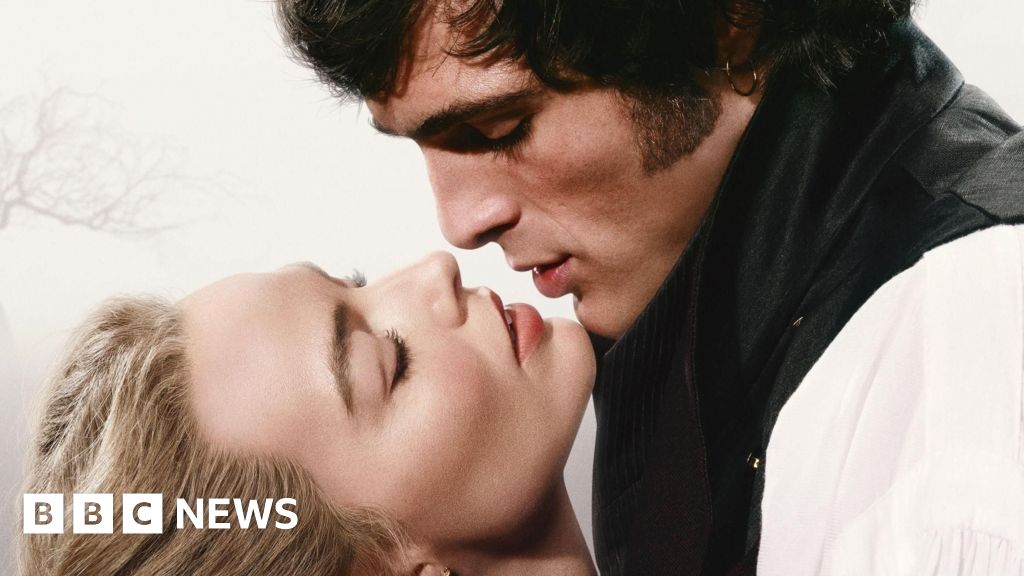
In February, I went to see Emerald Fennell’s “Wuthering Heights” at my local movie theatre, in Brooklyn. Next to me sat a man and a woman in their twenties. Early in the film, as Heathcliff (Jacob Elordi) and Cathy (Margot Robbie) breathlessly spy on a couple of servants engaging in a bout of horse-and-rider-themed roleplay, the man beside me began to squirm. This display of light bondage proved merely an amuse-bouche to the erotic banquet that Fennell had prepared. There are no sex scenes in Emily’s Brontë’s novel—the star-crossed protagonists never so much as kiss—but in Fennell’s adaptation they came and came and came: Heathcliff and Cathy snogging in a little carriage; Heathcliff and Cathy going at it on a dining table; Cathy furiously masturbating on the moors as Heathcliff sneaks up on her to watch. My neighbor reacted to such displays with a series of what Brontë would have called “ejaculations,” gasping and groaning in horrified astonishment. “Oh, my God!” he exclaimed. “He’s a sex addict!” he reported to his date, who had slipped away to the bathroom just as Heathcliff leashed up another poor girl and turned her into his willing slave. When the credits rolled, he sat, stunned, head in hands, tears rolling down his face. “That was so fucking dope,” he said, between sobs.For many months now—years, really—we have been hearing about the so-called sex recession. Studies show that sex is on the decline. In 1990, according to one survey, fifty-five per cent of Americans aged eighteen to sixty-four reported having sex weekly; by 2024, a mere thirty-seven per cent did. Most accounts suggest that young people are particularly affected. Between 2010 and 2024, the number of people between eighteen and twenty-nine who reported not having sex in the past year doubled, from twelve to twenty-four per cent. Experts and commentators have attributed the trend to a variety of factors: a generalized anxiety about social interaction that ails those who came of age during the pandemic; fear of pregnancy, given the punitive restrictions around abortion; the easy and inescapable access to pornography. The effects of such abstemiousness are less clear, though a pair of new movies point in two very different interpretative directions.Will Gluck’s romantic comedy “One Night Only” is set in a universe in which the American government, not content to let people stop having sex on their own, has outlawed the act for all unmarried people. To insure compliance, Americans have had microchips embedded in the tender flesh of their wrists, which glow green if they are married, red if they are not. (Gluck has advised his audience not to overthink “the rules of the world” in which his film takes place, but it is hard not to wonder how, in the same country in which mask mandates were widely treated as a desecration of individual liberty and COVID mRNA vaccines were feared to be vehicles for microchips, people have so willingly surrendered to invasive biotechnology.) To throw a bone to the boneless, our caring representatives have issued a loophole in the form of an annual twelve-hour rumspringa that takes place in August, during which singletons are given the chance to shag anyone they can.The fun way to approach this premise would be to focus on the rebels. You can imagine the protests that would sweep the land, the love-ins that would put the summer of ’68 to shame. But Gluck and his screenwriter, Travis Braun, are interested in those who play it straight, in every sense of the word. Our hero, Owen (Callum Turner), is a pizza-parlor owner with a mild, hangdog manner and a Bronx-adjacent accent; he lives with his girlfriend (Maya Hawke), sleeping chastely by her side night after night. Our heroine, Allie (Monica Barbaro), is a singer who records commercial jingles for products that treat acne and vaginal dryness (presumably less of a problem, given the current non-state of affairs). Skeptical about this whole hook-up-under-pressure thing, she is nevertheless compressed, by her cool lesbian roommate, into a plunging, sequinned minidress and sent off to walk the streets in search of a mate. “Tonight is for the straights. We’ve been dancing around your laws since before the Bible,” the roommate tells her—a sassy slogan that merely raises further bewildering questions about enforcement.On the night of the reprieve, Owen, cut loose for the evening by his girlfriend, who wants to canoodle with a neighbor, vomits in the vicinity of Allie’s high heels, in what might be called a meet-boot. They part, then meet again, and so on and so forth. High jinks ensue. There is a tussle over what seems to be the last remaining condom in the five boroughs. (One of the movie’s better jokes is that, on sex night, there is a surcharge on everything from wine to rubbers.) Owen is bamboozled by a cunning opportunist, handcuffed, and robbed in his underwear. Allie is bamboozled by a sleazy musician, who serenades her with an ode to date rape. Finally, they find each other in the harsh light of morning, with eleven minutes to spare before the mandate goes back into effect. Eleven minutes? They’ll take it!But, of course, they don’t. Though there is background groping aplenty in “One Night Only,” sex is kept totally offscreen. Gluck, when asked by Variety whether he was influenced by studies showing that the youth are squeamish about sex, replied, “The answer is 100% yes.” He went on, “The only thing is I don’t think it’s just Gen Z and Gen Alpha. I believe it’s been a societal shift from taking nudity in adult situations and putting them on your phones at home for everybody. Now it’s more of a private, intimate thing that people don’t want to see when they’re in a shared experience.”This is a deflating comparison; one might hope that a filmmaker would be the first to distinguish between all the things that cinema can do and all the things that porn can’t. But sex is a red herring here. Rom-coms have never needed to feature explicit sex, or sex at all. Attraction is the point—the promise of fulfillment, rather than its depiction, is the reward. And, where the comedy part of the equation is concerned, sex is inevitably better when it goes wrong. Think of the ill-starred romp in “When Harry Met Sally…,” when the leads finally consummate their relationship: the look of bliss on Meg Ryan’s face, paired with the sheer horror on Billy Crystal’s. Gluck isn’t bucking a trend by letting us leave things to the imagination; he’s working in a long tradition.More relevant than Gluck’s depiction, or non-depiction, of sex is what sex is made to signify. “One Night Only” works best when it magnifies the anhedonic grind of our evaluative, swipe-right dating culture. Allie, in particular, is disgusted by the men who treat her as functionally interchangeable with any other available, able-bodied woman. And who can blame her? Where can real connection, the spark of eros, be found? Not, sadly, in the flabby chemistry between Turner and Barbaro, two attractive and appealing actors who are peeled down to an emphatic, boiled-potato blandness, as if their characters were crowd-tested to offend the fewest possible viewers. If “One Night Only” is meant to address the problem of pleasure in our troubled political times, then it makes a very poor case for pleasure. The bizarre and grotesque outcome is that the repressiveness of the state proves to be its own reward. When Allie and Owen decide to bump their rumpy-pumpy to next year, in order to get to know each other better, there is a relief in their compliance, like exhausted toddlers who have stopped fighting bedtime.For something completely different, consider “I Want Your Sex,” Gregg Araki’s candy-colored fantasia of male submission and female domination. Elliot (Cooper Hoffman) is a scruffy recent college graduate who stumbles into a job as an assistant to Erika Tracy (Olivia Wilde), an artist who dresses in a sharp-shouldered array of dominatrix-themed outfits and makes work that riffs, ridiculously, on the erotic. (The first task assigned to Elliot is to chew pieces of gum that he then affixes to a drawing of a vulva.) A week into the job, Erika summons Elliot into her office and reports that he has been making her uncomfortable by ogling her body. Elliot is horrified; stammering, he apologizes with his eyes fixed on the ground, the very picture of pudeur. Now that she has him on the back foot, Erika proposes an arrangement: they will have sex, without emotional attachment, on her schedule, according to her whims and wishes. Elliot blushingly agrees.What ensues is, partly, a caper of personal liberation. Enlisted as Erika’s sub, Elliot finds freedom in sexual service. Araki has a comic-book, exploding-stars visual style that he employs here to show Elliot’s rapture as he is sent grovelling on the floor in lacy underthings, or is sheathed in a body stocking that Erika snips open with a pair of scissors, or is tied up and serviced with a pink dildo of ambitious length. The sex that Elliot has with his girlfriend, the apparently frigid medical student Minerva (a stone-faced Charli XCX), is kinky in a more inadvertent way: she does her best impression of an impatient corpse as he writhes over her, pressing his eyes closed to better picture Erika. The moral is clear: Elliot, a sensitive, respectful nice guy, has been made to understand something about himself that he never could have if he had been left in charge of his own sexual destiny.If Gluck has willingly conceded to the anti-erotic proclivities of his intended audience, Araki has, naturally, set out to defy them. This is his first movie in a decade, and though he has said that it was explicitly inspired by the sex recession, its depiction of a totally inappropriate workplace relationship seems as much a response to #MeToo. (There is also a hint, in the age gap between the entangled characters, of a winking response to the furor that befogged Wilde’s onetime relationship with Harry Styles, which was treated, by the crazier corners of his fan base, as tantamount to grooming.) Wilde is fabulous as an increasingly unhinged ice queen whose heart begins, inadvertently, to melt—the opposite of the disastrously uptight neurotic that she plays in “The Invite,” her own summer ode to sexual crisis among the middle-aged. Erika’s erotic tutelage put me in mind of Frank-N-Furter, in “The Rocky Horror Picture Show,” that sweet alien transvestite who sets out to corrupt Brad and Janet, a couple of nineteen-fifties innocents who wander into his debauched castle one stormy night. “Give yourself over to absolute pleasure,” Frank sings, and that mantra holds here, too—though only for a while. Erika’s manipulation has a sour edge, and foretells disastrous consequences; the film begins with a “Sunset Boulevard”-inspired shot of a nude Erika floating face down in a swimming pool, though it would be unwise to count her out.More disturbing is a scene in which Elliot, commanded to enlist a friend in a threesome, ropes in his roommate and bestie, Apple (Chase Sui Wonders), the Janet to his Brad, who has not slept with anyone in more than a year and seems confused about the nature of her own desires. (The prospect of a penis repulses her, she confesses to Elliot over a round of mini-golf, apparently oblivious to this problem’s obvious solution.) The ménage that ensues takes on an ugly, exploitative cast that the film doesn’t fully confront; after things go awry and Apple freaks out, she is made to simply disappear from the picture, her friendship a casualty of Elliot’s unstoppable obsession with Erika. Some violation, Araki suggests, can be character-expanding for the right person, even as it pushes another to the breaking point. Still, you don’t know if you don’t try. Live a little. Try bending the rules once in a while. And don’t let the sex-regulating fascists win. ♦
The Boom of the Sex-Recession Movie
In films like “One Night Only” and “I Want Your Sex,” our prudish age becomes the scene of a crime.
1,986 words~9 min read