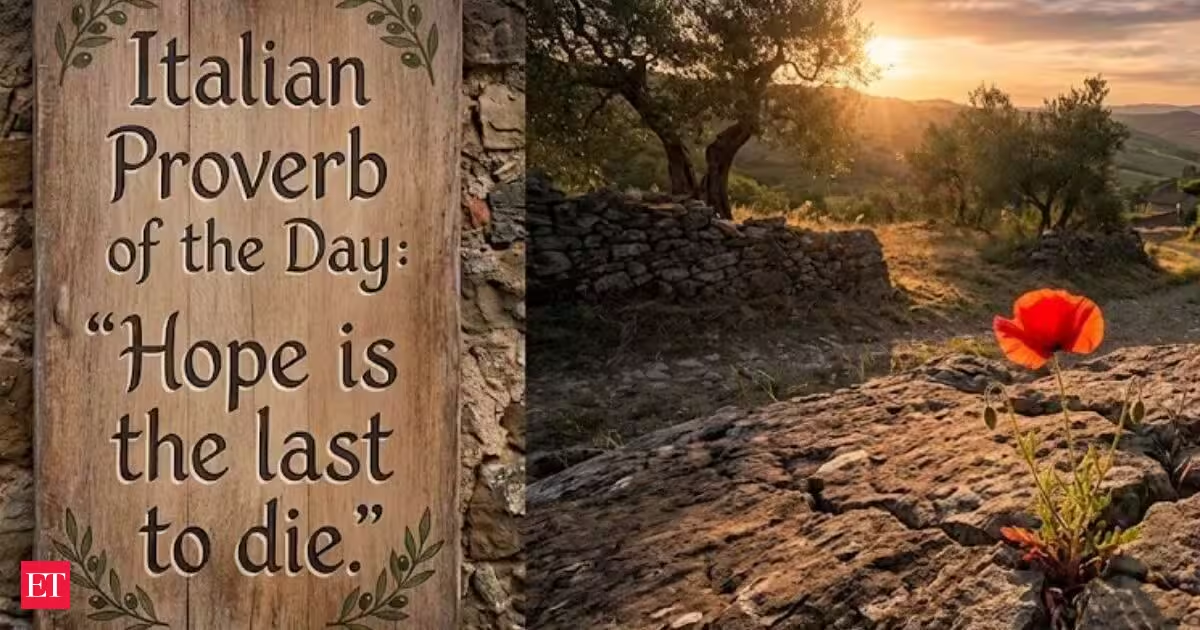
Italian Proverb of the Day: “La speranza è l’ultima a morire,” translated as “Hope is the last to die,” is a well-established Italian proverb about perseverance and the ability to continue hoping even when circumstances appear difficult. The saying suggests that as long as there remains a possibility of a positive outcome, hope can endure. Italian language references recognise the phrase as a proverbial formulation.The meaning of “Hope is the last to die”The proverb's central message is that hope can survive even in difficult circumstances.People may face setbacks, uncertainty or disappointment, but the possibility of improvement can prevent them from giving up completely. The saying places hope at the very end of the emotional journey, suggesting that it often remains when other expectations have disappeared.Its wording is simple, but the idea behind it is broad. Hope does not necessarily guarantee a particular outcome. Instead, it represents the willingness to believe that circumstances can still change.The origins of the proverbThe saying belongs to a much older tradition surrounding the idea that hope remains until the very end.The Instituto Cervantes' multilingual proverb collection records “La speranza è l'ultima a morire” as an Italian proverb and notes its continued use. It also connects the saying with related formulations found in Italian proverb collections.Treccani likewise gives “la speranza è l'ultima a morire” as a proverbial equivalent of “finché c'è vita c'è speranza,” meaning that hope exists as long as life continues.The idea also has an older classical association with “Spes ultima dea,” commonly understood as “Hope is the last goddess.” This reflects the long-standing cultural association between hope and the ability to endure difficult circumstances.Why hope matters during difficult timesHope can influence how people respond to uncertainty.When an outcome is unclear, believing that circumstances might improve can provide a reason to continue making an effort. It can encourage patience when immediate results are unavailable and help people consider possibilities beyond the present difficulty.The proverb does not suggest that hope eliminates problems. Instead, it highlights the psychological importance of maintaining the possibility that a difficult situation can change.That distinction is important. Hope is not the same as certainty.Hope is not a guaranteeThe proverb can be understood as an encouragement to remain hopeful without promising that every situation will eventually end positively.A person can hope for an outcome while recognising that there are no guarantees. The value of hope lies partly in keeping possibilities open rather than treating a difficult present situation as an unavoidable final result.In this sense, the proverb is less about predicting the future and more about how people respond to uncertainty.The connection between hope and perseveranceHope and perseverance often reinforce one another.A person who believes improvement remains possible may be more willing to continue trying. Similarly, continued effort can keep hope alive by creating the possibility of progress.This relationship gives the proverb practical relevance. It presents hope not merely as an emotion but as something that can remain present during prolonged difficulty.Even when circumstances become discouraging, the possibility of change can keep a person from completely abandoning the effort.“Finché c'è vita c'è speranza”The Italian proverb is closely connected with another familiar saying, “Finché c'è vita c'è speranza,” translated as “While there is life, there is hope.”Both expressions emphasise the same underlying principle: the possibility of a different outcome remains while the situation has not reached its final conclusion.The two sayings therefore place hope at the boundary between uncertainty and possibility.They recognise that circumstances can change, sometimes when an outcome appears unlikely.Why the proverb remains relevantThe message continues to resonate because uncertainty is a permanent part of life.Plans can change, expectations can be disappointed and circumstances can develop in unexpected ways. In such moments, the belief that an outcome is not yet settled can provide motivation to continue.The proverb does not ask people to ignore reality. Instead, it suggests that difficult circumstances should not automatically be treated as the end of every possibility.That balance between realism and optimism gives the saying its lasting appeal.The timeless lesson“Hope is the last to die” remains memorable because it expresses a simple but enduring idea: as long as possibilities remain, hope can remain too.The proverb does not promise that every difficulty will disappear or that every desired outcome will occur. Its message is more measured. It reminds people that uncertainty leaves room for change, and that giving up hope means closing that possibility before the situation has necessarily reached its conclusion.Ultimately, the saying presents hope as one of the final sources of resilience when circumstances become difficult.
Italian Proverb of the Day: “Hope is the last to die.” A timeless lesson on resilience
Italian Proverb of the Day: “Hope is the last to die” highlights the enduring role of hope during uncertainty, setbacks and difficult circumstances. The saying suggests that people can continue believing in the possibility of change even when outcomes appear uncertain. Rather than promising success, the proverb presents hope as a source of resilience that can encourage perseverance until the very end.
750 words~3 min read