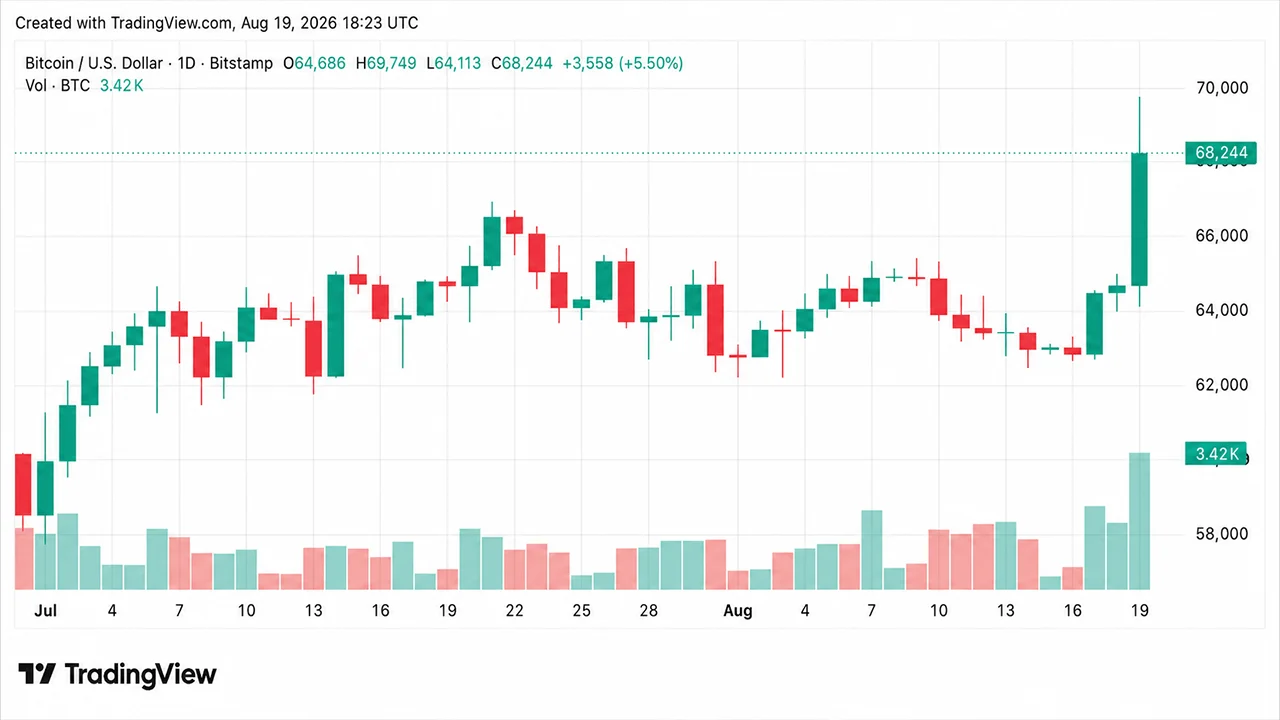
23 min ago5 min readU.S. Treasury's latest announcement has sent BTC to $78K. (Vitalii Vodolazskyi/Shutterstock)SummaryThe Treasury will double its buybacks of long-term U.S. bonds to at least $4 billion per operation through early November, using proceeds from short-term debt rather than creating new money.Officials and analysts say the move resembles a modern “Operation Twist” and is meant to smooth bond-market liquidity, not launch quantitative easing or formal yield curve control.Though small in scale, the buybacks signal concern over elevated long-term yields and raise expectations of more aggressive measures ahead, including yield-curve control—helping fuel rallies in bitcoin and gold.The U.S. Treasury on Wednesday said it would step in to support the market for its own bonds after the cost of long-term government borrowing shot up to the highest level in almost two decades. That rise in borrowing costs had become a problem for both the government's finances and maybe even crypto.The new measure doesn’t print money “out of thin air” and isn't quantitative easing (QE) or yield curve control (YCC) — two of the biggest tools governments and central banks have for pumping money into markets. Both have a long track record of triggering unprecedented risk-taking across financial assets, crypto included.Still, hard assets like bitcoin BTC$75,582.18 and gold are rallying, and the dollar is depreciating against major currencies. BTC has jumped past $77,000, up 23% for the week, which is the largest weekly gain since March 2023, according to CoinDesk data.The reason isn't really about what the Treasury is doing. It's about what the move is telling the market.Here's what was actually announcedStarting Sept. 9 and running through Nov. 4, the Treasury will buy back $4 billion or more of its own long-duration (10 to 30 years) bonds on multiple occasions, double the previous $2 billion cap.“We’re going to increase the size of the buyback,” Treasury Secretary Scott Bessent said during an interview with CNBC. “I would note that it could be more than the 4 billion per issue.” The bonds being repurchased are older ones and don't trade as often, which can make them harder to buy or sell without moving the price.The key point: Treasury is using money it already has, or money raised by selling short-term Treasury notes or bills, not creating new money."They are issuing short bonds to buy long bonds - this is Operation Twist 2.0. This is not a NEW, unprecedented program," Lance Roberts, chief investment strategist for RIA Advisors and lead editor of the Real Investment Report, said.Operation Twist was a policy deployed by the Fed in 2011, under which it bought longer-duration bonds while simultaneously selling short-term ones. That was aimed at twisting the yield curve to lower long-term yields (borrowing costs), encouraging borrowing and investment in the economy while keeping short-term rates steady. Essentially, no new money was pumped into the market.The action announced by the Treasury on Wednesday is the same.It's not QE or YCCQE happens when the Federal Reserve creates new bank reserves out of thin air and uses them to buy bonds, injecting fresh liquidity into the financial system. Only the Fed can do that.Yield curve control (YCC) is a monetary policy in which a central bank sets a target or ceiling for longer-dated bond yields and commits to buying as many bonds as needed to keep yields at or below that level. Unlike QE, which focuses on the quantity of assets purchased, YCC targets a specific interest rate on the yield curve.For instance, the U.S. effectively ran a form of yield curve control from 1942 to 1951, with the Federal Reserve pegging short-term Treasury bill yields and capping longer-term bond yields to help finance World War II. The Bank of Japan pursued explicit YCC from September 2016 until March 2024, targeting the 10-year Japanese government bond yield around 0% (with varying tolerance bands).Essentially, both QE and YCC are stimulatory and grease the wheels of risk-taking in financial markets. What the Treasury announced Wednesday is more of a liquidity-management move in the bond market, at a time when yields are rising.Signal mattersNevertheless, the Treasury's move is less about the buyback itself, which is small in both absolute terms and relative to net bond supply, and more about what it signifies.It indicates that neither the government nor the Treasury are in the mood to attack the real problem — the burgeoning deficit — and are instead looking for temporary fixes to cap rates.In other words, longer-duration yields could quickly resume their climb. It's already happening: The 30-year yield, which fell from 5.30% to 5.18% on Wednesday, has already bounced back to 5.25% as of this writing."Given that buybacks are a zero-sum game, they are unlikely to materially alter the natural trajectory for long-dated yields, which has been up," analysts at ING said in a note to clients.Secondly, the timing of the announcement — when bond yields are at their highest since 2007 — suggests growing unease among policymakers over these elevated borrowing costs.“We have a big toolkit, so we’ll see,” he said. “Part of it is signaling here and to show that we believe that the yields don’t reflect the underlying fundamentals,” Bessent told CNBC.Ole Hansen, head of commodity strategy at Saxo Bank, said the announcement suggests the Treasury is becoming increasingly sensitive to liquidity conditions and upward pressure on long-term borrowing costs.Taken together, these factors suggest that yields will likely continue to rise and that policymakers may need to step in more aggressively in the future. That could involve a full-blown Fed YCC, with the central bank committing to buying as many bonds as required to keep yields on, say, 10-year or 30-year bonds below a specific level. Such a move would lead to explosive growth in the Fed's balance sheet and a massive injection of liquidity into the markets."The bond market reacted to news of increased Treasury buybacks by pushing longer-term yields down across the board,” Mohamed El Erian, adviser at Allianz, said on X. “Beyond the immediate reaction, this move is less about the buyback itself, which is small in both absolute terms and relative to net issuance, than about the possibility of a broader deployment of 'yield curve control' (YCC)." Besides, the announcement itself represents a "soft form of financial repression," according to Deutsche Bank.Financial repression means policies that keep government borrowing costs artificially low, often below inflation, so the real value of debt and savings erodes over time. This is bullish for hard assets like gold and bitcoin.Moreover, while Treasury’s latest move appears to be driving the bullish sentiment, the unwinding of short positions, or bearish bets, is adding further fuel to the rally. Related Assets12345678910Anvil: The Missing Collateral LayerAnvil: The Missing Collateral LayerAnvil is a shared on-chain collateral layer built on a programmable letter of credit: reserve assets as a guarantee -no loan, no interest, keep custody & yield.Jul 29, 2026Anvil is a shared on-chain collateral layer built on a programmable letter of credit: reserve assets as a guarantee -no loan, no interest, keep custody & yield.Why it matters:Anvil is a shared on-chain collateral layer built on a programmable letter of credit: reserve assets as a guarantee -no loan, no interest, keep custody & yield.View Full Report
Bitcoin surges to $78,000 as Treasury move fuels Yyeld-curve control hopes
The rally in hard assets isn’t necessarily about what the Treasury is doing, but what its move signals to the market.
TL;DRAI
Treasury doubled long-term bond buybacks to $4B starting September, signaling yield concerns and driving Bitcoin to $78K (+23%). The move suggests future yield curve control deployment, a stimulus historically inflating venture and crypto asset valuations.
1,193 words~5 min read