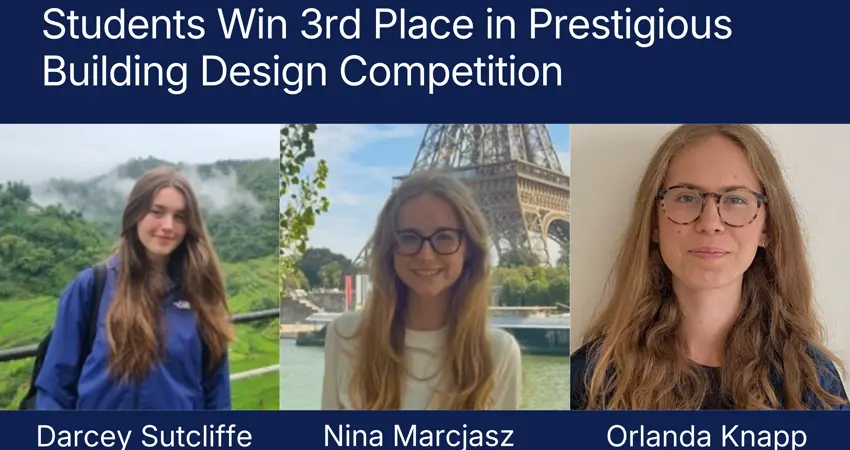
The students, Orlanda Knapp, Nina Marcjasz and Darcey Sutcliffe submitted a proposal for a net-zero building on a university campus in Denver, Colorado, focusing on the building’s heating, ventilation and air conditioning (HVAC) systems.The achievement makes Oxford University the only UK institution to be recognised in the HVAC category of this year’s competition and marks the University’s third major student award in the past two years.The team developed a baseline design that met minimum building code requirements alongside two advanced net-zero alternatives. These explored different approaches to generating, converting, distributing and storing energy, allowing the students to assess the advantages and trade-offs of different pathways to decarbonisation.Reflecting on the achievement, Darcey Sutcliffe said, “I am incredibly proud of the group for receiving this award. Over the last year, I have learnt so much about the importance of both innovation and effective implementation in changing building design.”The project was supervised by Professor Jesus Lizana, Professor David Wallom and Dr Scot Wheeler, and demonstrated strong technical expertise and careful consideration of how innovative engineering solutions can be implemented effectively in real-world buildings.The ZERO Institute helped to coordinate the team’s participation in the competition as part of its wider work to foster innovation and experiential learning in pursuit of net-zero solutions.Dr Jesus Lizana, Associate Professor and Programme Leader for Zero-Carbon Space Heating and Cooling at Oxford University’s ZERO Institute, says: “We’re incredibly proud of Nina, Orlanda and Darcey for their success in such a competitive international field. Their achievement is a testament to their hard work, creativity, and the relevance of their work to tackling real-world decarbonisation challenges.”The result builds on a growing record of success for Oxford engineering students in major competitions and highlights the role of opportunities such as these in enabling students to apply their engineering knowledge to practical sustainability challenges.“The project taught me how much care is needed to design for a minimal carbon footprint, and working with the team reinforced the value of creative thinking in finding the right solutions.” Nina MarcjaszAs part of the award, the team has been invited to the ASHRAE 2027 Winter Conference in Chicago, where they will be formally recognised alongside the world’s leading building engineering professionals and will showcase their project during the Student Program. Congratulations to Nina, Orlanda and Darcey, their supervisors and everyone involved in supporting the project through the Department of Engineering Science and the ZERO Institute.“I thoroughly enjoyed my time on the project; doing things like this reminds us of the importance of sustainable design as engineers.” Orlanda Knapp
Oxford Engineering students win 3rd place in prestigious Sustainable Design competition
Three Oxford University engineering students have been recognised with 3rd place in the 2026 ASHRAE Design Competition, an international competition recognising outstanding student engineering designs that demonstrate technical excellence, innovation and sustainable building performance.
421 words~2 min read