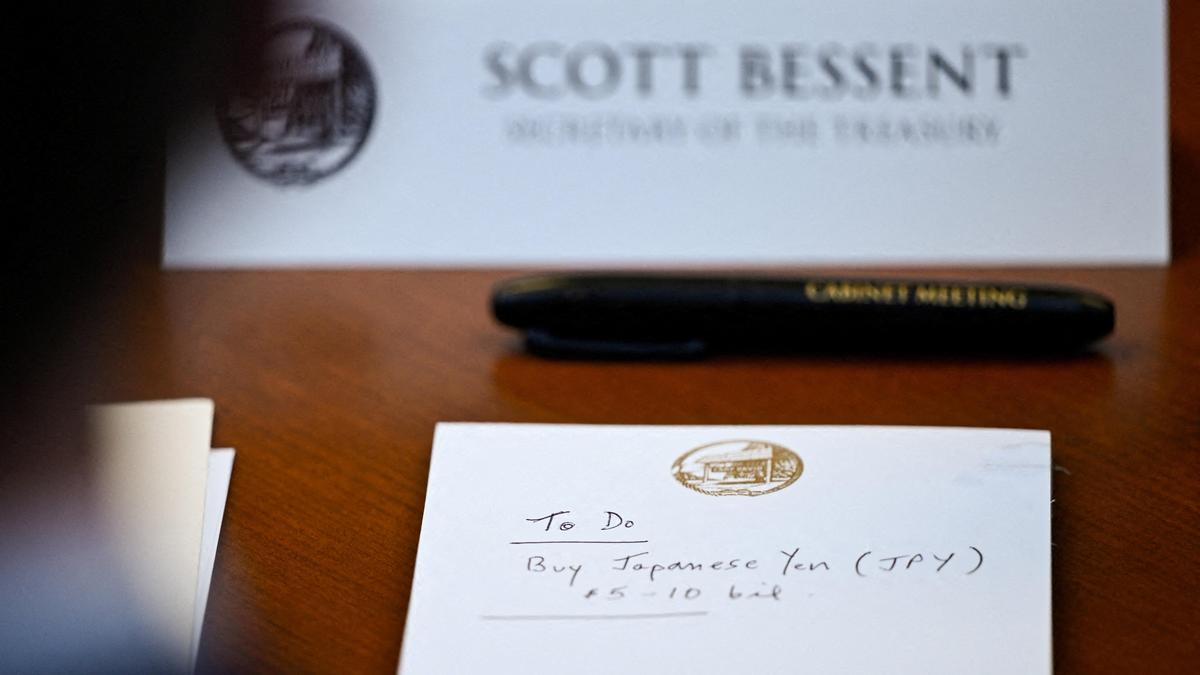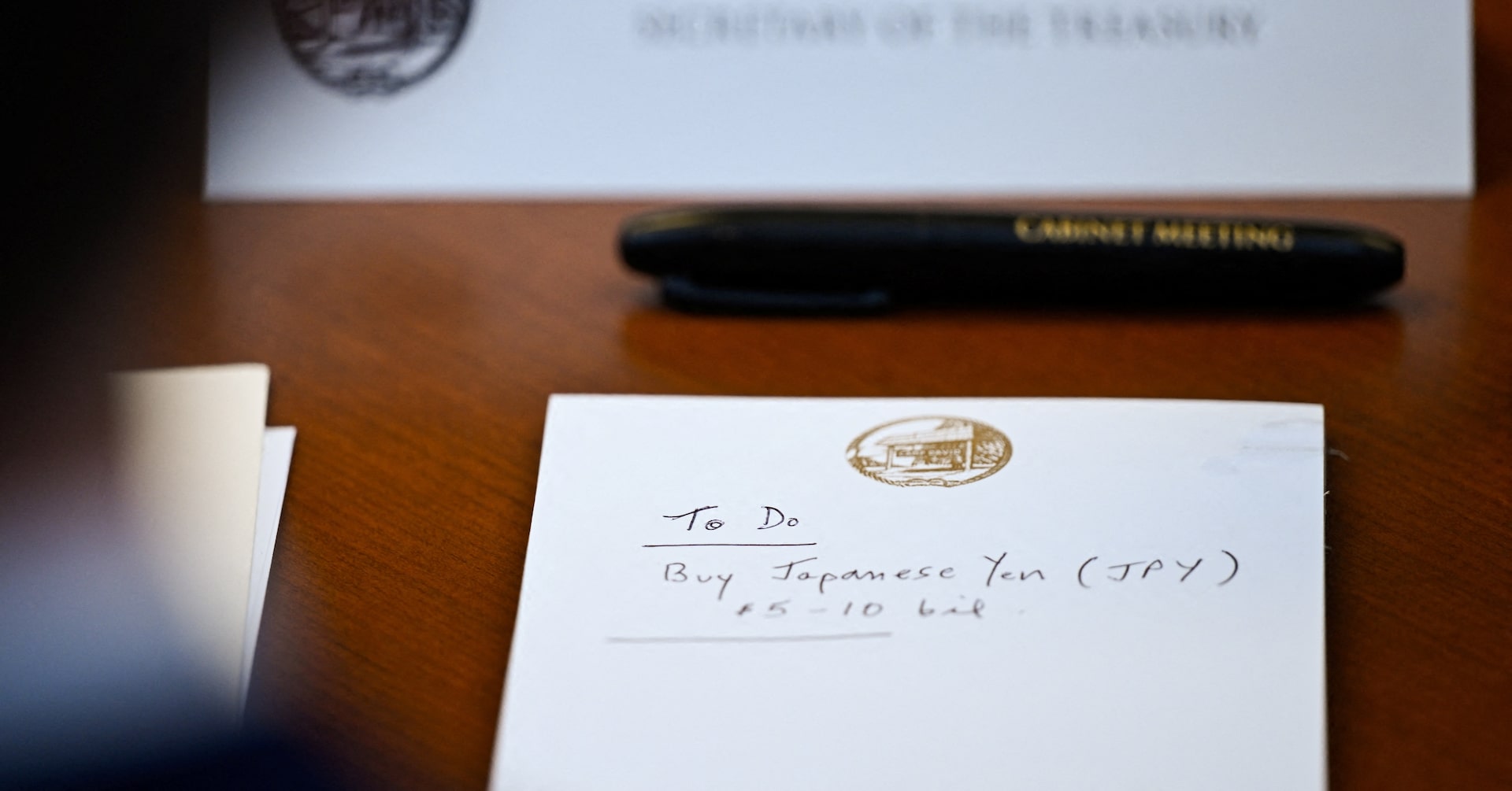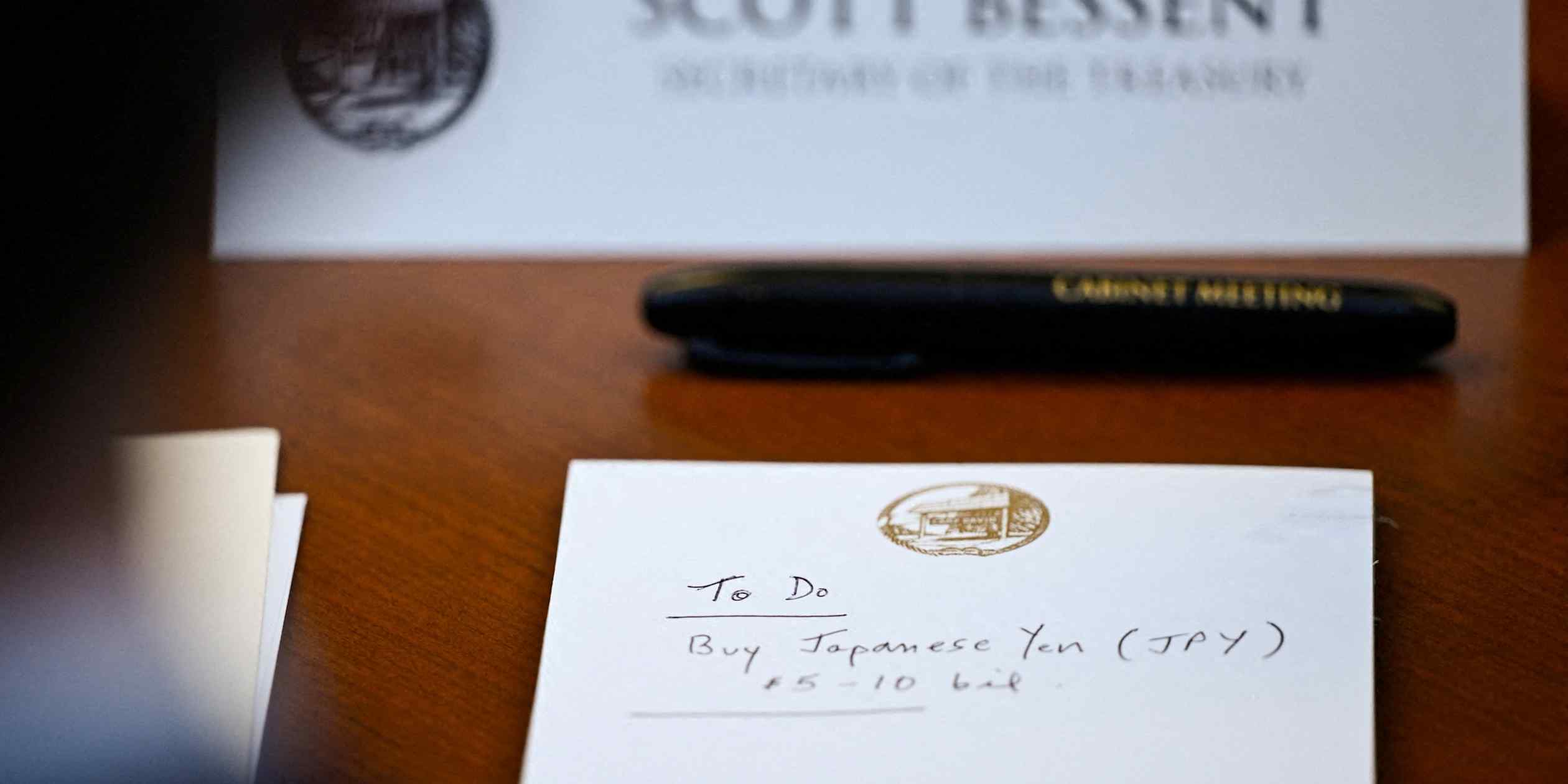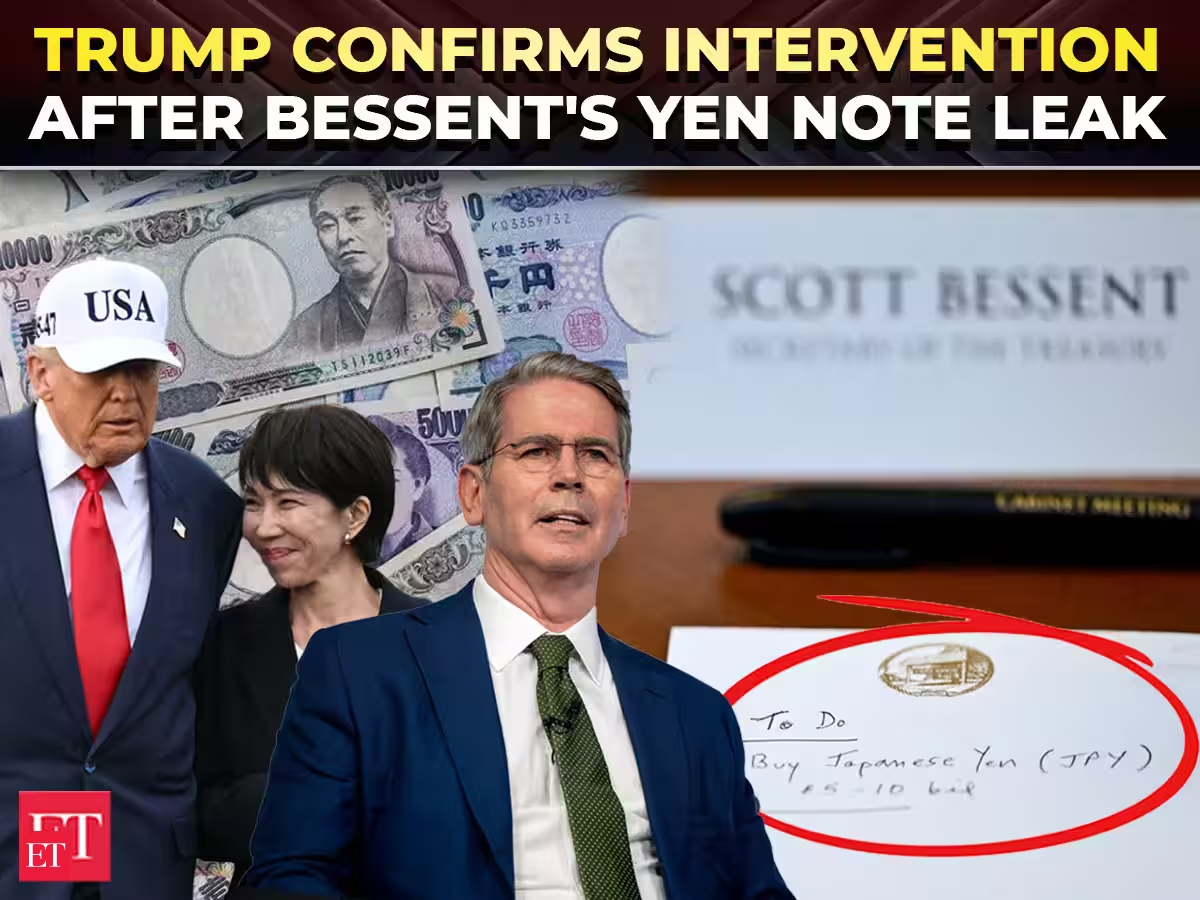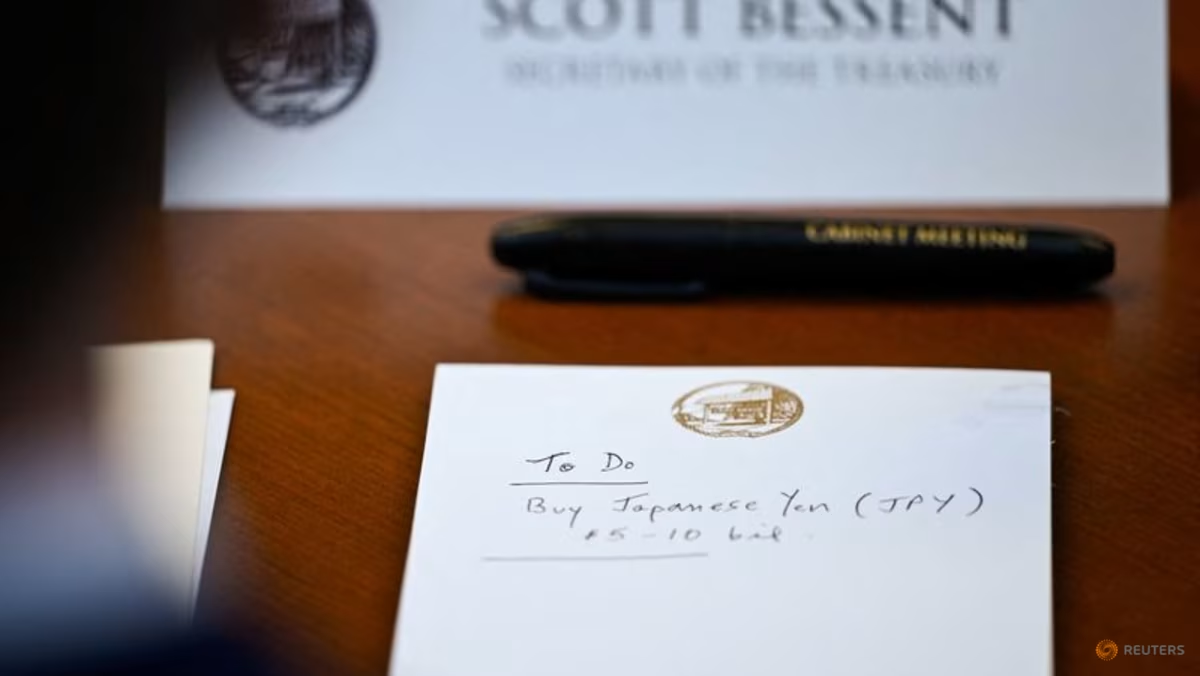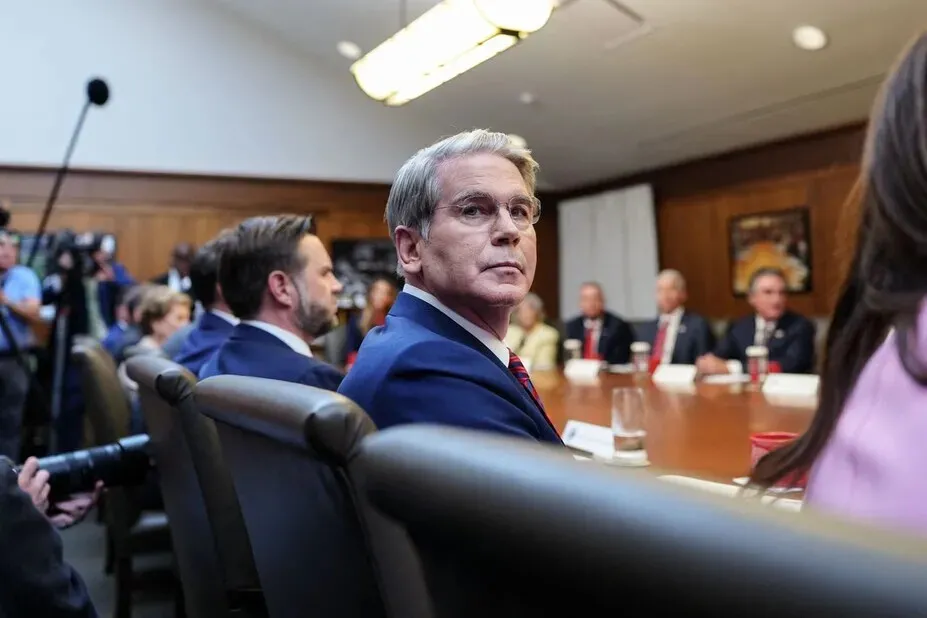
US Treasury Secretary Scott Bessent attends a Cabinet meeting at Camp David in Maryland on July 31, 2026. In front of him is a note he wrote saying, “To do: Buy Japanese Yen (JPY) -10 bil.” (AFP/Yonhap)
On July 31, the US and Japan made a joint intervention in the foreign exchange market. Their goal was to prop up the Japanese yen, which had fallen to a 40-year low.The US Treasury Department had the Federal Reserve Bank of New York purchase yen with euros from the Exchange Stabilization Fund, while Japan’s Ministry of Finance and the Bank of Japan deployed around 13.8 trillion yen in funds.The last time monetary officials in Washington and Tokyo organized a joint yen purchase was 28 years ago, during the Asian financial crisis of 1998. After the intervention, the yen was buoyed from near 164 yen to the dollar to 155 yen by Aug. 3.The justification offered by US Treasury Secretary Scott Bessent was to prevent Asian currency dominoes from falling. In an interview with CNBC on Aug. 4, Bessent said that the Asian Financial Crisis of 1997-1998 was partly “triggered by an overly weak yen.”“I think a stable yen is not only important for the US, but it’s very important for the entire region, because if the yen were to weaken substantially, then the other currencies would follow it,” he said.“We’d seen excess volatility in the Korean won. Many people believe that the Chinese RMB is undervalued,” he added.In short, Bessent said, the US was acting preemptively to forestall the kind of crisis seen 28 years ago.But forex experts have a different take: they believe that Treasury officials had the ulterior motivation of clamping down on a fire sale of treasuries.As of May, Japan held US$1.14 trillion worth of US treasuries, more than any other foreign country. For Japan to defend the yen, it needs to sell treasuries, and such a sale would raise bond yields even higher than they already are.In fact, Japan acquired dollars through the Federal Reserve’s Foreign and International Monetary Authorities Repo Facility instead of selling the treasuries in its possession.The US purchase of yen through a euro sale and Japan’s clever use of the Repo Facility underline the US’ greatest fear: a crackup of the domestic bond market. Public debt on par with GDP, US$1 trillion in yearly interestWarning lights are already flashing for the US’ fiscal position.This past March, US public debt hit US$31.27 trillion, or 100.2% of GDP. Excluding the pandemic, the last time public debt exceeded 100% was in 1946 (106.1%), shortly after World War II.The Congressional Budget Office says that, under current trends, the debt ratio would hit a historical record in 2030 and keep rising to 120% of GDP in 2036 and 175% in 2056.Even scarier than the actual amount of debt is the cost of servicing it. Last year, the US paid US$970 billion in interest payments; this year, those payments are expected to exceed US$1 trillion. The Committee for a Responsible Federal Budget, a Washington-based bipartisan think tank, predicted that under current treasury yields (around 4.6% for 10-year notes and 5.2% for 30-year notes), yearly interest payments on public debt would rise to US$2.5 trillion in 2036, with interest’s share of government revenues jumping from 19% last year to 30%.In short, the US would be paying a dollar in interest for every three dollars of taxes it brings in.This is where a fiscal issue becomes a financial one. Just as doubts about bank solvency can lead to a bank run, doubts about a government’s solvency can lead to a bond sell-off.In crises of the past, the world’s money flowed into US treasuries, as the world’s safest asset. But since US President Donald Trump’s “Liberation Day” declaration last April, dollar-denominated assets have been regarded not as refuges from crises but as their epicenter, leading to heavy liquidation of treasuries.When the market began to doubt Fed chair Kevin Warsh’s commitment to combating inflation, there was another such sell-off, leading to the recent rise in yields.The weakening of US treasuries’ safe haven status is a sign of American decline.To overcome this dilemma, the US needs to resort to painful belt-tightening, which would require both cutting spending and raising taxes.But the Trump administration has been jacking up the deficit with a massive tax cut and has ratcheted up defense spending with a spree of military interventions, including the war with Iran.Trump has asked Congress to raise the defense budget from US$961.4 billion this year to US$1.5 trillion next year.The sell-off in treasuries over the past two years has been an own goal for Trump, given his self-destructive tariffs, military adventurism and attacks on the independence of the Federal Reserve.This isn’t the first time the US has been consumed with concerns about national decline because of a mass issuance of government bonds. Similar fears were expressed in the 1980s.But the 1990s saw a favorable change in both internal and external conditions. At home, the IT revolution boosted productivity, while abroad, the Soviet Union fell to pieces. The Clinton administration raised taxes and cut spending, bringing about a budget surplus.That’s how the US managed to fend off competition from Japan and establish its position as global hegemon.Today, however, more and more factors are turning against the US.The debt-to-GDP ratio is much higher now than in the 1990s (30%-40%), and politicians lack the will to impose fiscal discipline.Under the influence of populism, the US is lowering taxes and increasing spending while waging needless wars. And unlike Japan of the 1980s, the US’ current challenger is China, which is competing not only on an economic level, but also on a military and ideological one. Imperial overreachIn his 1987 book “Rise and Fall of the Great Powers,” historian Paul Kennedy argued that an empire’s decline is accelerated by the “imperial overreach” of attempting to fulfill military and security obligations beyond the level that the state can actually bear.“If [. . .] too large a proportion of the state’s resources is diverted from wealth creation and allocated instead to military purposes, then that is likely to lead to a weakening of national power over the medium term,” Kennedy wrote, adding that when a state adopts a strategy of overexpansion — through, for example, exhausting territorial conquest or costly wars — the expense may far outweigh the benefits.The prime examples presented by Kennedy were the Spanish Empire in the 17th century and the British Empire in the early 20th century.A commonly used yardstick for the risk of overreach is whether interest on government debt exceeds defense spending. And the US has already been in that position since 2024.To be sure, the fact that bond interest payments now exceed the defense budget is not by itself proof of imperial decline.For hegemonic powers of the past, such trends persisted for decades, and the decisive break only came in a major war with a rising power. The classic example is the British Empire, which went into terminal decline over the course of two world wars with Germany.After World War II, the US was less focused on territorial expansion than European imperialists, enabling it to exercise its hegemony at a lower cost. Following the 9/11 terrorist attacks, Washington wasted US$8 trillion on Middle East entanglements, including its invasions of Iraq and Afghanistan. But those costs were incurred during the “unipolar moment,” in the effective absence of a challenger state.Things are different now.According to his own National Security Strategy, Trump ought to be focused on the Western Hemisphere. But given his apparent inability to rein in his reckless ambition, he has returned to the US’ forever wars. The conflict with Iran alone has currently cost around US$37.5 billion.Last month, US Defense Secretary Pete Hegseth asked Congress for US$67 billion in supplemental funding to help cover war expenses, which includes restocking depleted stores of weaponry.The increasingly perilous level of government debt, deficit spending, the snowballing defense budget, and an unpredictable foreign policy are all perpetuating a vicious cycle.