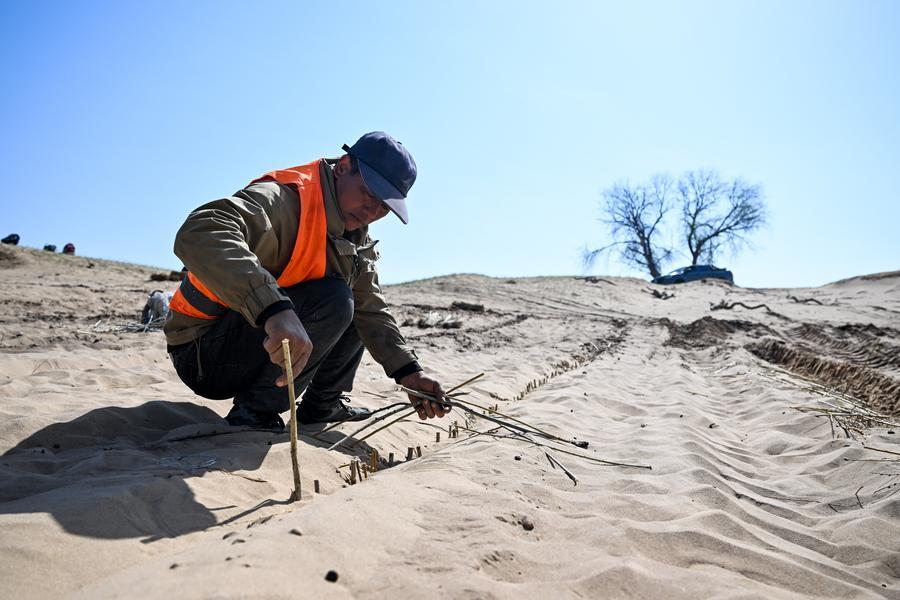
ULAANBAATAR/HOHHOT — Deep in Mongolia's Gobi area, technicians from M-Grass Ecology and Environment (Group), a Chinese company specializing in grass seed technology, crouched on the sandy ground in Khanbogd county inspecting newly planted Haloxylon ammodendron seedlings. With meticulous care, they parted the gravel to confirm each root was firmly nestled in soil.
Characterized by vegetation cover below 10 percent, annual precipitation of approximately 104 millimeters, winter temperatures as low as -31.5 C and summer maxima exceeding 42.2 C, this harsh setting creates major challenges for afforestation. Yet, backed by the Chinese enterprise, a durable green initiative is progressing.
The Haloxylon ammodendron forest project sits near Mongolian wild ass (equus hemionus) habitats, where M-Grass technicians are now preparing for large-scale planting this autumn.
"Whether Haloxylon ammodendron seedlings take root and survive depends on hydrological surveys, native vegetation assessments, seedling selection, soil testing, fertilizer comparisons, planting depth, irrigation during early growth and meticulous subsequent maintenance," said Wang Junfang, the project's technical team leader.
"Gobi afforestation must fully respect desert ecology. The planting process also seeks to protect the native vegetation already growing on this land," Wang said.