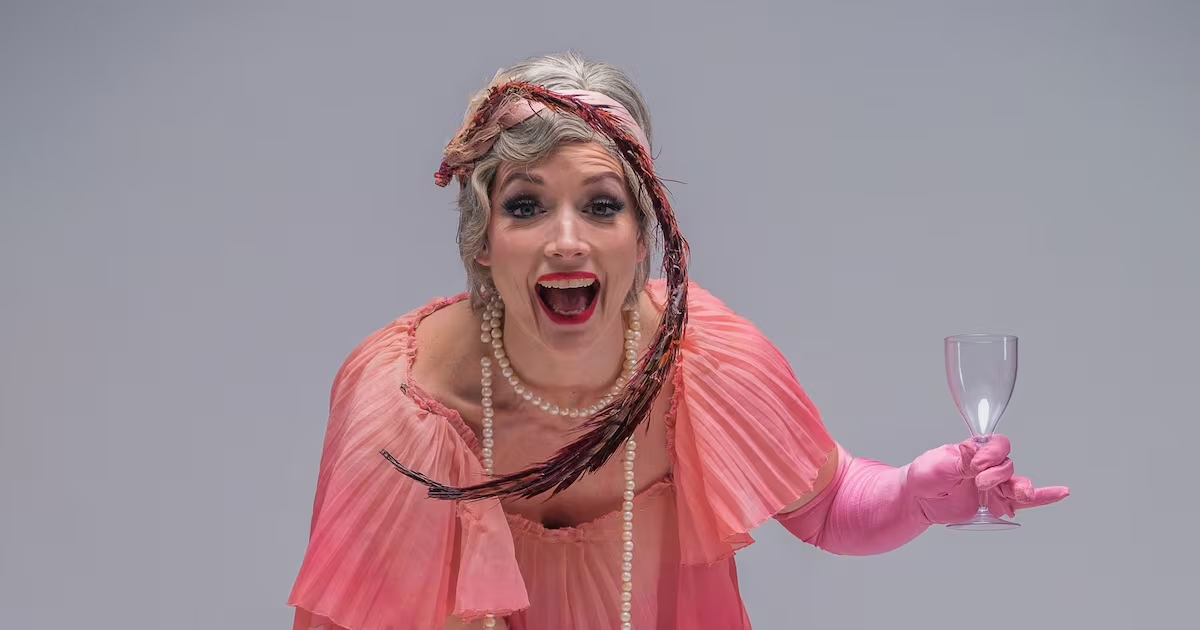
The Feast of the Clowns is an annual event organised by the Tshwane Leadership Foundation.It’s billed as “a community-based festival, a celebration of the city, its diversity and God’s presence” that provides “an awareness-raising platform for various social justice issues” and incorporates “a peaceful, playful protest”.All this was enough to confuse a dull-witted large language model when it was asked to spit out an advert for an item on the festival programme taking place this week at the University of Pretoria: a tour of the Javett Art Centre (Javett-UP) on the university’s Hatfield campus, followed by a workshop on its Mamelodi campus.The concept — and doubtless the content — of the initiative was fantastic. Participants would learn about art education and create posters in the spirit of the festival, which affirms that “the jester can tell the truth to a naked emperor, and the harlequin can lead the parade of protest towards a better tomorrow”.The problem was that someone did an AI. Like when a baby makes a poo. You’re proud of them at a few months old: “Look, he made an AI!” But after the novelty wears off, it’s embarrassing: “Shame, he did a big AI in front of everyone.”The resulting image, another bucket added to the digital slop we now have to wade through, was not only an offence to the eye but also to the very principles behind the gallery tour and the workshop.When theatre maker Kyla Davis drew attention to this contradiction on social media, Javett-UP CEO Jackie Rens was quick to respond and assure the artists who had joined Davis in expressing their outrage that the centre did not produce the advert and that it does, in fact, have a talented human designer. Ironically, the AI-generated poster did manage to generate some of the things its word soup promised: “Solidarity” between creative practitioners, emphasising that art should be “a form of resistance”, and so on.It was a productive exchange, with a lesson learnt and a shared conviction aired. But out there in the digital ether, where nothing can be permanently deleted — circulating infinitely in cyberspace, like a piece of junk from one of Elon Musk’s rockets drifting forever through zero gravity — a flat, glossy image of a circus clown holding a megaphone will be yet another reminder that AI is ultimately the enemy of artists.For all their talk about the jester and the harlequin, the Tshwane Leadership Foundation’s notion of clowning seems to owe a little too much to Barnum & Bailey (or perhaps, more eerily, Stephen King). This is a great pity, as the most memorable clown figures are not the Ringling Brothers type (or even the scary type). Rather, it is the sad clown who strikes at the heart of human experience. The clown can show us that laughter and sorrow, joy and pity, even life and death, are simply two sides of the same coin.But out there in the digital ether, where nothing can be permanently deleted — circulating infinitely in cyberspace, like a piece of junk from one of Elon Musk’s rockets drifting forever through zero gravity — a flat, glossy image of a circus clown holding a megaphone will be yet another reminder that AI is ultimately the enemy of artists.South Africa recently lost two of its tragicomic titans: Seputla Sebogodi and Lionel Newton. The pair performed together in Lara Foot’s 2001 adaptation of Waiting for Godot, playing Samuel Beckett’s maudlin vaudeville duo Vladimir and Estragon — a point of intersection in two very different careers on stage and screen.Sebogodi and Newton had earned their acting chops in theatres across the country in the late 1980s and throughout the 1990s, and by then both had appeared in a handful of sitcoms and soapies. But Sebogodi would go on to become better known to a national television audience through his roles in series like Yizo Yizo, Scandal!, Rhythm City and Generations. Newton, for his part, became something of a film and TV cameo specialist, winning awards for supporting roles that were regular scene-stealers.These droll, quirky characters were often drowning in booze and drugs; life reflected art, as Newton wrestled with his own demons. Always, however, there was a clear artistic vision, cutting right to the core of the human condition in all its misery and splendour. Perhaps Newton’s sad clowning as a conduit for the sublime was most effective in his collaboration with Andrew Buckland, resulting in a series of groundbreaking and wonder-filled physical theatre works.Sebogodi and Newton died less than a month apart. They will be greatly missed.Business Day
CHRIS THURMAN | AI clown poster misses the point of a festival celebrating art
A festival celebrating protest exposes the irony of using AI to promote creativity
761 words~3 min read