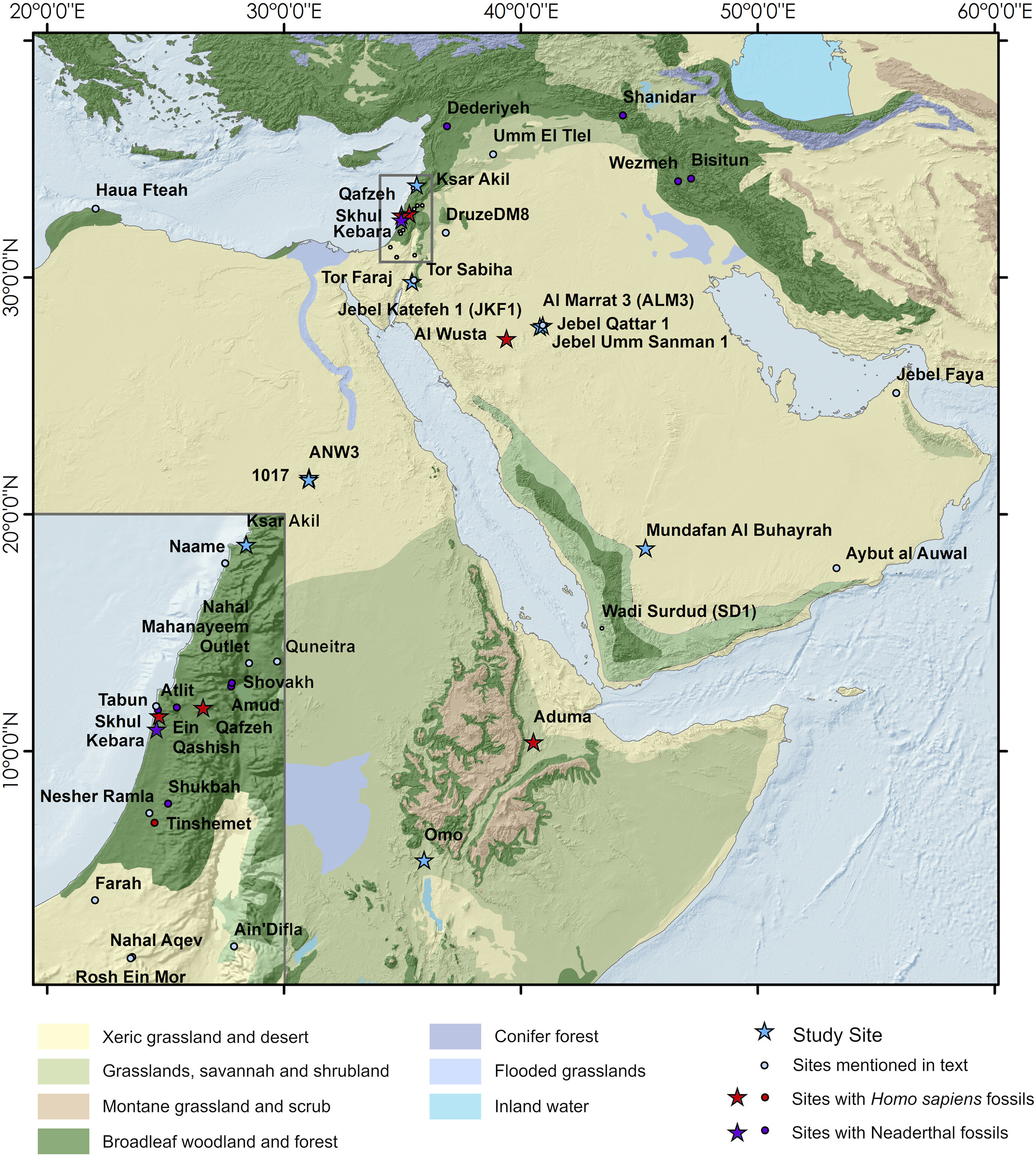
Map of study sites and other sites mentioned in the text (Data: (GEBCO Compilation Group, 2019; Jarvis et al., 2008; Olson et al., 2001); produced with ArcMap 10.5 and GIMP 2.10.38). Credit: Quaternary Science Reviews (2026). DOI: 10.1016/j.quascirev.2026.110196
Neanderthals are largely associated with colder climates across Eurasia. But researchers know that both Homo sapiens and Neanderthals moved through nearby Southwest Asia between about 100,000 and 50,000 years ago, and Arabia was a crossroads between Africa, Europe and Asia during the Ice Age.
Although no Neanderthal bones have ever been found in Arabia, a new study on stone tools in Arabia suggests Neanderthals roamed this warmer region 60,000 to 50,000 years ago. The study, published in Quaternary Science Reviews, links Neanderthal tool-flaking methods to tools from a site called Jebel Katefeh-1 (JKF-1), near an ancient lake in Saudi Arabia's Nefud Desert.
Unexplained variations in Arabian stone tools
Stone tools found across different sites in Arabia show striking differences, which researchers have had trouble explaining. Fossils are scarce in Arabia, so stone tools are crucial for determining what populations may have lived there. To determine which populations occupied the sites, researchers needed to separate the effects of climate, geography, toolstone, site use and population history, all factors that might have contributed to the tool differences.