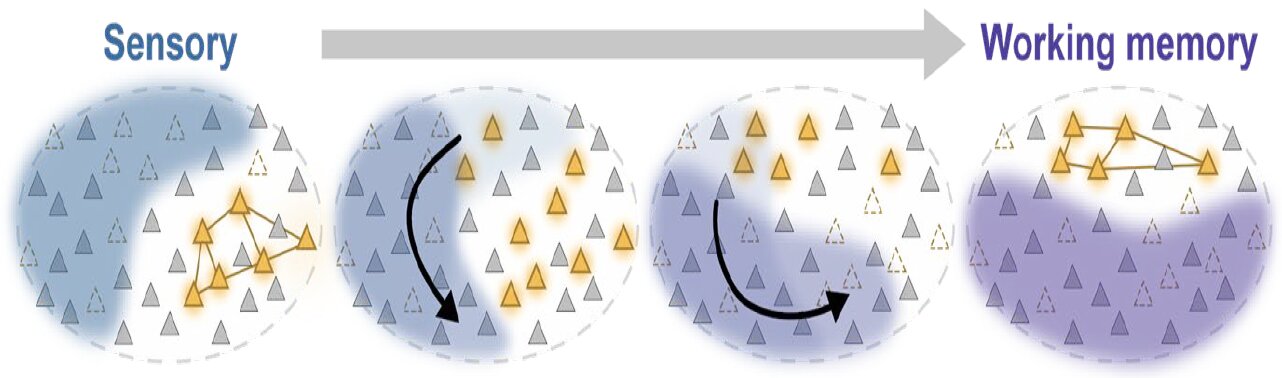
A figure from the paper depicts how a traveling beta frequency wave (gray-blue) can implement "spatiotemporal computing." On the left, outside the wave area, a neural ensemble can form to encode sensory information about an object. As the wave rotates, a neural ensemble in a newly freed-up area can assemble to store the object in working memory. Credit: Miller Lab/MIT PIcower Institute
A new theory, published in The Journal of Neuroscience by three scientists at the Picower Institute for Learning and Memory at MIT, offers an explanation of how the brain produces cognition and consciousness: It uses traveling waves of rhythmic neural activity to coordinate nimble neural networks with analog computations.
The metaphor that the brain operates with "circuits" is incomplete, said Picower Professor Earl K. Miller, the paper's senior author. Certainly, the brain's physically connected circuits provide the infrastructure to store our memories and represent our ongoing needs and goals. But when we need to make improvised use of that knowledge in the rapid-fire, anything-goes sensory context the world constantly throws our way, we can't just depend on the relatively slow chemical process of rewiring those circuit connections, called "synapses," he said.