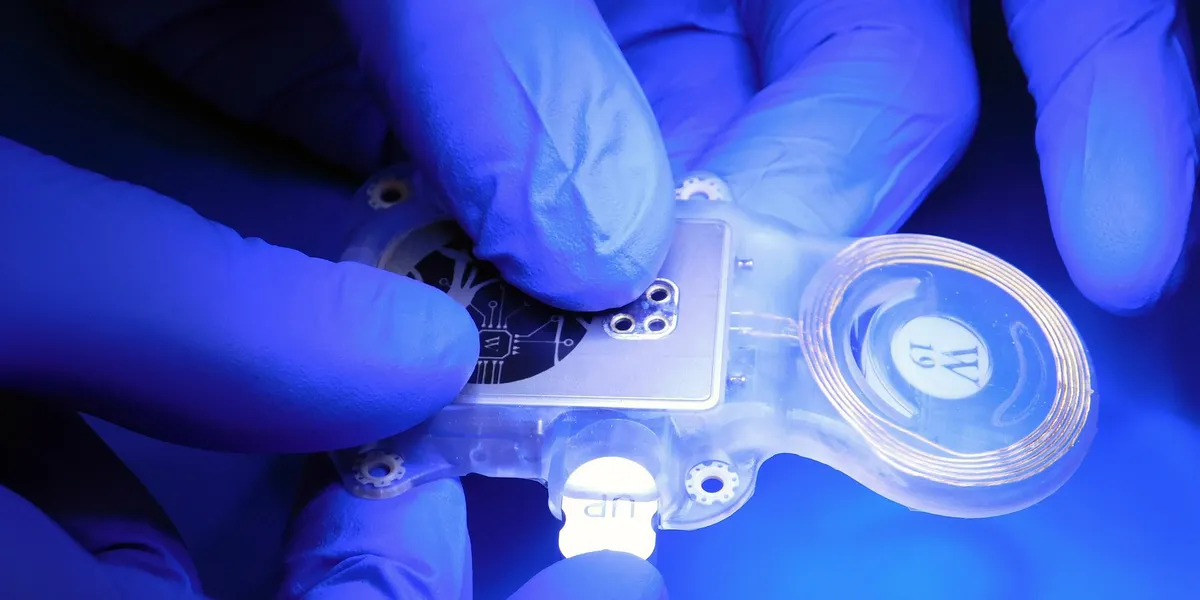
For years, brain-computer interfaces (BCIs) have promised to help people with severe paralysis communicate. The technology is still experimental, but more researchers and companies like Neuralink and Synchron are now testing these devices in human clinical trials. Geneva-based Ability Neurotech is the latest to join their ranks, as it gears up to move its optical BCI from brief tests during surgery toward months-long use in a clinical trial. Last month, the company started an intraoperative study in Germany, recording neural signals from patients undergoing brain tumor surgery in brief, 20- to 30-minute sessions. Later stages of the ongoing study will use the device to record brain activity in up to five conscious patients as they perform speech and movement tasks. A separate chronic clinical trial in the Netherlands, planned for late 2026, will also test the system over a longer period. As part of a project aiming to develop a BCI to restore speech for paralyzed individuals, University Medical Center Utrecht is recruiting participants for a year-long study in which people with amyotrophic lateral sclerosis (ALS) will receive the implant, train with it at home, and undergo repeated brain-signal recordings. Sending Brain Data with Light Ability’s system differs from many other experimental BCIs in a few key ways. For one, the implant uses electrocorticography (ECoG) electrode arrays that rest on the brain’s surface—a distinction from other BCI designs that place penetrating electrodes inside brain tissue. It can monitor neural signals from 128 separate channels at once, sampling each 30,000 times every second to capture a highly detailed recording of brain activity. Unlike the usual radio frequency transmission method used in wireless electronics, the implant uses an infrared laser-based optical link to stream brain data through the skin at speeds of up to 50 megabits per second. The data is received by an external headpiece and sent to a separate processor for decoding. The wearable also powers the implant wirelessly through induction, eliminating the need for an internal battery that could eventually require replacement. Ability Neurotech CEO Rotem Kopel says the company evaluated several ways to handle the large data stream before choosing the optical link. The goal was to get raw recordings out of the implant without reducing them first. Ability doesn’t downsample or compress the data before transmission, leaving decoding and processing to equipment outside the body. That extra information can be valuable in decoding, according to Maitreyee Wairagkar, a project scientist in the Neuroprosthetics Lab at the University of California, Davis, who says Ability’s combination of a battery-free design and optical link “sounds very promising for chronic ECoG recordings.”“Preserving the information available in raw neural data through transmission is also useful for decoding purposes, since precious data is not lost due to transmission limitations,” Wairagkar says. “I think this is the right focus for longitudinal BCI use, as it offers flexibility over neural feature extraction, which can be useful for improving decoding performance.” Ability isn’t alone in pursuing high-bandwidth wireless transmission. Wairagkar says other fully implantable BCIs, including both ECoG and penetrating-electrode designs, use similar high-bandwidth architectures, with some exceeding 50 Mbps. “Wireless implantable BCIs are still in early days, and we’re seeing multiple new clinical trials being conducted with these devices with varying capabilities in channel counts, signal-to-noise ratio, and data transfer rates, which will determine their performance, functionality, and long-term utility,” Wairagkar says. Ability Neurotech’s BCI was tested during a brain surgery in Germany as part of the company’s first study involving a human patient. ABILITY Neurotech; TU MunichEngineering Challenges of BCIsKopel says the implant had to meet several tight engineering constraints, including power and temperature limits. Moving that much data takes power and generates heat, making temperature control a key challenge. Engineers also had to route the electrode connections into a hermetically sealed case designed to keep moisture away from the electronics. The optical link must work through varying skin thickness, blood vessels, and hair, and tolerate imperfect alignment with the external headpiece. Kopel says the technology took about 10 years to develop, followed by roughly 18 months of bench, durability, and other validation testing once the design was finalized.The upcoming study will test those engineering choices over longer periods. Kopel says the company will first evaluate the implantation procedure and the device’s safety and performance. The next goal is to test whether participants can use the device to control a computer, followed by speech decoding—translating intended speech from brain activity into words in real time. Long-Term Support and Durability The harder test comes after implantation: keeping the system useful over years of daily life. Software needs updates, brain signals may change over time, and patients could remain dependent on an implant long after the company that built it has changed or disappeared.Wairagkar says sustained performance and decoding accuracy over several years are critical for the long-term use of implantable BCIs. “Software challenges, like maintaining and calibrating the decoders and updating the user applications, are easier to solve, but it is important that the underlying signal quality obtained from the device is maintained over long periods,” Wairagkar says. Fully implanted wireless systems already avoid a major durability problem: the permanent connection through the skin used by some BCIs, Wairagkar says. Eliminating that connection can reduce infection risk and help with maintenance and everyday use.Long-term support also depends on the company behind the implant. Kopel says Ability has planned for that possibility through its relationship with the nonprofit Wyss Center for Bio and Neuroengineering in Geneva, where the technology was developed before the company spun out in 2025. According to Kopel, if Ability ceased operations, its intellectual property and responsibilities would return to the center. Wairagkar says the wider field will need stronger systems for supporting patients as implantable BCIs become more common. Groups are already examining questions around safety, access and sustainability. Wairagkar added, “As the field matures, there will need to be structures and policies in place to support the use and deployment of implantable BCIs and to provide appropriate services to patients.”
Brain Implant Uses Infrared Light to Send Neural Signals
Ability Neurotech’s optical BCI will soon begin European clinical trial
999 words~5 min read