The Hyderabad audio maker moves its marketing brief from the founding team to a hire from outside it.Key HighlightsAbout The AuthorAt heart, I am a storyteller drawn to the watershed moments that bend the technology landscape. I braid narrative with data, humanise statistics, and trace the arc from first spark to world-changing impact. My reportage, features and reviews are witty, sardonic, visual and vivid, using anecdote to illuminate rather than eviscerate.
As a technology journalist with over sixteen years of experience, I have travelled the world and the seven seas, covered every major tech conference worth its lanyard, chronicled the defining breakthroughs of the last decade and a half, and played a pivotal role in launching some of India’s most important technology publishing platforms across web, print and TV.
In my current role as Editor of Gadgets Now Studios, I bring that experience, instinct and editorial firepower to the table, with the mandate of scaling the brand to towering heights.
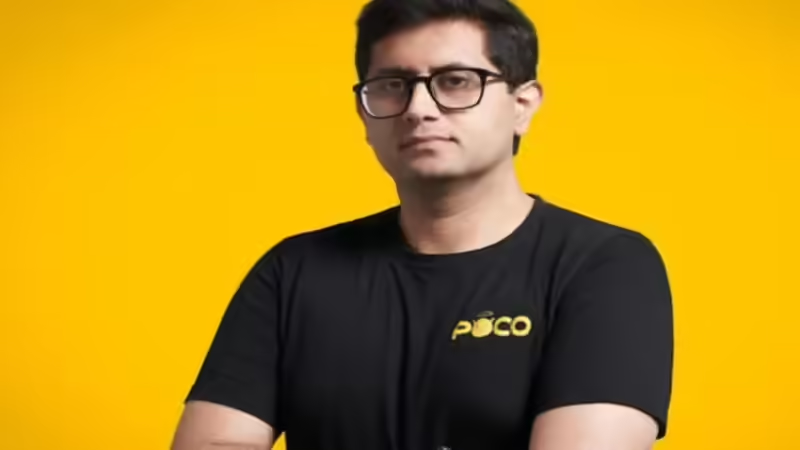
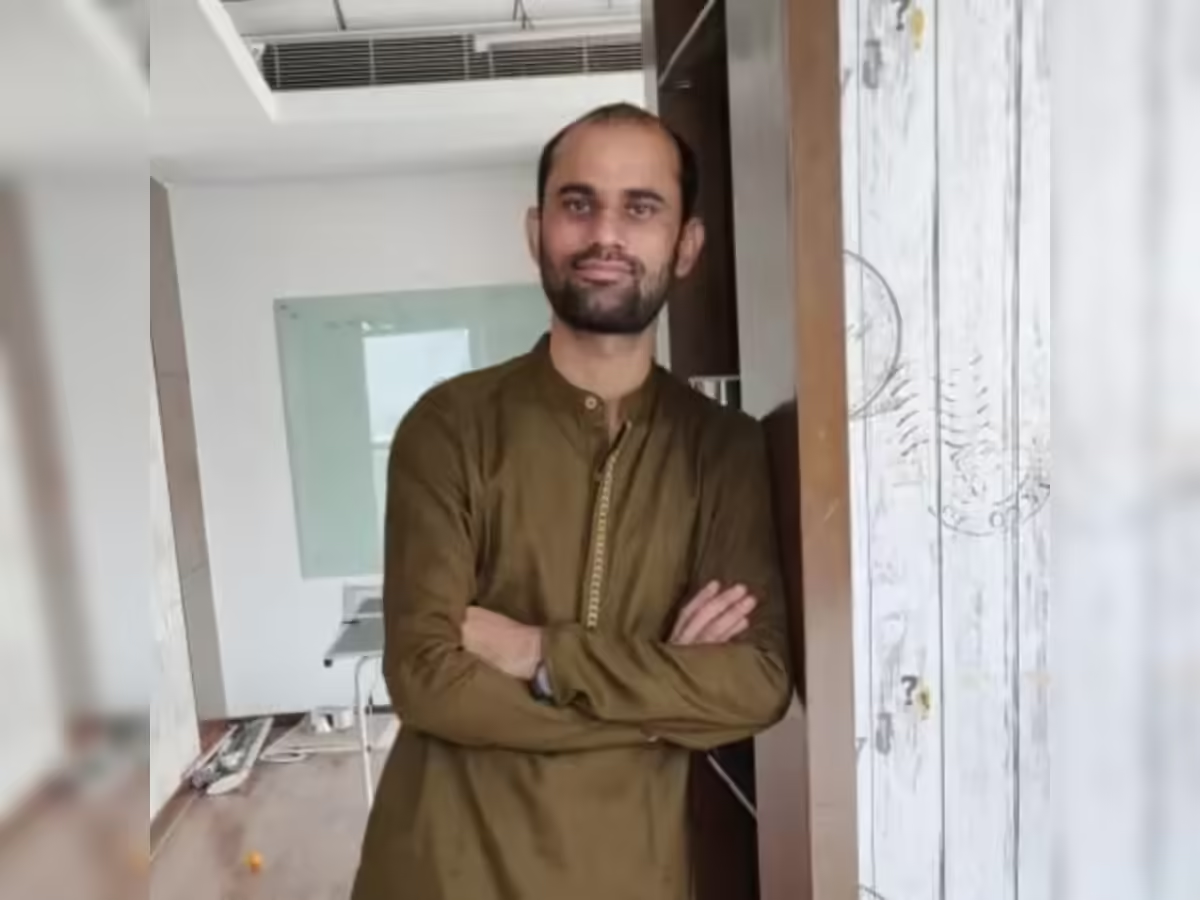
When I am off the clock, I am usually lost in music, from underground electronic and progressive rock to stone-cold blues. I am also an incurable F1 nut, a hangover from my previous life as an auto journalist, and always game for a jam session with friends, where I do my best to make my guitar gently weep.● Himanshu Tandon joins Mivi as chief business officer after running Poco India and then the business at CMF by Nothing.● Mivi puts FY25 revenue above Rs 300 crore and has kept its FY26 figure private.● India true wireless shipments grew 1 per cent in 2025, and Mivi sat outside Counterpoint's top five.Himanshu Tandon, who ran Poco in India for three years and then took CMF by Nothing to a standalone brand registration, is joining Mivi as chief business officer. The Hyderabad company sells true wireless earbuds, neckbands and speakers, and builds them at its own plant in Shamshabad. Mivi has run marketing through co-founder Midhula Devabhaktuni, who holds the chief business officer title. Moving that brief to a hire from outside the founding team changes how the company has run its brand since its founding.On 2 July 2026, Tandon stepped down as vice president of business at CMF, eleven months into the job. Nothing had cancelled the CMF Phone 3 Pro in June and paused every CMF smartphone launch planned for 2026, pointing at memory and component costs. Carl Pei, who runs Nothing, said memory costs doubled between the point his team committed to a product and the day it shipped, then doubled again. Mivi has yet to announce the appointment, and the start date sits inside the company.Why Mivi is hiring a chief business officer nowMivi has grown as a manufacturer first and a consumer brand second. The company puts its FY25 revenue above Rs 300 crore, employs more than 1,500 people, and set a Rs 1,000 crore target for FY26, a year that closed in March 2026 with the figure held private. Devabhaktuni and Viswanadh Kandula, who founded the company together, have talked about a public listing inside five years. A factory build-out and a listing timetable put different demands on the same company.More articles by AuthorTrending StoriesThrough its first years, Mivi grew on earphones sold online while the marketing brief stayed inside the founding team. The company now ships earbuds, neckbands and speakers, plans IoT devices, smart CCTVs and smart wearables, and wants revenue from the United States, the Middle East and Europe. Each of those moves needs a brand argument that travels past price and a made-in-India badge. Tandon has spent the past four years building that argument for two other challenger brands.What Himanshu Tandon did at Poco and CMFTandon worked at Wipro, Sapient Nitro and Videocon Mobile Phones before Xiaomi. He joined Xiaomi India as national programme manager for Mi Stores and Mi Studios, moved to Poco as part of its founding team, and ran its Flipkart sales business. Poco India promoted him to India head on 6 June 2022, in place of Anuj Sharma. He held the job until July 2025, with Poco holding shipments steady for Xiaomi India through that period.At CMF by Nothing, Tandon took the vice president of business role in August 2025. He drove CMF's registration as an independent brand in India, in place of its earlier status as a Nothing sub-line, and built out its retail and partnership base. "In this role, my goal is to help CMF become a cultural keystone for Gen Z and young consumers worldwide," Tandon said at the time. Pei said Tandon's "proven success in the industry" made him "the ideal leader to drive CMF forward".The product line he inherited at CMF had begun with audio, well before any phone. CMF debuted in September 2023 with a watch, earbuds and a 65W charger, and shipped its first phone the following July. Headphones and a third-generation watch followed during his year in charge, while the 2026 phone was cancelled before he left. Audio and wearables took up most of his year in charge.Himanshu Tandon's career to datePeriodRoleCompanyEarly careerSales and marketing rolesWipro, Sapient Nitro, Videocon Mobile PhonesPre-PocoNational programme manager, Mi Stores and Mi StudiosXiaomi IndiaPoco launch onwardsHead of sales, founding team memberPoco IndiaJune 2022 to July 2025India headPoco IndiaAugust 2025 to 2 July 2026Vice president, businessCMF by NothingIncomingChief business officerMiviWhat happened at CMF by Nothing before Tandon leftSqueezed by memory prices, Nothing has cut jobs and reset its 2026 product plan. Co-founder Akis Evangelidis confirmed job cuts in July 2026 while calling a reported 40 per cent headcount figure exaggerated, and he denied a claim that the company would leave a dozen markets. India ran the other way: Nothing grew 105 per cent year on year in the second quarter of 2026, its Phone (4b) topped Flipkart's Rs 30,000-plus segment on day one, and a limited RCB edition sold out in under two hours. The squeeze landed in the budget tier, where CMF lived. Tandon's own reasons for going stay between him and the company.LPDDR5X mobile DRAM and NAND flash prices have risen about four times over since September 2025. A budget phone priced under Rs 20,000 now carries more than half its hardware cost in memory in some configurations, on Nothing's own costing. Equivalent hardware would need to retail between Rs 30,000 and Rs 35,000, which is a different product for a different buyer. Earbuds carry a fraction of that memory content, so the cost shock that removed CMF's 2026 phone leaves Mivi's shelf intact.How India's TWS earbuds market changed in 2025 and 2026While the wider wearables market shrank 4 per cent to 114.2 million units in 2025, IDC counted 84.7 million earwear units, a rise of 1.4 per cent. Counterpoint Research put 2025 true wireless shipments up 1 per cent for the full year, with the fourth quarter up 12 per cent, and the first quarter of 2026 down 2 per cent. Unit growth has flattened in a category that grew 168 per cent year on year in the second quarter of 2022. Counterpoint attributes the first-quarter softness to replacement upgrades taking over from first-time urban buyers.Across the same stretch, prices split by category and by tracker. Counterpoint recorded average selling prices up 9 per cent in the first quarter of 2026, while IDC put earwear prices down 1.1 per cent across 2025 against a smartwatch rise of 11.7 per cent. Omdia analyst Jack Leathem described the global picture as premium brands "pivoting from volume wars to value creation", with cheap noise cancellation doing the work at the bottom. Anshika Jain, principal analyst at Counterpoint, said devices offering ANC grew 24 per cent year on year in 2025 and spatial audio expanded 67 per cent, with close to 40 per cent of those feature-rich devices priced between Rs 1,000 and Rs 2,000.The premium end of the Indian market has consolidated around three names. Apple, OnePlus and Samsung together hold close to 70 per cent of sales above Rs 5,000, according to Counterpoint's consumer IoT tracking. Survey work from the same firm found 27 per cent of the market sitting above Rs 5,000 today. Pavel Naiya of Counterpoint said that band "will have stronger grip in future", with about 40 per cent of buyers planning their next purchase from it.India's earbuds and wearables market at a glanceMeasureFigure2025 shipment growth1 per centQ4 2025 shipment growth12 per centQ1 2026 shipment growthDown 2 per centQ1 2026 average selling priceUp 9 per cent2025 earwear shipments84.7 million units, up 1.4 per cent2025 India wearables market114.2 million units, down 4 per centTop five brands, 2025boAt, GoBoult, Noise, OnePlus and realmeSales above Rs 5,000Apple, OnePlus and Samsung hold close to 70 per centANC device growth, 202524 per centSpatial audio growth, 202567 per centSource: Counterpoint Research and IDC.Mivi revenue against boAt, Noise and GoBoultMivi's place outside that top five is the number Tandon will be measured against. Counterpoint had Mivi inside the top five in the second quarter of 2022 with 6 per cent of India's true wireless shipments, behind boAt, Noise and Boult Audio, which now trades as GoBoult. Three years later the same tracker's full-year ranking runs boAt, GoBoult, Noise, OnePlus and realme, and Mivi sits below them. The revenue ladder runs the same way, and closing either gap is the brief.In revenue terms, boAt reported Rs 3,073 crore in FY25 against Rs 3,118 crore a year earlier, and turned a Rs 80 crore loss into a Rs 61 crore profit. GoBoult posted Rs 763 crore in FY25, up 10 per cent, with profit rising from Rs 2.5 crore to Rs 24 crore. Noise fell 24 per cent to Rs 1,048 crore and made Rs 3.2 crore. Mivi's own FY25 count lands above Rs 300 crore, with the FY26 number held back.Mivi against India's larger audio brandsCompanyFY25 revenueFY25 profitFundingListing positionboAt (Imagine Marketing)Rs 3,073 croreRs 61 croreExternal investorsSEBI-approved IPO of Rs 1,500 croreNoiseRs 1,048 croreRs 3.2 croreExternal investorsPrivateGoBoultRs 763 croreRs 24 croreBootstrappedPrivateMiviAbove Rs 300 croreHeld privateBootstrappedTargets a listing inside five yearsMivi's Hyderabad factory and voice platformManufacturing is the part of Mivi's pitch that already works. The company runs an audio plant at Hardware Park in Shamshabad and has put Rs 200 crore into a second unit of two lakh square feet, designed for 100,000 units a day and 2,000 jobs. Devabhaktuni has said the expansion will bring component manufacturing for wearables into India, a segment she describes as underserved at home. Mivi has also spent Rs 100 crore over 18 months on a voice platform with custom wake words tuned for Indian accents.Mivi by the numbersMeasureFigureFY25 revenueAbove Rs 300 croreFY26 revenue targetRs 1,000 croreEmployeesMore than 1,500Second factory investmentRs 200 croreSecond factory sizeTwo lakh square feetPlanned daily output at the second unit100,000 unitsJobs planned at the second unit2,000Voice platform investmentRs 100 crore over 18 monthsTarget export marketsUnited States, Middle East, EuropeListing intentInside five yearsWhat Himanshu Tandon has to fix at MiviThe category has a poor record of rewarding marketing spend on its own. boAt led India's wearables market with a 29.2 per cent share in 2025 on IDC's count, and still went from Rs 3,118 crore to Rs 3,073 crore in a year while its profit turned positive. Noise fell 24 per cent across the same period. GoBoult grew 10 per cent to Rs 763 crore and led offline growth among the top brands on Counterpoint's count, which is a distribution answer more than a brand one.Handing over the brief is the second problem, and it sits inside the company. A founder who has held the marketing title for more than a decade has to pass on budget, agency relationships and the final call on campaigns, and Mivi's public voice has been Devabhaktuni's for most of that time. Bhuvan Bam and Samantha Ruth Prabhu front the brand as ambassadors. Tandon arrives with a playbook built on launch cadence, community and retail push, and the two approaches will have to settle.Category expansion brings its own risk for a company of Mivi's size. Mivi wants IoT devices, smart CCTVs, smart wearables and more speakers, and each of those puts it against brands with deeper pockets and existing distribution. Noise led India smartwatches with 26.6 per cent share in 2025, boAt led the wider wearables market, and Xiaomi and realme pick up accessory sales bundled with phones. Tandon has worked inside that attach model at Xiaomi.Whether Devabhaktuni keeps the chief business officer title alongside Tandon, or moves to a wider founder role, will decide how much of the brief travels with him. The FY26 revenue figure that would settle the Rs 1,000 crore question has stayed off the record. Counterpoint's 2022 comparison rests on a single quarter while the 2025 ranking covers a full year, so Mivi's slide looks sharper in the shorthand than in the data. Each gap stands between the hire and any judgement on whether it worked.What happens next for Mivi and the TWS marketThrough 2026, Counterpoint expects India's true wireless market to grow in low single digits, supported by replacement demand and feature upgrades. Omdia counted open-wear stereo shipments rising 69 per cent year on year in the third quarter of 2025 and forecasts 40 million units worldwide in 2026, close to one in ten of all true wireless units. Open-wear is the shape growing at that rate, and Counterpoint already counts more than 20 brands selling it in India. Mivi builds its own product, and that shortens the path from a design decision to a shelf.boAt holds SEBI approval for a Rs 1,500 crore IPO, and its filing shows revenue lower in FY25 than in FY24. Mivi wants a listing of its own inside five years, on a revenue base about a tenth of boAt's, in a market where volume growth has flattened. Hiring a chief business officer out of the smartphone business points at brand strength as the way up, with price cuts retired as the lever. Mivi has spent more than a decade proving it can build the product; Tandon has been hired to prove the product is worth a premium. FAQsWho is Himanshu Tandon?Tandon is a consumer technology executive who was part of Poco's founding team in India, ran its Flipkart sales business, and became Poco India head in June 2022. He moved to CMF by Nothing in August 2025 as vice president of business. Before Xiaomi he worked at Wipro, Sapient Nitro and Videocon Mobile Phones.What is Himanshu Tandon's role at Mivi?Tandon joins Mivi as chief marketing officer. Mivi is a Hyderabad audio and wearables brand with its own manufacturing at Hardware Park in Shamshabad, and it has taken the marketing function through its founding team so far. Co-founder Midhula Devabhaktuni holds the chief marketing officer title.Why did Himanshu Tandon leave CMF by Nothing?He stepped down on 2 July 2026, eleven months into the role, as Nothing pulled back from the budget phone tier. Memory prices have risen about four times over since September 2025, which pushed the cost of a sub-Rs 20,000 phone past what the segment supports.How big is Mivi?Mivi puts its FY25 revenue above Rs 300 crore, employs more than 1,500 people, and has kept its FY26 figure private against a Rs 1,000 crore target. It has committed Rs 200 crore to a second Hyderabad plant of two lakh square feet built for 100,000 units a day.Who leads India's true wireless earbuds market?Counterpoint Research lists boAt, GoBoult, Noise, OnePlus and realme as the top five brands for 2025. Above Rs 5,000, Apple, OnePlus and Samsung hold close to 70 per cent of sales. India shipments grew 1 per cent across 2025 and fell 2 per cent in the first quarter of 2026.Is Mivi planning an IPO?Co-founders Midhula Devabhaktuni and Viswanadh Kandula have talked about taking Mivi public inside five years. The company is bootstrapped. Rival boAt holds SEBI approval for an IPO of Rs 1,500 crore, made up of a Rs 500 crore fresh issue and a Rs 1,000 crore offer for sale.end of article