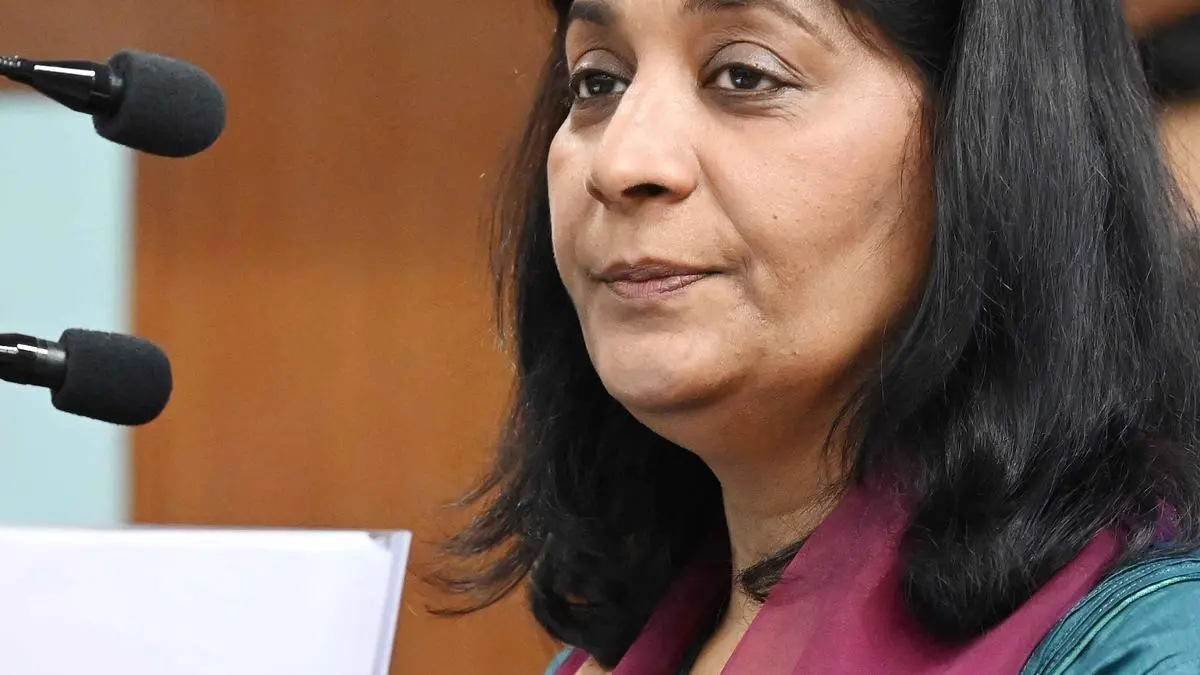
Poonam Gupta, Deputy Governor, RBI delivering a lecture on ‘Indian Economy : Shocks, Resilience and the Way Forward’ at Madras School of Economics, in Chennai.
| Photo Credit:
Even as India navigates oil-price shock, geopolitical risks and potential weather disruptions, the country is estimated to grow over 7 per cent and it speaks to the resilience of the economy, RBI Deputy Governor Poonam Gupta said here.“While we have projected growth to be 6.7 per cent this year, but it’s quite likely the numbers may turn out to be better based on the high frequency indicators and based on the analysis of others,” she said. “But going forward, notwithstanding this shock ridden year, growth in recent years, I would say 7.5 per cent is a given and we should aspire to do better than that,” she added.She was delivering a lecture at the Madras School of Economics in Chennai, on the topic of “Indian Economy: Shocks, Resilience and the Way Forward.”The central premise of her address was that India’s resilience is not accidental and comes from strong policy frameworks, fiscal prudence, a more resilient banking system, healthy external buffers and a diversified economy.Rise In FDIMaking “a personal assessment” of the current account situation, the RBI Deputy Governor said that barring any global shocks such as a major oil-price shock, India could potentially become a current-account-neutral economy within 5–6 years. “My sense is that the current account deficit minus a shock like an oil price shock will continue to decline further,” she said.Similarly, on FDI, she said that India received around $95 billion in FDI last year, and it is possible that inflows could reach $150 billion annually in the coming years if current trends continue.The Deputy Governor highlighted some studies to note that India’s growth has averaged 4.8 percentage points higher than advanced economies and 2.5 percentage points higher than emerging-market economies in recent years. Services remain the strongest-performing sector, while agriculture and industry have also become steadier, she said.As per Gupta, RBI’s ongoing work also suggests India’s growth is increasingly being supported by improvements in labour and capital quality and total factor productivity (TFP), rather than simply by putting more inputs into the economy.Inflation Trajectory“Comparing with other countries, you know India’s inflation rate in the past few years has been close to the average of advanced economies and much less than that the average inflation rate experienced in emerging market and developing economies,” Gupta said on India’s inflation trajectory.“Financial sector is not just resilient. It’s becoming much more efficient,” she said. External sector is showing a lot of resilience under the circumstances of global challenges, she noted.The Deputy Governor also cited a diversified economy as a key driver. “For oil, we diversified our pool of importers. When we had a tariff from the US, we could diversify our pool where the countries we export to,” she said. She also stressed how every state in India was today growing faster than before.Published on August 20, 2026