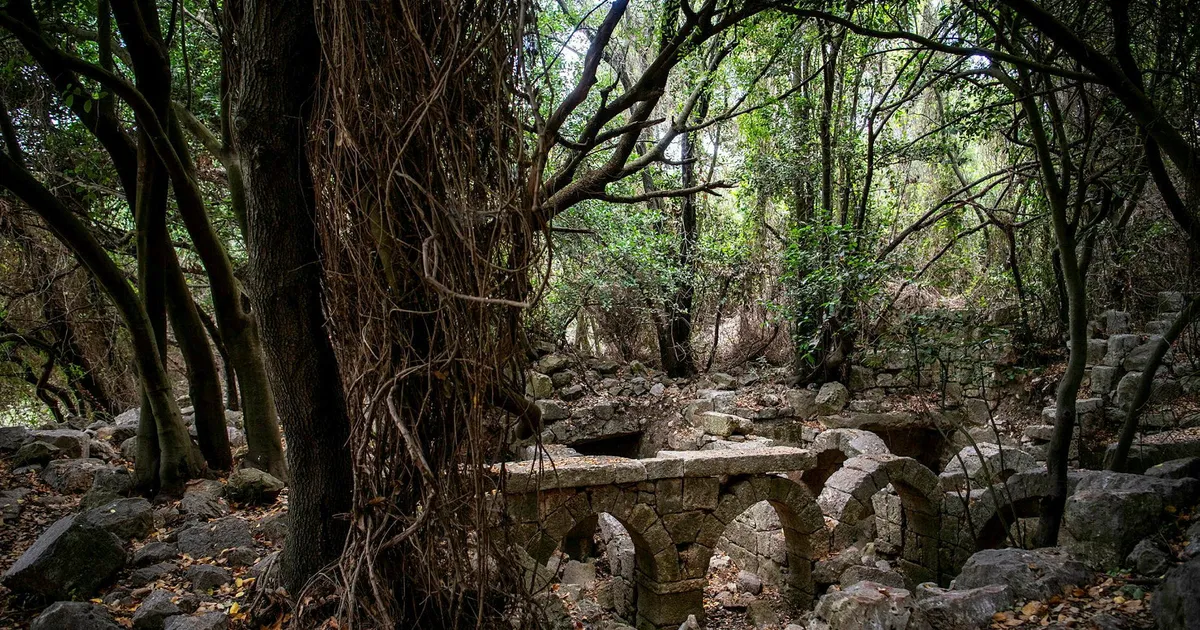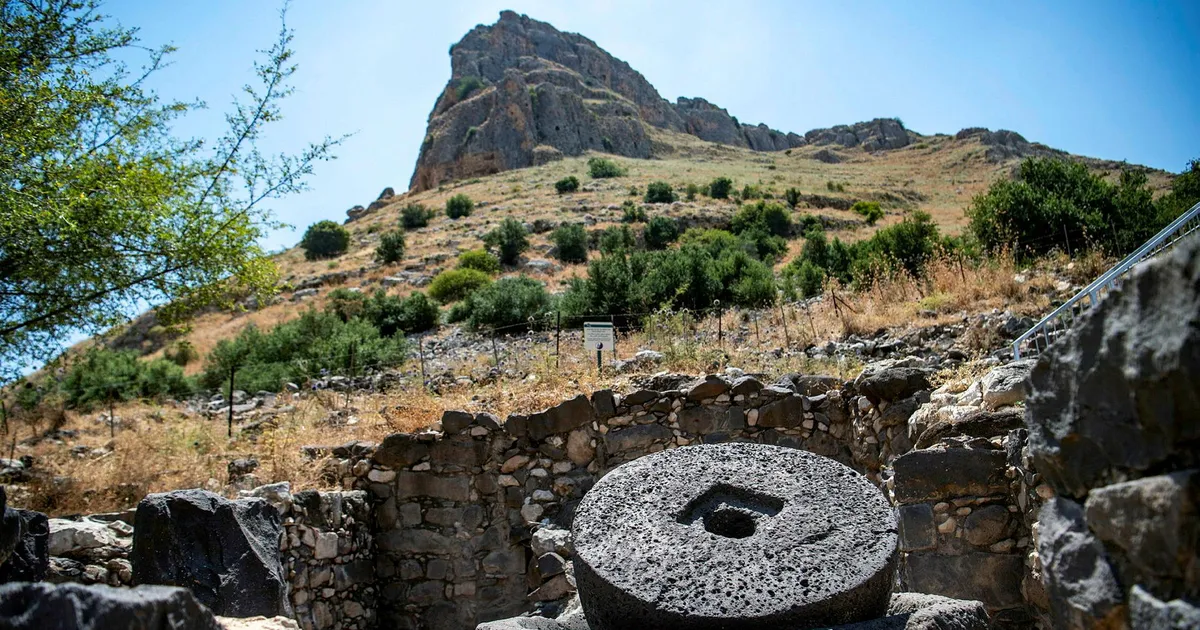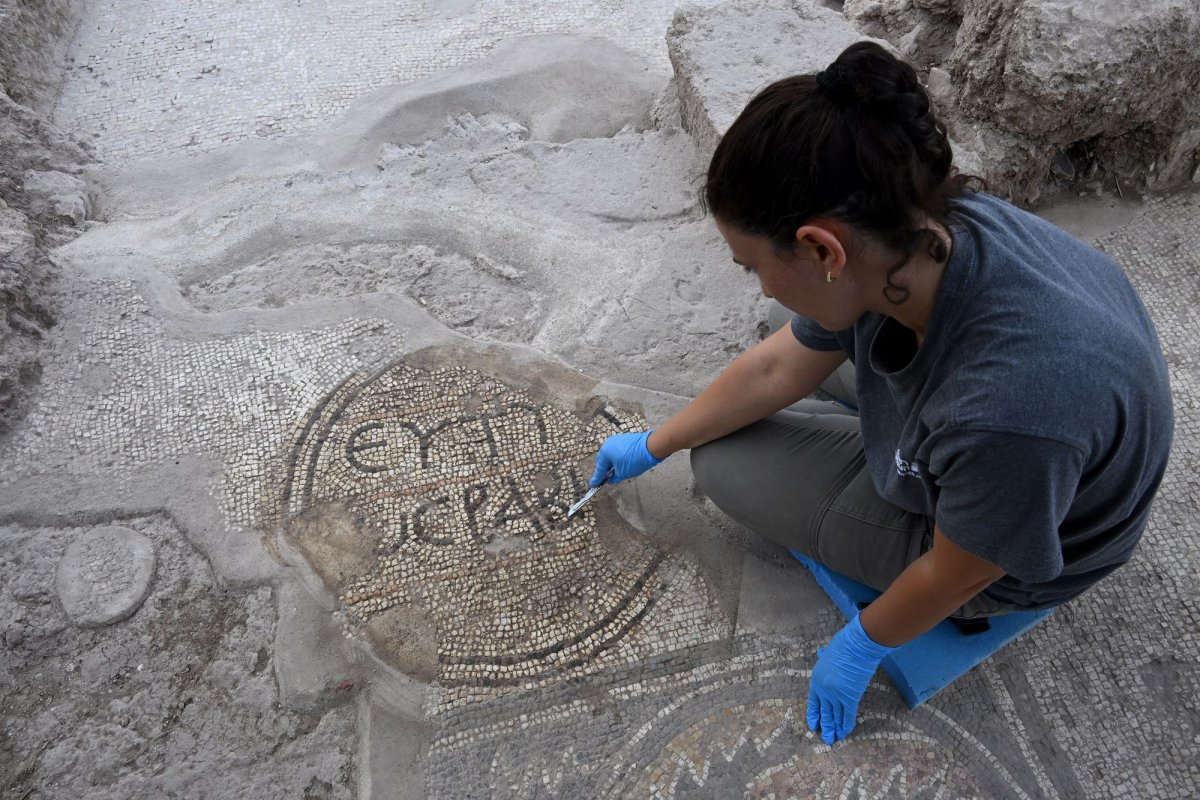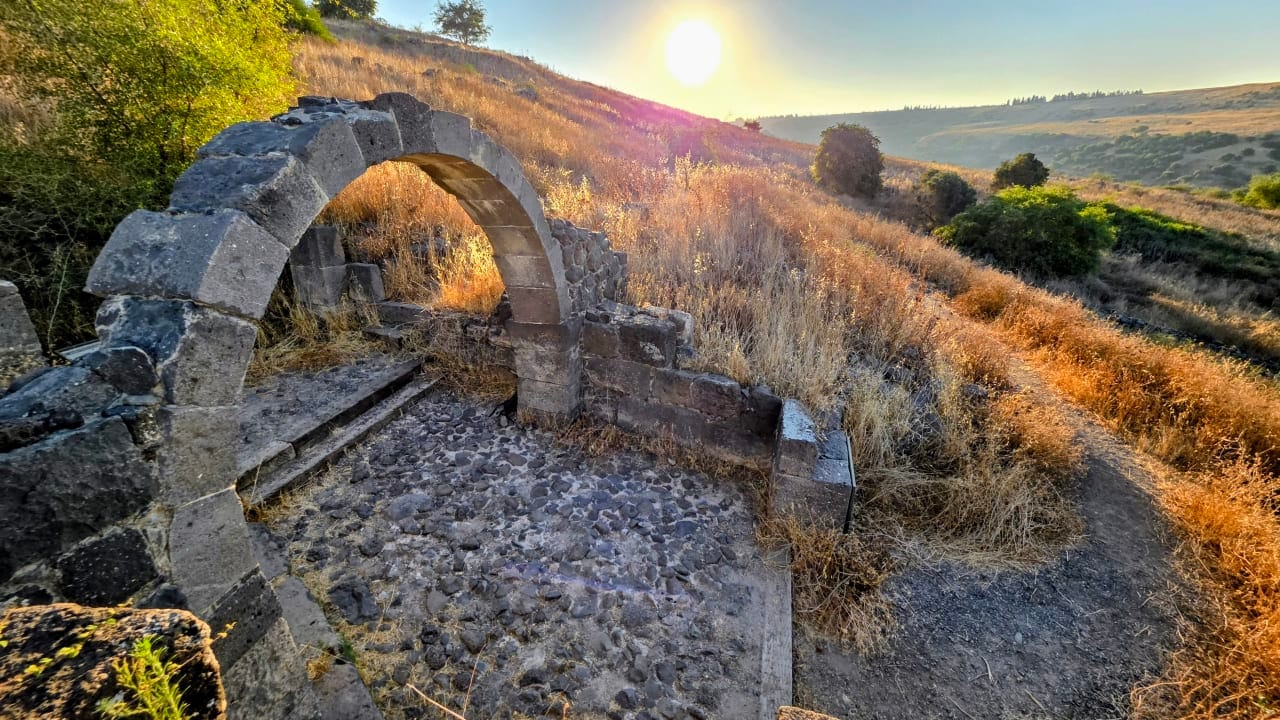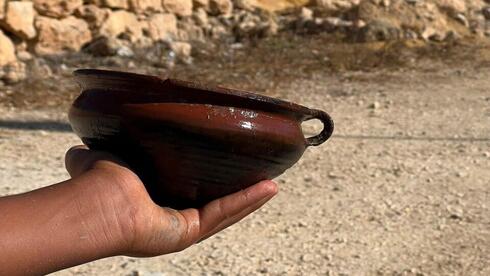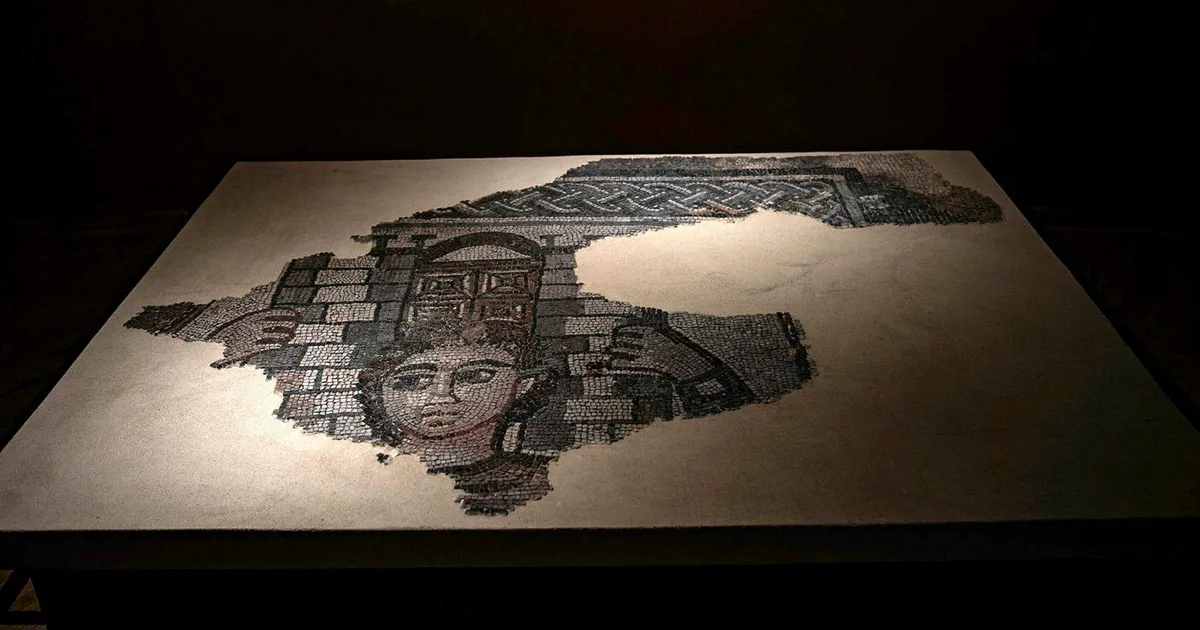
We walked about a kilometer (half a mile) in intense heat from the tomb of the prophet Habakkuk to Ein Huqoq, in the Lower Galilee. The tomb probably holds the sheikh of the village of Yaquq, but the dozens of Jewish worshippers there did not seem bothered by that. In the recently restored spring, two men in undershirts sat in the cool water and invited us to join them. A couple from the Israeli Arab city of Kalansua, who had arrived on an ATV, posed for a photo, arms around each other, in back and knee guards that gave them the look of ancient warriors. A few girls sat beside the spring. In a faint heat haze I saw the biblical Rebecca there, giving Eliezer cool water to drink. The camels were not there.Six kilometers (3.7 miles) away, at the Yigal Allon House in kibbutz Ginosar – on the western shore of the Sea of Galilee – a model of the ancient village of Huqoq is now on display. This, the model's creators surmise, is how the Galilean village looked 1,600 years ago. Even the small spring we visited appears in it. The model is based on excavation finds, surveys, comparison with contemporaneous villages in the Galilee and reconstruction. In an adjoining room, a fragment of mosaic is on display showing Samson carrying the gates of Gaza. The stones are small. The work is lovely, and the biblical story is beautifully brought to life. Samson appears there as a handsome man, with prominent ears and a stylish haircut.From the exhibition at Kibbutz Ginosar. The Jewish National Fund website states: "Within a few years Huqoq will become one of the leading archaeological sites in the country and in the world. Credit: Gil EliyahuFrom the exhibition at Kibbutz Ginosar. The Jewish National Fund website states: "Within a few years Huqoq will become one of the leading archaeological sites in the country and in the world. Credit: Gil EliyahuIn recent years the ancient village of Huqoq has become an object of longing for every archaeology enthusiast in Israel, and especially for mosaic lovers. It is the forbidden land that everyone wants to see. Reports of the thrilling finds at Huqoq have been published since 2012. Seven years ago, Nir Hasson wrote in Haaretz that the Samson mosaic is "the richest and most beautiful floor in Israel." That was enough to send a slight tremor of excitement through me and others. Curiosity has only grown since. Until now it has been all but impossible to see anything of the finds in the mysterious Galilean village. In the meantime we traveled to see the mosaics in Lod, which was given an impressive museum; those in Tzippori, Kfar Nahum and Tiberias, which got structures and roofing and were opened to the public; and, of course, earlier still, those of Beit Alfa (at Kibbutz Heftziba), where a breathtaking mosaic has been on display for decades.The head of a military commander in the Elephant Mosaic at Huqoq. Credit: Jim HabermanThe head of a military commander in the Elephant Mosaic at Huqoq. Credit: Jim HabermanBut the desire to make the comparison ourselves – between what has been uncovered at Huqoq and the other mosaics – kept growing. That longing is now partly satisfied by the exhibition in Ginosar. The satisfaction is only partial, since most of the mosaics will be visible only once the site itself opens to the public, for which there isn't even a vague target date yet – but the exhibition is welcome in itself, intriguing and encouraging. It is worth the trip. The Jewish National Fund website states: "Within a few years Huqoq will become one of the leading and most fascinating archaeological sites in the country, and even in the world."The exhibition's curator, Dr. Einat Ambar-Armon, director of the education and community center for the northern district at the Israel Antiquities Authority, explained on a tour she gave us that the "Secrets of Huqoq" exhibition was created to reveal the intriguing site to the public even before it opens for visits. The exhibition, she says, serves as a kind of "preliminary visitors' center" for Huqoq.Haaretz Election Podcast with Esther Solomon and Judy MaltzAt its heart is the mosaic of Samson carrying the gates of Gaza – the only original find from Huqoq currently on display. Photographs of other mosaics are shown as well: the Elephant Mosaic, the dedicatory inscription, Noah's Ark and the Flood, Jonah and the fish, and the Tower of Babel. All are very rich, filled with figures, and biblical stories are easy to make out in them. Whoever created them understood – 1,600 years ago – our need to receive the Bible in pictures and not only in text. He also understood our pull toward good drama, toward animals that devour people, toward battles with a large cast.The exhibition's aim is not only to present finds but to tell the story of a place gradually being revealed: how you connect wall remains, mosaics, installations, small artifacts and field evidence into a picture of a community that lived in the Galilee in the period between the second and fifth centuries C.E.Then, suddenly, a synagogueIn the summer of 2011, the first scientific excavation at Huqoq began, carried out by a joint university expedition from the United States and Canada led by Prof. Jodi Magness of the University of North Carolina at Chapel Hill. The dig uncovered an ancient settlement that had existed for thousands of years, from the Early Bronze Age until 1948. The Jewish settlement there began in the Late Hellenistic period (the second and first centuries B.C.E.) and peaked in the Roman and Byzantine periods (the first through seventh centuries C.E.). In medieval pilgrims' accounts, Huqoq is mentioned as a Muslim village named Yaquq. In the Ottoman period and under the British Mandate too, the village was referred to by that name and described as a Muslim farming village.The residents of the village of Yaquq were expelled in 1948 by Israel Defense Forces troops and were not allowed to return. The village houses were demolished in the 1950s. Kibbutz Huqoq was founded in 1943, about two kilometers (1.2 miles) southeast of the village.First, the expedition led by Prof. Magness uncovered Huqoq's monumental synagogue. Then, slowly and steadily, the synagogue floor emerged, with its magnificent mosaics. The excavations exposed many elements of the community's daily life: houses and alleyways, Jewish ritual baths, water cisterns and ancient roads. Alongside these, quarries, agricultural terraces and various installations were found, among them unusual facilities for producing oil from the mustard plant.The hiding tunnels at Huqoq. The three hiding complexes are among the largest and most elaborate found in the Galilee. Credit: Gil EliyahuThe hiding tunnels at Huqoq. The three hiding complexes are among the largest and most elaborate found in the Galilee. Credit: Gil EliyahuAnother surprising and intriguing layer of the site also came to light – three underground hiding complexes, among the largest and most elaborate found in the Galilee. Two of the hiding complexes were dug beneath the synagogue. They predate the construction of the Byzantine-era synagogue.The hiding complexes were hewn by the residents in the Roman period, particularly against the backdrop of the Great Revolt (66-73 C.E.) and the Bar Kochba revolt (132-135 C.E.). They contain chambers, tunnels, narrow passages, shafts and burrows. The entrances were camouflaged and the passages were low and winding, sometimes requiring one to crawl, making it hard for enemy forces to advance.Prof. Jodi Magness's team uncovering the mosaic, around 2013. Credit: Jim HabermanProf. Jodi Magness's team uncovering the mosaic, around 2013. Credit: Jim HabermanIn recent years the hiding complexes at Huqoq have been excavated by the Antiquities Authority and Zefat Academic College, led by Uri Berger and Prof. Yinon Shivtiel, Tzviki Badichi and Oren Zingboim. Two years ago, for an article on underground burrows in the Galilee, the photographer Gil Eliyahu and I crawled through some of these burrows in the company of Shivtiel and Berger. It was an interesting and instructive experience, one I'm in no rush to repeat.In 2018, during a dig south of the synagogue's main structure, a hoard of 364 gold and silver coins from the 14th and 15th centuries C.E. was uncovered at Huqoq. The hoard includes coins from the Venetian Republic and the Mamluk Sultanate. In that period, Prof. Magness explained in our conversation this week, another distinctive and exceptional synagogue stood at the excavated site. If the identification is correct, then Huqoq preserves the only synagogue known in the country today from the Mamluk period. It proves that even centuries after the Byzantine era, Huqoq continued serving as a center of Jewish communal life.Pagan motifs, tooThe conversation with Prof. Magness – by phone, from her home in North Carolina – is riveting. It was a rare chance to hear about contemporary archaeology from a slightly different angle than the usual Israeli one. She speaks with tremendous fluency and speed. Knowledge of the site pours out of her, and precision, even in small details, matters to her.Is Huqoq your life's work?(Laughs) "Huqoq wasn't supposed to be my big project. It happened because of the astonishing finds we made from the very first year. I didn't come to Huqoq to find mosaics. No one had any idea there would be mosaics there. In all likelihood, had they known I'd find mosaics, they wouldn't have let me dig there."It's important to understand: Archaeology is a science. We are not treasure hunters. I began excavating at Huqoq because I had research questions I hoped to answer. One of them focused on the faith of the Jews in the eastern Galilee, against the backdrop of the spread of Christianity in this country in the first centuries C.E. Credit: Jim Haberman"Many colleagues in Israel believed that Jewish settlement in the Galilee waned and shrank in the fourth century because of the rise of Christianity. They thought the new Christians put pressure on the Jews. My impression was the opposite. I thought Jewish settlement in the Galilee kept flourishing alongside Christianity until the sixth century. I dug at Huqoq to uncover a local village and see what the finds would tell us. What we discovered supports my claims that the settlement at Huqoq flourished for another 200 years."The synagogue we found was built around 400 C.E. It was dated using carbon testing, coins we found and the bedrock. All the evidence points to its construction date. It's a Galilean synagogue, and the structure resembles those at Kfar Nahum, Bar'am and Korazim [all in the Galilee]. The construction is characterized by a large basilica – a large rectangular building with internal columns dividing the space into a central nave and aisles. These synagogues usually have no impressive mosaics, so we didn't expect to find any."The site at Huqoq had never been excavated before, but among the remnants of the Palestinian village of Yaquq we found fragments of carved stones that attested to the existence of a Galilean synagogue. Luckily, in the first year we found the synagogue's eastern wall. The following year we reached floor level and found the first mosaic."Uncovering Huqoq. The finds confirmed that Jewish settlement in the Galilee kept flourishing alongside Christianity until the sixth century. Credit: Jim HabermanUncovering Huqoq. The finds confirmed that Jewish settlement in the Galilee kept flourishing alongside Christianity until the sixth century. Credit: Jim HabermanWas Huqoq a large place? What do we know about the people who lived there?"It's clear to us that it wasn't a city, but the place was wealthy and well-established. It's hard to say more, because we've excavated only a small part of the village. The synagogue clearly attests to the residents' wealth. They were Jews and people of means. We found ritual baths, Hebrew inscriptions and other evidence. We don't have a single Greek inscription at Huqoq. There is one Aramaic inscription, and all the rest are Hebrew."Part of the perennial problem is that our view of Judaism is entirely shaped by rabbinic literature – the writings of the sages. That is our written source for Judaism in that period. Whatever isn't mentioned in rabbinic literature supposedly doesn't exist. This, in my view, is where the great value of archaeology lies. "Rabbinic literature reflects the views of a small and fairly marginal group. The archaeological finds at Huqoq give us a look at a much broader swath of the Jewish population in the Galilee. These were people who held different views. Judaism was never uniform and monolithic. Even then there were differences among various kinds of Judaism. The rabbis disagreed among themselves, and there are a great many things we don't get from rabbinic literature but can get and learn from archaeology."The impression is that the mosaics are exceptional both in their beauty and in their quality."People are always surprised by the many figures you see in the mosaics, but that exists in other mosaics too. Pagan motifs have been found in other Jewish places as well – like the zodiac wheel at Beit Alfa. What sets Huqoq apart is the richness of the mosaics and their close tie to the biblical stories. In them you see the story of Samson at the gates of Gaza, the Tower of Babel, Jonah and the fish, Noah and the Ark, the parting of the Red Sea and more. We're lucky they've been preserved so well."Jodi Magness (center) at the excavation in Huqoq, 2022. Credit: Jim HabermanJodi Magness (center) at the excavation in Huqoq, 2022. Credit: Jim HabermanWhy were these particular biblical stories chosen?"That's an interesting question. Why did they love Samson so much? The sages, after all, did not like Samson. The very choice of him is strange, and I don't think we'll ever know the answer. We can offer hypotheses. It may be that some of the scenes were chosen because that's what the patron wanted. Perhaps he simply loved the Samson stories."You can make out a lot of water in the mosaics – the Jonah stories, Noah's Ark and others. There's a recurring motif of large fish swallowing people. That may point to fear. Several scenes show how God saved the people, and there's a lot of violence. There are also quite a few references to eschatology, the study of the end of days. Samson, too, is that kind of figure – someone who could have been the Messiah and failed – but I don't identify one single unifying element."A photograph of a mosaic from the exhibition "Secrets of Huqoq" in Ginosar. "What sets Huqoq apart is the richness of the mosaics and their close tie to the biblical stories." Credit: Gil EliyahuA photograph of a mosaic from the exhibition "Secrets of Huqoq" in Ginosar. "What sets Huqoq apart is the richness of the mosaics and their close tie to the biblical stories." Credit: Gil EliyahuWere they created by a single artist?"We believe several artists created the mosaics, but they probably worked in a single workshop. Everything we found looks like one large tapestry. There are no additions or extensions to it."What is it like to do archaeology in Israel as an expert coming from the United States?"I'm a slightly different case. We could have conducted this conversation in Hebrew. I have a bachelor's degree from the Hebrew University. I've worked in archaeology in Israel all my life, since I was 18. I have a history and experience here. I'm not a researcher who showed up in the Galilee from North Carolina and started working. At the same time, it's important to me to stress that I raised all the funding for these excavations myself. I didn't get a single dollar from the Antiquities Authority or the State of Israel."A model of the ancient village of Huqoq, from the exhibition in Ginosar. Credit: Gil EliyahuA model of the ancient village of Huqoq, from the exhibition in Ginosar. Credit: Gil EliyahuWaiting for an opening dateEfforts to find out how close we are to the opening of the Huqoq site to the public do not inspire optimism. Many bodies are partners in the effort to develop Huqoq as a visitor site, among them the Jewish National Fund, the Antiquities Authority, the Albright Institute of Archaeological Research, the U.S. State Department and the U.S. Embassy in Israel. The Albright Institute is an independent American institution that, alongside the Jewish National Fund, works to preserve the Huqoq site and make it accessible. Together with the fund, the institute runs a website that displays many finds from Huqoq along with plans and simulations for developing the place.None of those involved is eager to name a target date. In the first phase, the springhouse we visited – at the foot of the hill on which the village stands – was restored. In the next phase, the synagogue and the mosaics will be prepared for viewing. Walking paths will let the public reach the agricultural installations and the springhouse. After that, the burrows too will be made ready for crawling, so that the hiding tunnels can be experienced. For now, this is only a design proposal for the site, with a simulation produced by the firm Shlomo Aronson Architects.
A 1,600-year-old village, a dazzling mosaic and a new story of ancient Judaism
An exhibition near the Sea of Galilee offers a glimpse of Huqoq, the ancient village uncovered in 2011 that has archaeology enthusiasts enthralled. What does its spectacular mosaic reveal about Galilean Judaism – and when will the public finally get to see it?
2,857 words~13 min read