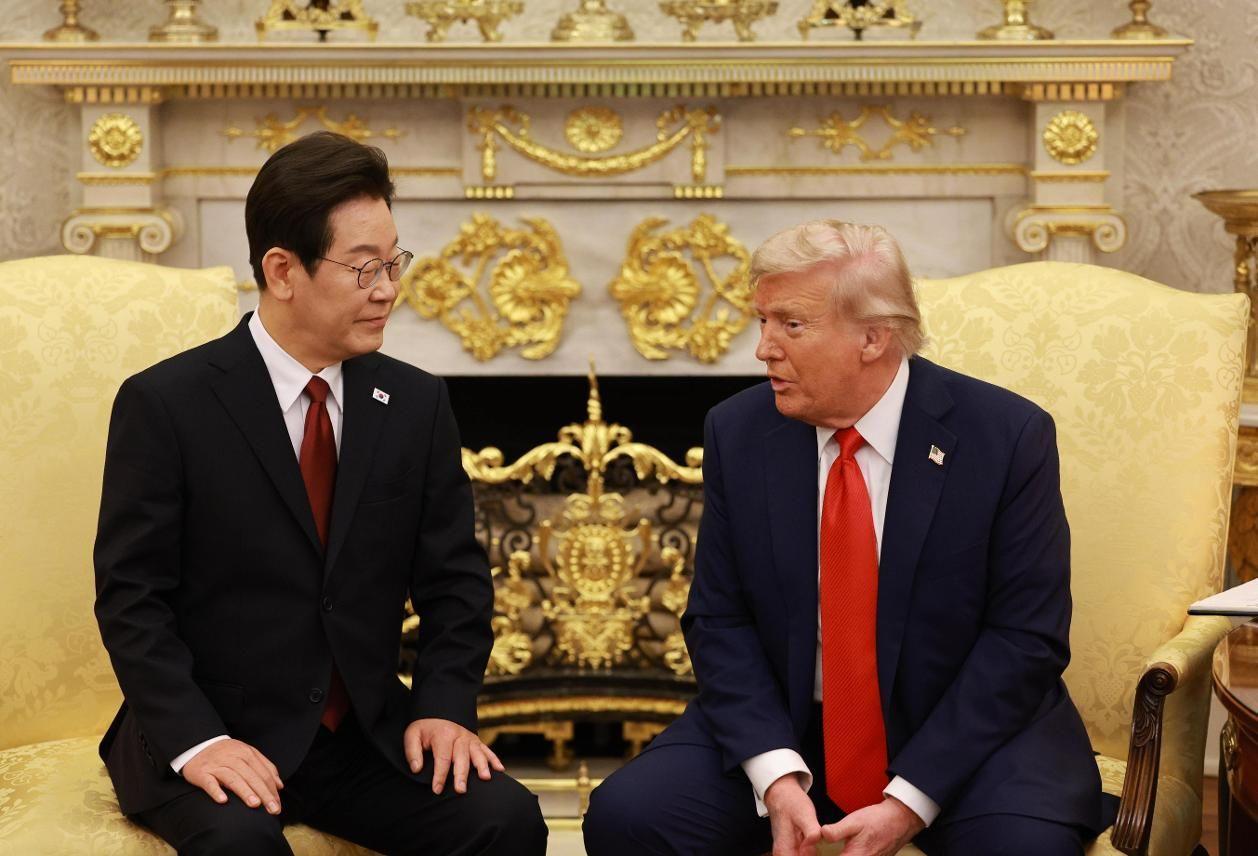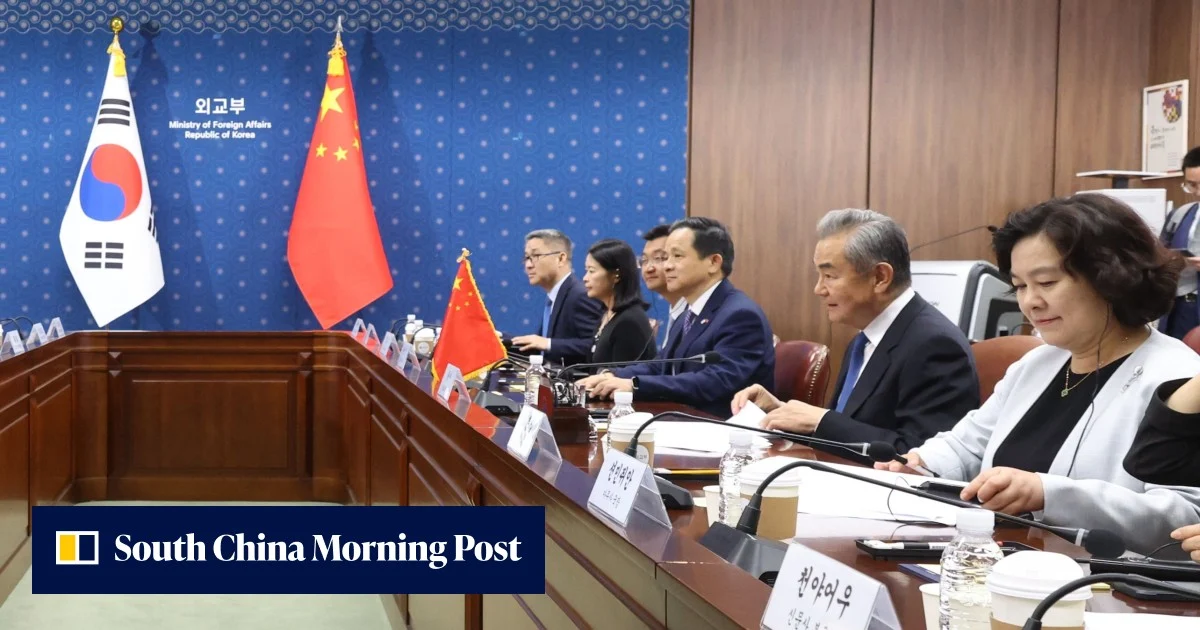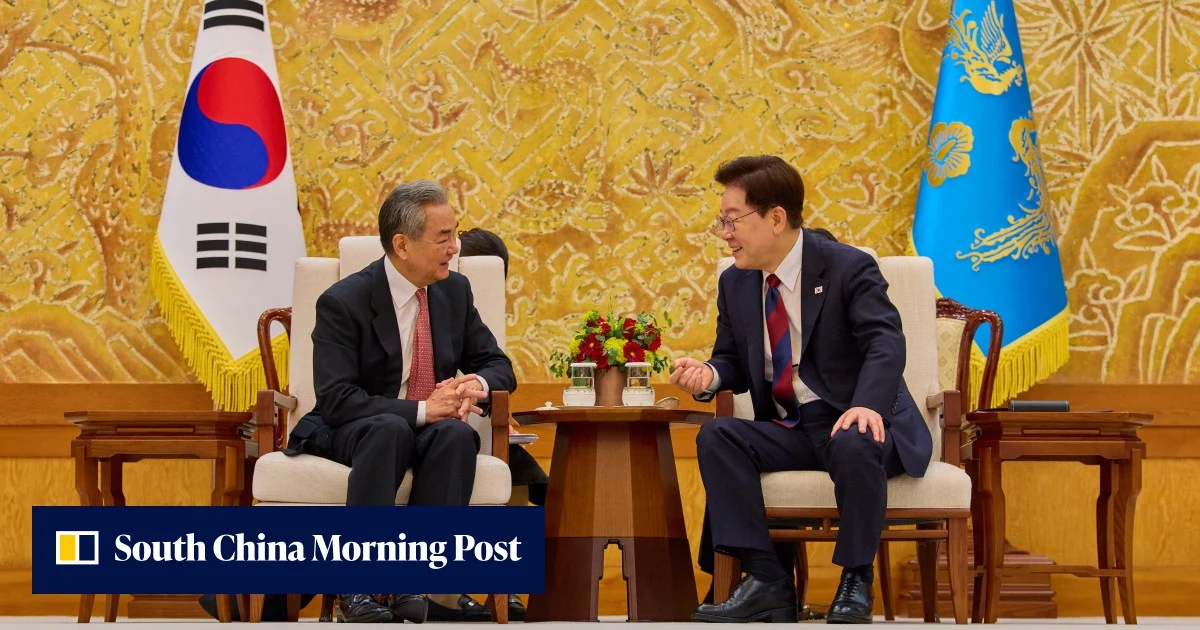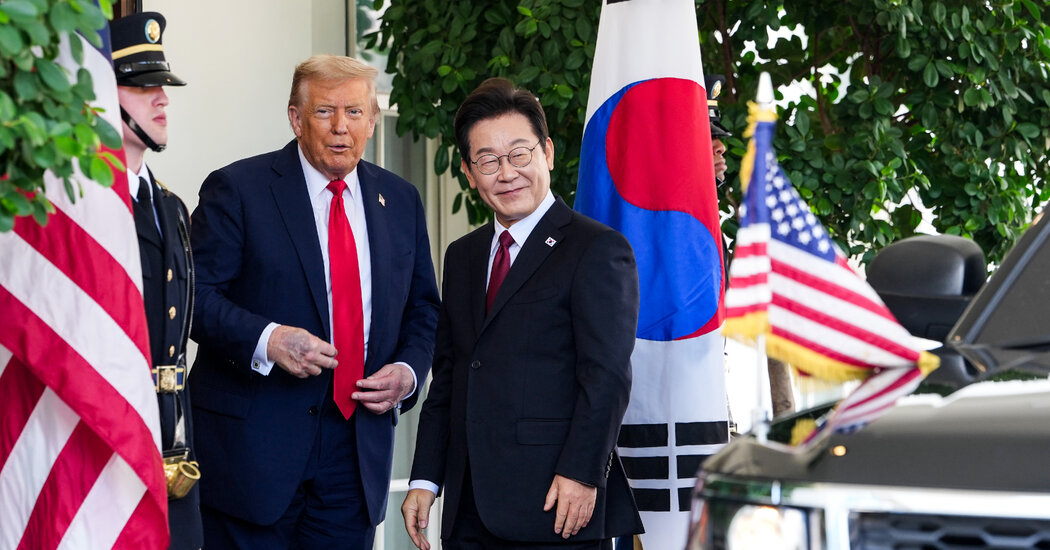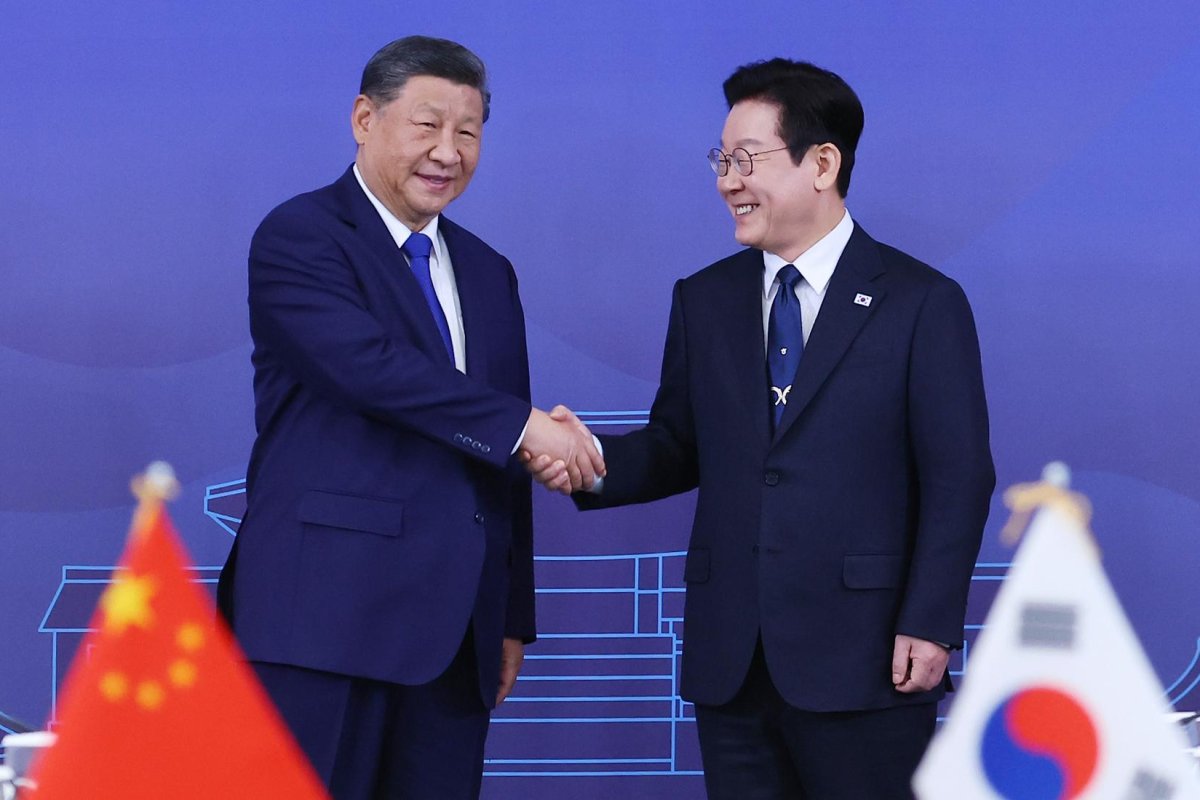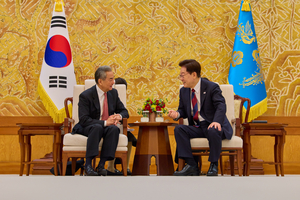
President Lee Jae Myung meets with Chinese Foreign Minister Wang Yi at Cheong Wa Dae in Seoul on Thursday. (Cheong Wa Dae via Yonhap) President Lee Jae Myung met Chinese Foreign Minister Wang Yi at Cheong Wa Dae on Thursday, as US President Donald Trump’s overtures to North Korea bring Beijing’s potential role back into focus.Lee and Wang assessed bilateral ties as being on a steady path of improvement following reciprocal summit visits, and they agreed to build on that momentum ahead of the Asia-Pacific Economic Cooperation summit in Shenzhen in November, according to Cheong Wa Dae.“Lee also asked Wang to maintain close strategic communication with Foreign Minister Cho Hyun and National Security Adviser Wi Sung-lac on South Korea-China relations and issues concerning the Korean Peninsula,” Cheong Wa Dae said of the meeting.The meeting between Lee and Wang has drawn attention as Trump has repeatedly signaled his desire to revive dialogue with North Korean leader Kim Jong-un. Trump's expected trip to China for the APEC summit in November is viewed as a possible opportunity for an in-person meeting with Kim.Trump also ordered the US Defense Department to “substantially reduce” annual combined military exercises with South Korea.Lee publicly backed Trump’s renewed diplomatic push in a post on X on Thursday, a day after South Korean and US military authorities announced their decision to shorten the Ulchi Freedom Shield exercise from 11 days to five, and scale back associated field training exercises.Lee’s support comes as his administration pursues its own broader effort to formally end the Korean War and establish a permanent peace arrangement.In his Aug. 15 Liberation Day speech, Lee called on "the parties concerned" to begin discussions to “bring this long-standing war to an end” and replace the armistice with a peace regime.The proposal dovetails with a plan laid out by the Unification Ministry in its Aug. 5 policy briefing to build momentum for four-party dialogue involving South Korea, North Korea, the US and China as part of a broader push to replace the armistice with a permanent peace regime.Lee did not specify which countries he meant by “the parties concerned” in his speech.South Korea, North Korea, the US and China, however, have long been regarded as the key stakeholders in efforts to formally end the Korean War, although South Korea was not a signatory to the 1953 Armistice Agreement. At the time, Seoul opposed an armistice that would cement the division of the peninsula.Against that backdrop, Wang’s visit has taken on added significance given China’s long-standing role in Korean Peninsula affairs.The visit is Wang’s first stand-alone bilateral trip to South Korea since September 2021, after a reciprocal visit was repeatedly delayed amid strained bilateral ties. President Lee Jae Myung (right) shakes hands with Chinese Foreign Minister Wang Yi during a walk along the Dasan Seonggwak-gil trail on Namsan in Seoul on Thursday. The two took a morning walk after breakfast, following their meeting and dinner the previous day. (Repblic of Korea Ministry of Foreign Affairs) Wang held talks with Foreign Minister Cho Hyun on Wednesday and joined him for a morning outing on Namsan the following day.During their formal talks, the two discussed high-level exchanges, efforts to improve bilateral ties and Lee’s planned participation in the APEC summit in Shenzhen, according to Seoul’s Foreign Ministry.They also covered economic cooperation, including upgrading the bilateral free trade agreement and stabilizing supply chains; Seoul’s concerns over China’s unilateral installation of structures in jointly managed waters of the West Sea; denuclearization and peace on the Korean Peninsula; and broader regional and global developments.On the Korean Peninsula, the South Korean side briefed Wang on Lee’s Liberation Day proposal for multilateral discussions on formally ending the Korean War, although the talks did not extend to a specific four-party format involving South Korea, North Korea, the US and China, a Foreign Ministry official said Thursday during a closed-door briefing.Trump’s recent overtures to Pyongyang were also discussed. “It is an important issue overall, so the two sides exchanged their views on it,” the official said.The talks, however, also revealed a subtle difference in how Seoul and Beijing framed the denuclearization issue.In his opening remarks, Cho said, “The Korean government will continue its efforts to achieve denuclearization and peace on the Korean Peninsula.”Wang, by contrast, avoided explicitly referring to denuclearization, saying, “As the Korean Peninsula’s most important neighboring country, China will continue to play a constructive role in promoting peace, development and stability on the Korean Peninsula.”The Foreign Ministry official, speaking on condition of anonymity, said China has been refraining from using the term “denuclearization” out of consideration for its relations with Pyongyang.“China is also well aware of the implications that refraining from using the term ‘denuclearization’ could have for the international nonproliferation regime,” the official said.Wang also appeared to draw a line at China directly mediating between Washington and Pyongyang.Asked by South Korean reporters after the meeting whether Beijing would be willing to help facilitate a summit between the leaders of the US and North Korea, Wang said, “That is a matter for North Korea and the US to decide, and the US in particular must change its long-standing hostile policy toward North Korea.”Hours after Wang wrapped up his visit, South Korea’s military said it detected around a dozen short-range ballistic missiles launched from the Pyongyang area toward the East Sea at around 5 p.m. Thursday.
Lee meets China’s top diplomat amid Trump overtures to NK
President Lee Jae Myung met Chinese Foreign Minister Wang Yi at Cheong Wa Dae on Thursday, as US President Donald Trump’s overtures to North Korea bring Beijing
890 words~4 min read