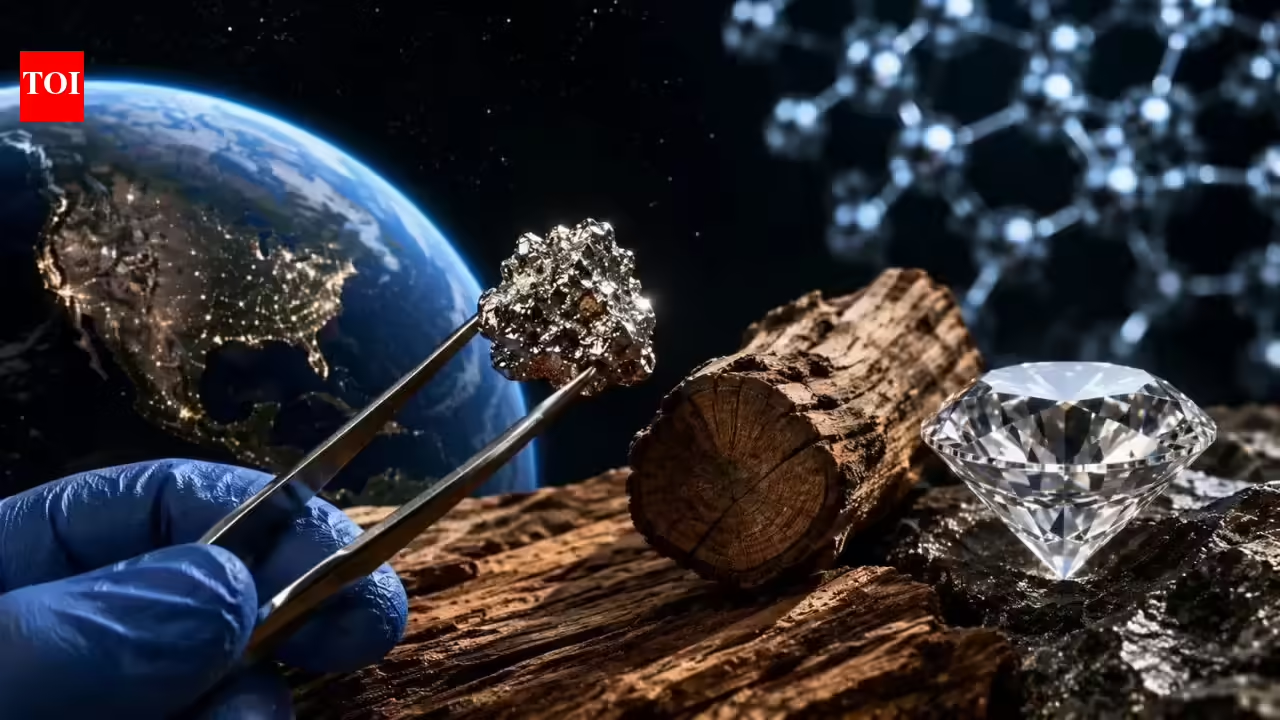
Diamond is famous for its beauty, but its value extends far beyond jewelry. This exceptionally hard form of carbon is used to make the tiny capsules that hold fuel in inertial confinement fusion experiments. Scientists also think diamonds may form and fall like rain far beneath the surfaces of ice giant planets such as Neptune and Uranus.
In both environments, diamond is subjected to immense pressure. Yet researchers have struggled for years to determine exactly how the material responds under such extreme conditions because laboratory measurements and computer simulations have produced conflicting results.
A new study published in Nature Physics may finally resolve that problem. Researchers at Lawrence Livermore National Laboratory (LLNL) measured how diamond melts at pressures three times greater than those found at Earth's core.
"We were able to take tiny diamond samples and shock compress them to temperatures hotter than the surface of the sun and to pressures higher than the center of Neptune and Uranus -- and still measure atomic structure, temperature, density and optical reflectivity," said author and LLNL scientist Marius Millot.
The results settle two long-standing discrepancies in diamond research and bring experimental measurements into close agreement with simulations based on quantum mechanics. The findings could also have important practical consequences. Applying them to inertial confinement fusion may allow researchers to triple energy gain, while a clearer picture of diamond's behavior at high pressure could improve models of planetary interiors.