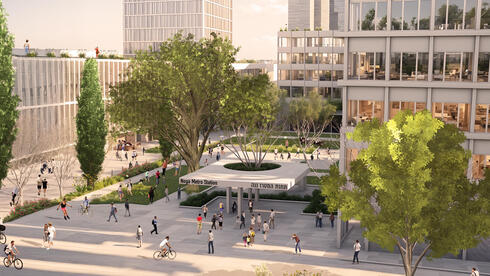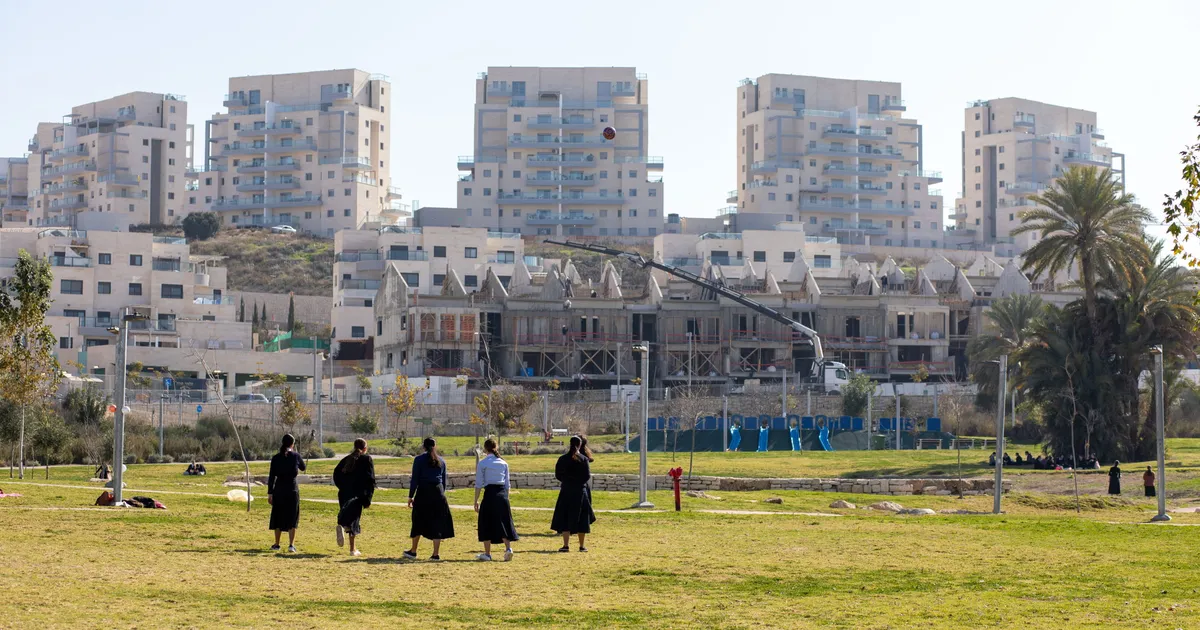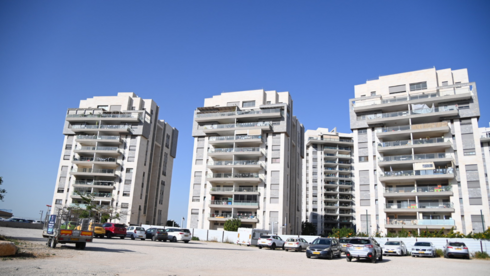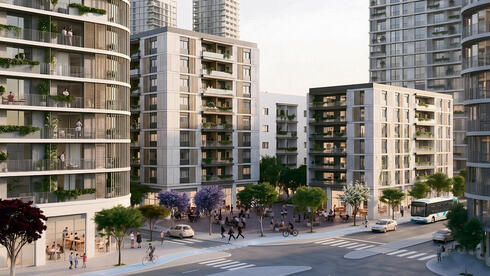
Nearly 1,500 aging apartments in Yad HaTisha would be demolished as the historic neighborhood adds new schools, commercial space and transit links, with its population projected to rise from 3,500 to nearly 15,000With Israel steadily running out of available land for new construction, urban renewal is becoming one of the housing market’s main engines of growth. Increasingly, planners are moving beyond the renewal of individual buildings and toward the wholesale redesign of aging neighborhoods, while improving quality of life, reinforcing community identity and creating a more attractive urban environment.One of the most ambitious examples is now taking shape in Herzliya’s Yad HaTisha neighborhood, also historically known as Shaviv, where nearly 1,500 old apartments are slated for demolition and replacement with more than 4,600 new homes, including towers up to 35 stories.GalleryIllustration of the Yad HaTisha neighborhood. Building permits are expected in 2030(Illustration: Gutman Assif Architects)Yad HaTisha has deep historical roots. Located in northeastern Herzliya near the Ra’anana border and Route 531, it began in 1950 as a transit camp for new immigrants. It was later known as Shaviv and in 1969 was renamed Yad HaTisha, in memory of nine Jews from Basra, Iraq, who were accused of espionage and publicly hanged.Immigrants from Turkey, Ethiopia, North Africa, Russia and Yemen settled there over the years. Beginning in the late 1960s, the first permanent housing blocks were built, typically three or four stories high with relatively small apartments.The neighborhood also became embedded in Israeli popular culture as a filming location for “Sallah Shabati,” the iconic film starring Chaim Topol about the difficulties faced by new immigrants in the young state.Like dozens of other neighborhoods across Israel, Yad HaTisha underwent a major rehabilitation program in the 1980s that upgraded local infrastructure, renovated sidewalks and roads and added a large public park. The neighborhood expanded further in 2001, when the Herzliya Local Planning and Building Committee approved a plan for about 1,200 apartments measuring 50 square meters (about 538 sq.ft.) and allowed units to be enlarged to as much as 120 square meters (about 1,292 sq.ft).Today, much of the neighborhood consists of aging housing stock, and after several unsuccessful renewal attempts, a broader renewal plan is moving forward.The Yad HaTisha neighborhood today. By the end of the renewal process, the neighborhood’s population is expected to grow to 14,770(Photo: Assaf Friedman)The Herzliya Local Planning and Building Committee recently approved the neighborhood renewal plan for deposit. Under the proposal, 1,483 existing apartments would be demolished and replaced by 4,616 new units.Most of the current buildings are one to five stories tall and generally lack elevators and parking. The new plan combines mid-rise construction of six to 10 stories in the neighborhood’s center and south with towers of up to 35 stories near major transportation corridors, including Route 531 and Jerusalem Road.The plan also provides for an additional 84,000 square meters (about 904,000 sq. ft) of employment and commercial space as well as new educational institutions.Student housing is included, with small apartments ranging from 30 to 55 square meters (about 323 to 592 sq. ft). About 20% of the new apartments are planned at between 66 and 80 square meters (about 710 to 861 sq. ft), while up to 10% will be large homes of 141 square meters (about 1,518 sq. ft) or more.The local committee also called for a permanent allocation of apartments for long-term rental under unified ownership.Around 3,500 people currently live in Yad HaTisha. Once renewal is complete, the neighborhood’s population is projected to reach 14,770.Formal deposit of the plan is expected in early 2027, followed by hearings on objections. It could receive final approval later that year. Over the following three years, the municipality and developers are expected to prepare detailed construction and development plans and obtain demolition and building permits. Demolition and construction would then take an additional three to five years.Several developers, including NBS and Dimri, Israel Land Development Company and Metropolis, are already advancing evacuation-reconstruction projects in the neighborhood.The transformation would sharply increase density. Yad HaTisha currently has 5.3 housing units per dunam (about 21 units per acre) across the neighborhood, compared with a planned 16.6 units per dunam (about 67 per acre). Within residential areas alone, density would rise from 10.1 units per dunam (about 41 per acre) to 45.2 (about 183 per acre). Gutman Assif Architects, led by Adi Assif, is overseeing the planning of the neighborhood’s large-scale urban renewal project.The average apartment in the neighborhood today measures about 60 square meters (about 646 sq. ft). Under Herzliya municipality policy, existing homeowners are expected to receive an additional 12 square meters (about 129 sq. ft), including a reinforced safe room, as well as underground parking and a 12-square-meter (129-sq.ft) balcony.Real estate appraiser Zerit Gali Szewach, co-founder of the Goldshmidt-Szewach appraisal firm, said an older 2.5- to three-room apartment measuring about 60 square meters (646 sq. ft) currently sells for roughly 2.2 million shekels (about $732,000) and rents for around 5,000 shekels (about $1,660) a month.“After the urban renewal process, a 72-square-meter (775-sq.ft) apartment is expected to sell for about 2.91 million shekels (about $968,000),” she said. “Appropriate monthly rent for such an apartment is expected to be about 6,800 shekels (about $2,260).”Zerit Gali Szewach(Photo: Yosef Tetro)New four-room apartments in Herzliya have risen by an estimated 12.7% over the past four years, according to valuation estimates cited in the project. Szewach estimates that after renewal, an average new four-room apartment in the neighborhood could carry a starting price of about 3.64 million shekels (about $1.21 million), with monthly rent of around 7,600 shekels (about $2,530).Infrastructure will be one of the central challenges as the neighborhood’s population grows more than fourfold.As part of the planning process, Herzliya municipality conducted public consultations to identify residents’ needs. The plan concentrates denser construction near a future metro station northwest of the neighborhood and the existing Ra’anana West railway station.It also calls for new bicycle paths, along with charging infrastructure for electric bicycles and electric vehicles. At present, the neighborhood has only one entrance from Har Sinai Street. Renewal would add a northern entrance to Har Sinai, another access point via Ma’apilei Morocco Street into the neighborhood center and a third from Zisso Street in the north.Ma’apilei Morocco Street is expected to become a major east-west route, linking the existing neighborhood with planned future development.Several Metropoline bus routes already serve the area, including Route 525 between Ra’anana and Ramat Gan. The planned M1 metro line will also run nearby, continuing to three Herzliya stations: two stations along Ben-Gurion Street and another in Herzliya, north of Reichman University. The closest station to Yad HaTisha, however, is expected to be Ra’anana West, across the municipal boundary.The plan allocates 60 dunams (about 14.8 acres) for public buildings and institutions, 30 dunams (about 7.4 acres) for open public space and 80 dunams (about 19.8 acres) for roads. Public facilities are expected to include synagogues, health and welfare services, youth and senior centers and new clinics.The neighborhood currently has two schools, the religious Ahia High School and Reut junior high school. Both are slated for expansion into 36-class secondary schools. Three new elementary schools, each with 24 classrooms, are also planned.Seven kindergartens currently operate in the neighborhood. The renewal plan provides for 33 kindergarten classrooms, most on publicly owned land and some incorporated into residential buildings.Engineer Lior Zeitler, co-owner of A.L. Engineering and chairman of the Israel Urban Renewal Inspectors Association, said the scale of construction means public infrastructure cannot be treated as an afterthought.“Yad HaTisha is undergoing extensive urban renewal that combines mid-rise construction and towers and adds a large number of housing units, so it must be planned together with public infrastructure, schools, kindergartens and commercial centers,” he said.Engineer Lior Zeitler(Photo: Daniel Edri)He also stressed the importance of reinforced safe rooms and improved earthquake resistance. But, he said, the more difficult challenge is preserving the neighborhood’s social fabric. “The synagogues, neighborhood gardens and seating areas used by longtime residents are community infrastructure in every sense, and if they are not taken into account from the beginning of the planning process, they disappear,” Zeitler said.“A renewed neighborhood needs more than new apartments; it needs its gathering places back. Good urban renewal should not erase a community and replace it with something entirely new. It should preserve that community while giving it a modern setting.”That concern is particularly resonant in Yad HaTisha because of its history. In “Sallah Shabati,” Topol’s character joins a staged demonstration by transit-camp residents and declares: “We don’t want housing, we want the transit camp!”The scene reflected the distrust many olim felt toward government institutions and their fear that relocation into permanent housing would destroy the communities they had formed. Decades later, planners are again confronting a version of the same question.Yad HaTisha today has a diverse population that includes longtime families of Asian and North African origin, immigrants from the former Soviet Union and younger families. Roughly half of residents own their homes and half rent.A significant portion of the population is traditional or religious, and the neighborhood contains numerous synagogues, particularly around Harei Gilad Street, as well as a ritual bath on Zisso Street.The municipal urban renewal administration and social consulting firm People have been working with residents to explain the renewal process and establish tenant representative committees.A social survey was also conducted to map residents’ needs. So far, the consultants and municipal team have held 18 meetings in residential buildings aimed at creating tenant committees.Organizing residents has proved more difficult in areas dominated by detached houses and two-story buildings because of complex ownership patterns and the neighborhood’s physical structure. In denser apartment blocks, organization has advanced more quickly.Guri Nadler, head of planning at the government authority for urban renewal, described the project as far more than a local renewal initiative. “The renewal planGuri Nadler(Photo: Roni Cnaani ) for Herzliya’s Yad HaTisha neighborhood is an event on a metropolitan scale,” he said. “It is located in an attractive and sought-after area, and the plan includes high-quality and diverse housing for existing residents and thousands of additional families, alongside new public infrastructure, with an emphasis on educational buildings and gardens.”Developers, he added, are already active on the ground. “Implementation of the plan is expected to be rapid.”
Herzliya neighborhood set for dramatic overhaul with 35-story towers and 4,600 new homes
Nearly 1,500 aging apartments in Yad HaTisha would be demolished as the historic neighborhood adds new schools, commercial space and transit links, with its population projected to rise from 3,500 to nearly 15,000
1,703 words~8 min read