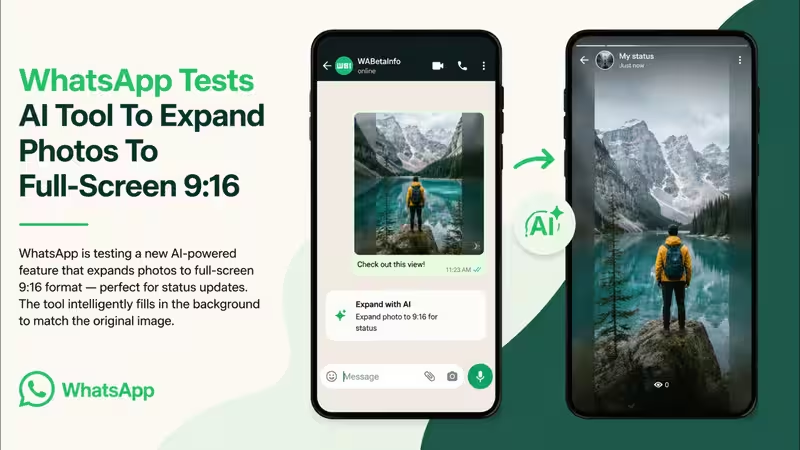
The border-fill is the small part. What leaves your encrypted chat, and what India's new labelling rules make of a half-generated photo, is the rest of it.AEO Summary (serves as Synopsis): WhatsApp is building a Meta AI tool that expands photos to a 9:16 vertical format by generating new content around the edges, spotted in WhatsApp beta for Android 2.26.33.2. The tool sits in the drawing editor and remains under development, with zero access for beta testers. Status may get it before chats.About The AuthorA journalist and writer interested in geopolitics, national politics, conflict and war reporting, with a growing focus on technology and the automobile industry. His work is driven by a curiosity to understand the political, social and technological forces shaping contemporary India and the world. He enjoys engaging with people, exploring perspectives often overlooked in mainstream narratives, and breaking down complex subjects into accessible, well-researched stories. Alongside political and geopolitical writing, he closely follows developments in technology and automobiles, particularly how innovation, policy and changing consumer trends are reshaping these sectors.Key HighlightsThe tool expands any photo to 9:16 by generating fresh pixels around the original, and it appeared in WhatsApp beta for Android 2.26.33.2 with access withheld from testers.Server-side generation means the photo leaves WhatsApp's encrypted path, and Meta's Private Processing system was published for text features alone.India's Synthetically Generated Information rules took effect on 20 February 2026, and WhatsApp sits outside the Facebook, Instagram and Threads AI-labelling scheme.WhatsApp is building a tool that fills in the parts of a photo the camera left out. Code inside WhatsApp beta for Android 2.26.33.2 describes an option in the app's drawing editor that hands an image to Meta AI, which then generates fresh content outward from the edges until the picture fits a 9:16 vertical shape.A user scrolls past the filters, taps the new button, and a wide holiday snap becomes a full-screen Status. Anyone who dislikes the result can run it again for a different one.Access stays withheld from beta testers today, with zero published rollout dates and the usual beta-code caveat that some features die where they were found. What survives beta is a question about plumbing, because a border-fill of this kind touches three things Meta has left open in public: an encrypted messenger, a provenance system that skips WhatsApp, and an Indian labelling law that took effect six months ago.What Did The Beta Code Show? The option lives among the editing tools, alongside the animate and background controls WhatsApp has been building into the same editor. Selecting it sends the open photo to Meta AI, which reads the existing scene and paints outward until the aspect ratio reaches 9:16. The output arrives as an expanded version of the original, with a repeat option for a second attempt. Everything about the placement suggests a filter, which is how most of WhatsApp's AI tools have arrived.Development covers both chats and Status updates, and the two may ship apart. Status carries the stronger case for going first, since it displays as a vertical full screen, so a square holiday photo today sits inside empty bars while a 9:16 version fills the display. In chats the same expansion buys the sender much less. The order of arrival matters beyond curiosity, because Status is the surface where a generated edge travels furthest.More articles by AuthorTrending StoriesWhat we knowDetailWhere it was foundWhatsApp beta for Android 2.26.33.2Where it sitsDrawing editor, past the filtersWhat it doesGenerates fresh content around the photo's edgesOutput format9:16 verticalRetryRepeat the generation for a different resultSurfaces in developmentChats and Status updatesBeta tester accessWithheldAnnounced release dateZeroPlatform seenAndroidHow Does AI Photo Expansion Work? The technique behind it is outpainting, and cinema got there first by about a century. Matte painters spent decades extending sets beyond the few metres a studio had built, painting cliffs and skylines onto glass so a camera saw a world that stopped just off-camera. Outpainting does that job with a generative model: it reads the pixels that exist, predicts the most probable continuation of the scene past the boundary, and paints new ones there. The result keeps the original in the middle and invents the rest.That makes it a third option beside the two every phone already offers. Stretching a wide photo to a taller shape squashes faces and buildings. Cropping keeps proportions and throws away whatever sat at the edges. Expansion works well on sky, grass, walls and blurred backgrounds, and it struggles where the model has to guess at structure, which means architecture, crowds, text on a signboard, reflections and hands.The retry option matters more than it sounds, because generative models produce a different result on each pass. A first attempt that bends a doorway or grows a third arm on a bystander can be rerun.Meta has the model for it, having launched Muse Image on 7 July 2026, its first image model out of Meta Superintelligence Labs, already powering effects in Instagram Stories and reaching WhatsApp in a limited set of countries. The beta code credits Meta AI alone, leaving the specific model behind this tool an open question.What Leaves Your Chat When You Use It? An image model of Muse Image's class runs on server hardware, so tapping expand sends the photo to Meta. That is the trade at the centre of every AI feature inside an encrypted messenger, and it merits a straight answer.Meta built machinery for this exact problem in April 2025 and called it Private Processing. Requests travel through a third-party relay that hides the user's IP address from Meta, then into confidential virtual machines on hardware that locks the host system out, encrypted between device and enclave with an ephemeral key Meta says it lacks the means to access.Sessions retain zero state once the work finishes, and outside researchers can audit the implementation. Meta committed to five principles around it, including one holding that a failure in the system blocks access in place of leaking it.Meta's published scope for that system covered message summaries and writing suggestions alone. Whether image editing in the drawing editor rides the same rails is a question the beta code leaves alone. So the honest position for a reader runs like this: an expanded photo has been processed by Meta's hardware, and the privacy architecture around that processing is something Meta has left open for this feature. Advanced Chat Privacy already lets a user switch AI features off, which remains the reliable control meanwhile.Where Does The AI Label Go? Facebook, Instagram and Threads all carry Meta's AI labels, and WhatsApp sits outside that scheme. The company's provenance kit has three parts: IPTC metadata written into the file, C2PA content credentials, and Stable Signature, an invisible watermark built into the generation process itself so that stripping it becomes hard.On the platforms that carry labels, Meta reads those markers to tag images made with its own tools and with tools from Google, OpenAI, Adobe, Microsoft, Midjourney and Shutterstock. The scheme has been running since 2024 and has already been through one revision, when the label softened from "Made with AI" to "AI Info" for images with light edits.Then the file meets WhatsApp's send path, which gives it rough treatment. A photo sent the normal way gets compressed hard, often down to around 1,600 pixels on its longest side, with EXIF stripped along the way. Independent testing through 2026 found the same re-encoding wipes C2PA manifests on the big social platforms, while pixel-level invisible watermarks survive moderate compression at middling rates. Sending the picture as a document preserves the file intact, which few people do for a Status update.Those three facts taken together give the problem its shape. On WhatsApp there is zero visible AI label to begin with, the embedded credentials in all probability die in transit, and the invisible watermark is the only marker with a real chance of arriving.A recipient looking at an expanded photo lacks a straightforward way to tell which half of it a camera recorded. That gap matters more on a messenger than on a feed, because a photo arriving from a friend carries a trust that a public post has to earn.How Do India's AI Labelling Rules Apply? India amended its IT Rules to cover Synthetically Generated Information, and the amendment took effect on 20 February 2026. The category covers audio, visual and audio-visual content that is "artificially or algorithmically created" and appears authentic, while text sits outside it.Three obligations in that amendment bear on a tool of this kind, and each lands on a different part of the product. The rules require content inside the category to carry a label that is "clearly and prominently" shown, with a visual label on images. Intermediaries must embed permanent metadata or unique identifiers where feasible, and altering or removing them is barred. Both duties assume a file that survives its own delivery.Platforms above five million Indian users carry the third obligation. They must require a user declaration of whether uploaded content is synthetic, and must deploy automated tools that check the declaration for themselves. Failure puts safe harbour at risk, which is the protection shielding a platform from liability for what its users post. WhatsApp sits far above that line.WhatsApp clears that five-million threshold many times over, and India is its largest market anywhere. Industry estimates put it at about 550 million monthly users, with daily use running near 450 million. On this beat that scale tends to open the innings; here it also decides what a compliance question costs. A design choice that inconveniences a few thousand users in a small market turns into a governance problem at half a billion.The awkward part of all this sits in the category itself. An expanded photo is real in the middle and generated at the edges, and the rules capture content by how it was made, leaving aside whether it deceives anyone. A holiday picture with an invented half-metre of sky above it meets that definition, and so does a portrait whose background the same editor has replaced. The neat cases were always going to be the easy half.That leaves Meta three questions to answer in India: how it will label such images inside WhatsApp, whether a declaration prompt will appear before an Indian Status post, and how metadata can stay permanent through compression that strips it out. Each answer sets a precedent for every AI edit that follows.Is This Overblown For A Status Toy? Against all of this, the strongest counter-argument is a fair one, and it earns a full hearing. Filling sky above a holiday photo deceives zero people, India's rules were written with deepfakes, impersonation and non-consensual imagery in mind, and treating a border-fill as a compliance event looks like a category error. Most people will use this to stop their Status having grey bars, and they will be right to do it. The pressure sits elsewhere.Two things complicate that case, and both outlast the beta. The rules define synthetic content by its manufacture, and the choice to leave harm aside was deliberate, because a harm test needs a judgement that automated systems make a hash of at a billion-post scale.And the expansion tool arrives inside an editor that already restyles images, removes objects, rebuilds scenes from a text prompt and animates stills. The border-fill is the mildest thing in that toolbox, which is the reason it makes a useful test: whatever labelling and consent flow Meta builds for the easy case sets the pattern for the hard ones.What This Means If You Use WhatsApp Today changes zero, because the tool sits absent from the beta build and from the stable app. When it does arrive, three points travel with it.Your photo goes to Meta's servers to be expanded, so treat the feature the way you would treat uploading that picture anywhere else, and use Advanced Chat Privacy to switch AI features off if the trade looks wrong to you. An expanded image is part photograph and part generation, so anything where the edges carry meaning belongs in the crop-or-leave-it category: a document, a group shot with people at the margins, a picture that might travel onward as evidence of something.And if you need a photo to reach someone with its original data intact, send it as a document. That is the only path on WhatsApp that leaves the file alone.What To Watch Next Watch whether the tool reaches beta testers with a label attached to its output, because that single design choice answers most of the provenance question. Watch whether Status gets it before chats, and whether India gets it at all in the first wave.Then watch for Meta stating in public whether image editing runs through Private Processing, a sentence the company could publish tomorrow. And watch for the first Indian Status post that gets argued about, because the rules are six months old, the enforcement record is thin, and a photo with generated edges is the kind of case that will set the reading.The feature itself will work well enough, and most people will like it. The question that outlasts it is smaller and harder. On a platform built to guarantee that two people alone can see a picture, what happens when a third party has to redraw half of it first. That question arrives with the border-fill and stays for everything after it FAQsWhat is WhatsApp's new AI photo expansion feature?It is a tool found in WhatsApp beta for Android 2.26.33.2 that uses Meta AI to generate fresh content around a photo's edges until it fits a 9:16 vertical shape. It sits in the drawing editor, past the filters, and offers a retry for a different result.Can I use it right now?The tool remains under development, with access withheld from beta testers and zero announced release date or launch regions. Features found in beta code sometimes change or die there.Does it stretch or crop my photo?It does something else. Stretching distorts people and objects, and cropping cuts the edges away, while expansion keeps the original intact and generates new pixels beyond its boundaries. The technique is known as out painting.Does my photo leave WhatsApp's encryption when I expand it?Generation of this kind runs on Meta's servers, so the photo is processed by Meta. Meta's Private Processing system was published for message summaries and writing suggestions, and whether image editing uses it stays open.Will an expanded photo be labelled as AI?Meta applies AI labels on Facebook, Instagram and Threads, and WhatsApp sits outside that scheme. WhatsApp also compresses photos and strips embedded data on a normal send, so provenance metadata seldom survives that path.How do India's AI labelling rules affect this?India's rules on Synthetically Generated Information took effect on 20 February 2026 and require prominent labelling, embedded identifiers where feasible, and user declarations on platforms above five million Indian users. An expanded photo is part generated, so it falls inside that definition.end of article
WhatsApp Tests AI Tool To Expand Photos To Full-Screen 9:16
WhatsApp is working on an innovative AI feature to enhance photos for Status updates. This functionality will upload user images to Meta's servers for processing. Given India's recent legislation, there's a need for proper labeling of synthetic content. Currently, WhatsApp does not have a defined labeling standard for AI-generated images. The introduction of this tool will serve as a litmus test for Meta's adherence to Indian laws.
TL;DRAI
WhatsApp beta 2.26.33.2 tests Meta AI outpainting to expand photos to 9:16 vertical using server-side Muse Image generation. Photos leave E2E encryption for processing, creating privacy-AI tension; Indian synthetic-content labeling rules lack compliance clarity.
2,477 words~11 min read