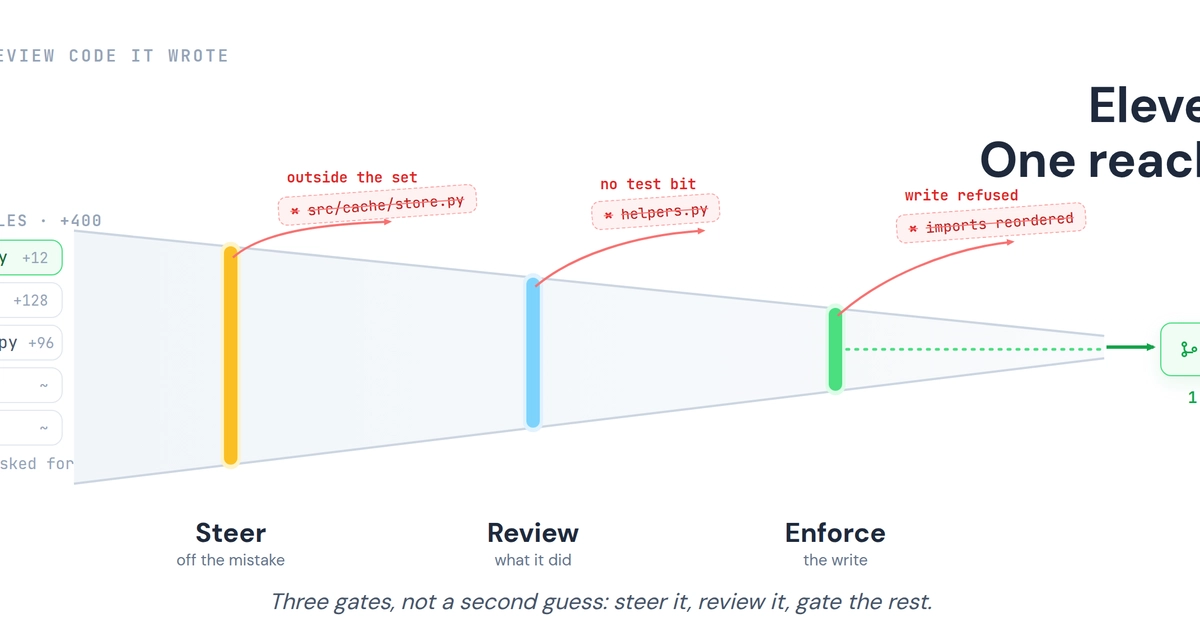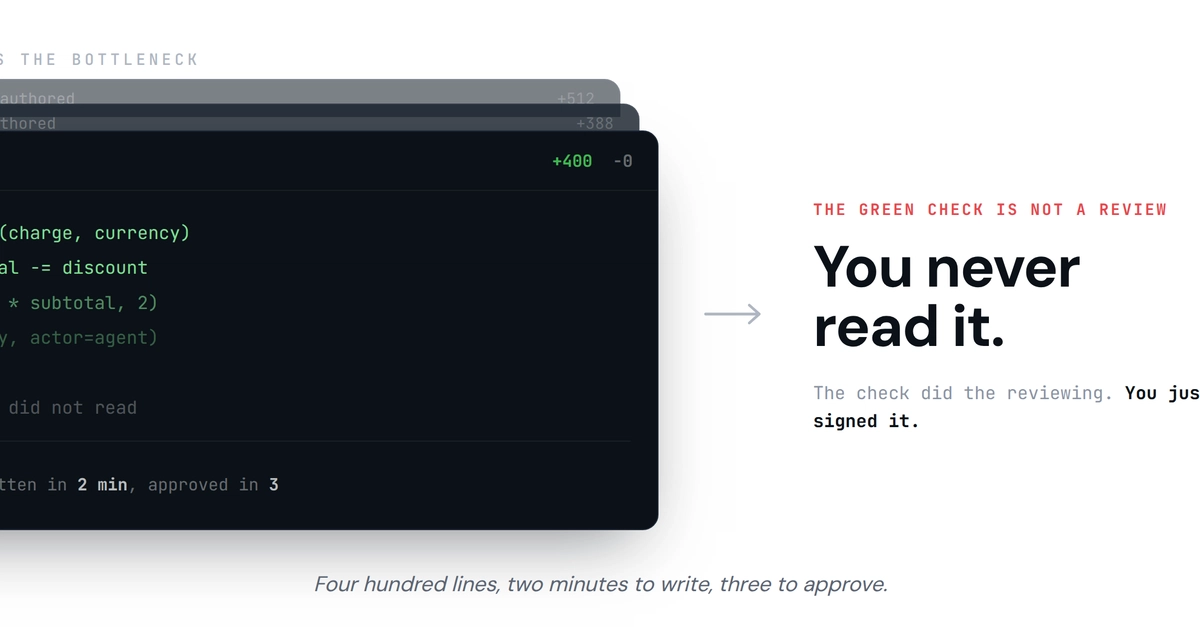
The pitch for Opus 5 was that the model checks its own work now. Anthropic's Opus 5 guidance says as much: the model verifies by default, and the verify and double-check lines you used to write now only make it over-verify. Checking its own work as it writes is one job; reviewing the finished diff is another. Opus 5 got better at the first, and that quietly excuses you from the second: the four-hundred-line change it just produced lands on your branch behind a green check nobody actually read.
If you run Claude Code with a few agents at once, you know the shape of it. One developer on Hacker News put the volume plainly: "Once AI starts generating code, it flows out like water through a burst dam. It's impossible for any human to fully understand it all." Another, running the same setup I do: "I also fire off tons of parallel agents, and review is hands down the biggest bottleneck." (Hacker News)
Opus 5 was supposed to make this faster. What it did was move the work. You write less and review more, and reviewing what a machine wrote is harder than reviewing your own, because none of the context is already in your head. Robert Laszczak said it cleanly this month: "Reviewing code written by an agent is much harder than reviewing code that you have written by hand." You reached for a faster writer. You got a full-time reviewer of code you cannot fully hold in your head.