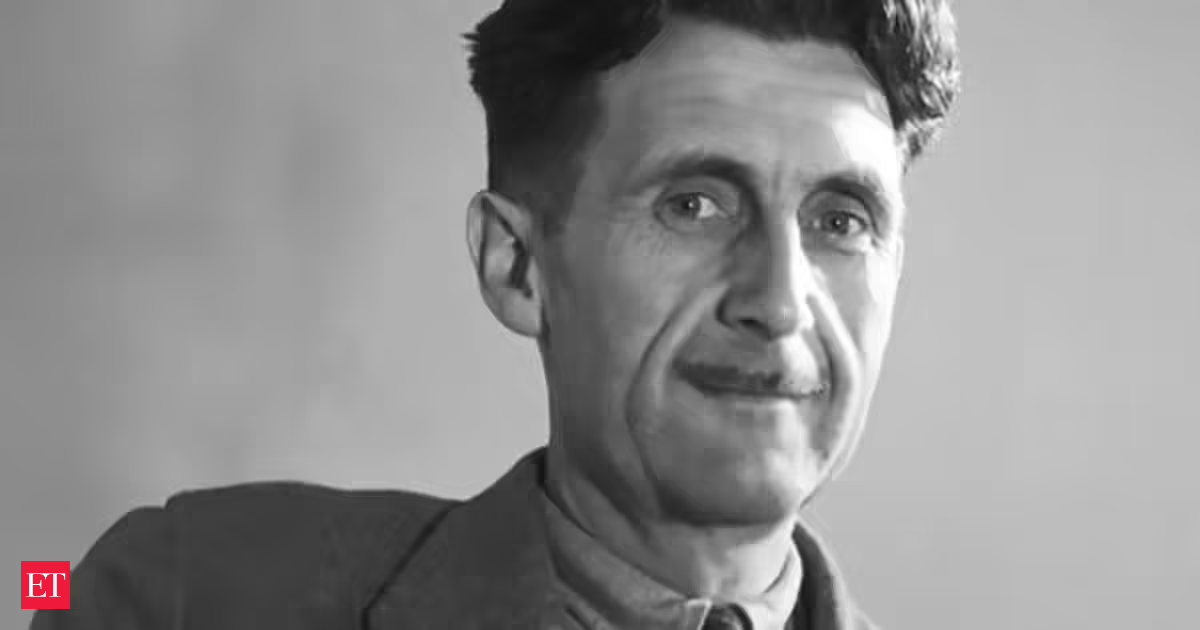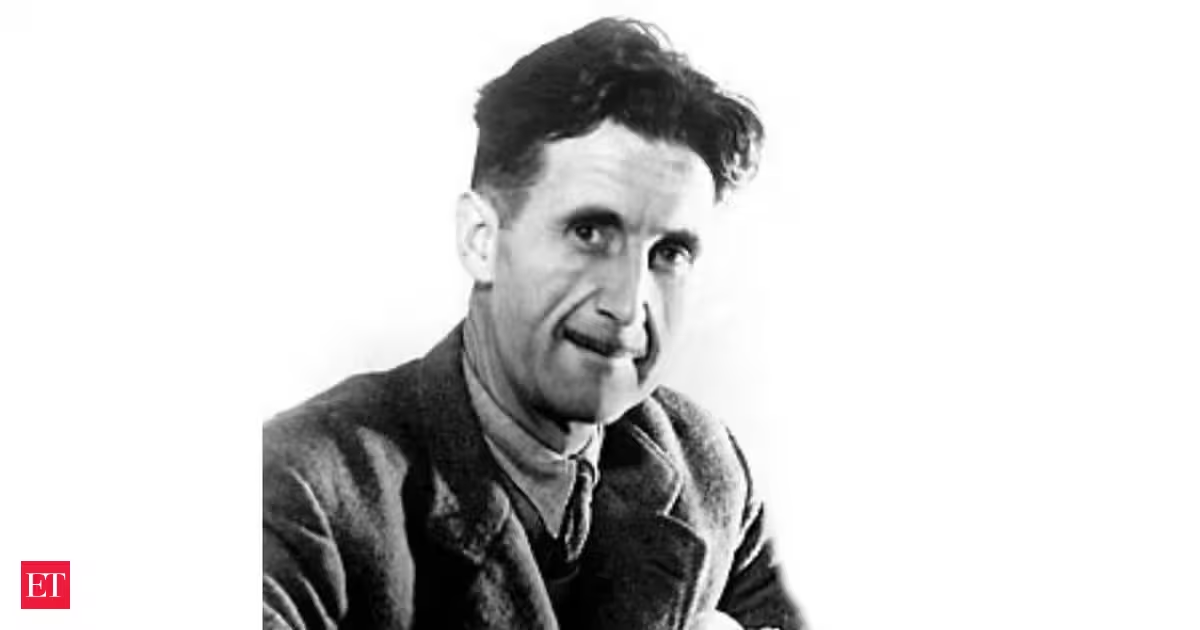
Quote of the day by George Orwell: Power can start with promises of change, protection or a better future. But what happens when gaining power is no longer a means to achieve something else, and instead becomes the goal itself? George Orwell explored that unsettling idea in his famous dystopian novel Nineteen Eighty-Four, where political control is taken to its most extreme form. One of the book’s most striking lines comes during a conversation between Winston Smith and O’Brien, a member of the ruling Party. O’Brien explains that the Party does not seek power simply to accomplish another political objective. It wants power because controlling others is the objective.George Orwell said, “Power is not a means, it is an end. One does not establish a dictatorship in order to safeguard a revolution; one makes the revolution in order to establish the dictatorship,” as per BrainyQuote.The quote appears in Part Three, Chapter Three of Orwell’s Nineteen Eighty-Four, published in 1949.What Does George Orwell’s Quote MeanOrwell’s words challenge the idea that power is always gained for a larger purpose. In Nineteen Eighty-Four, O’Brien explains that the Party’s ultimate goal is power itself. The regime is not interested in using control temporarily to create a better society. Instead, maintaining control becomes the purpose.The quote therefore presents a warning about what can happen when political power becomes an end in itself.You Might Also Like:Life Lesson From George Orwell’s QuoteThe quote offers a simple but powerful lesson about authority: it is worth paying attention to what people seeking power ultimately want to achieve.Promises of change may sound convincing, but Orwell’s words encourage readers to look at how power is used once it has been obtained.Who Was George OrwellGeorge Orwell, born Eric Arthur Blair on June 25, 1903, in Motihari, India, was an English novelist, essayist and critic best known for Animal Farm and Nineteen Eighty-four. His writing explored oppression, propaganda and totalitarian rule.George Orwell’s Early LifeOrwell returned to England with his family and attended Eton from 1917 to 1921. In 1922, he joined the Indian Imperial Police in Burma, as per a Britannica report. His experiences under British colonial rule made him increasingly uncomfortable with his role, leading him to resign in 1928.You Might Also Like:Why George Orwell Became a WriterAfter leaving Burma, Orwell lived among poor and marginalized people in London, Paris and across England. These experiences inspired Down and Out in Paris and London, published in 1933. He later wrote Burmese Days, A Clergyman’s Daughter and Keep the Aspidistra Flying.George Orwell and the Spanish Civil WarIn 1936, Orwell went to Spain to report on the Civil War but joined the Republican side as part of the POUM militia. He was seriously wounded at Teruel and later fled Spain with his wife, Eileen O’Shaughnessy, after fighting in Barcelona against pro-Stalinist communists, as per the Britannica report. He recounted the experience in Homage to Catalonia.Animal Farm and Nineteen Eighty-fourAnimal Farm, published in 1945, used a political fable to examine the Russian Revolution and Stalin’s betrayal of its ideals. The book made Orwell famous and prosperous.His final novel, Nineteen Eighty-four, followed in 1949. It warned about totalitarianism, surveillance, propaganda and the manipulation of truth. Its terms, including Big Brother, Newspeak and doublethink, became associated with modern political abuses.You Might Also Like:Orwell spent his final years on Scotland’s Jura island while suffering from tuberculosis, as per the Britannica report. He died in London on January 21, 1950, aged 46.You Might Also Like:
Quote of the day by George Orwell: 'Power is not a means, it is an end. One does not establish a dictatorship in order to...' - motivational quote by Animal Farm and Nineteen Eighty-Four author teaches life lessons on power, authority, leadership, ambition and dangers of absolute control
Quote of the day by George Orwell: Discover the profound insights of George Orwell on power, control, and totalitarianism in this exploration of his quote from Nineteen Eighty-Four. Learn how his experiences shaped his views and the relevance of his warnings today.
575 words~3 min read