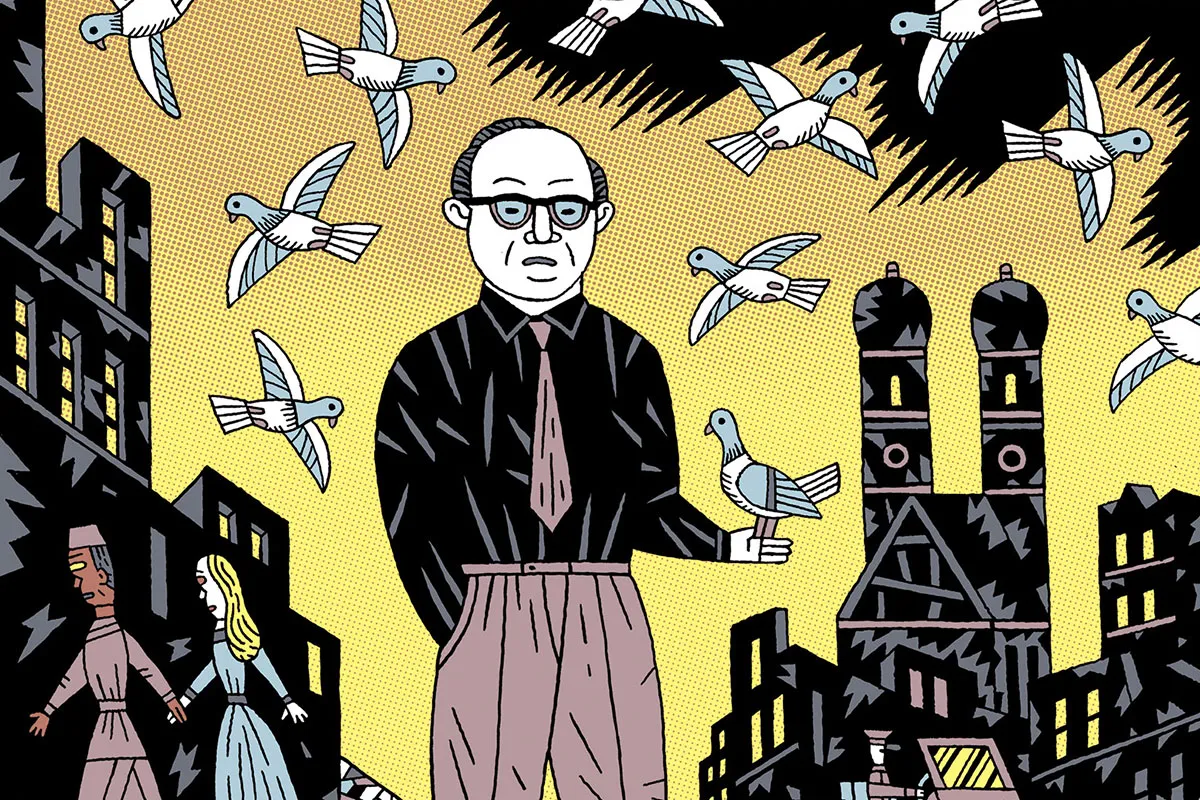
Small wonder that Wolfgang Koeppen’s native Germany greeted his suite of postwar novels with hostility when they were first published in the early 1950s: When things go wrong, who needs to be shamed? Who needs to be mocked? Who needs—even worse—to be warned? The past is over, that’s its whole point.Now that the past of those years—the years immediately following World War II—has been superseded by so many other pasts, these novels are apparently received in Germany with (however temporarily) the great admiration and pleasure that was always their due. My own experience with them, though less illustrative, is vaguely parallel to Germany’s: some decades ago an acquaintance gave me a copy of Death in Rome, the third volume of the so-called postwar trilogy, and urged me to read it. I opened it up, it was opaque and inert, I closed it, and thought no more about it until recently, when it was reissued along with a new translation of Pigeons on the Grass and the first English translation of The Hothouse. Out of mild curiosity, I opened it up again, and, who knows why—possibly the atmospheric conditions of 2026—comets and stars came exploding out. I proceeded to read the three books in sequence, dazzled and enthralled, and every time I put one down (which, owing to their richness, intensity, velocity, and sheer unexpectedness, was often) I wondered what on earth had just happened to me; it seemed I’d been tuned, sharpened, elasticized—reformulated with better neurons. Pigeons on the Grass is the earliest of the three, published in 1951, followed by The Hothouse in 1953 and Death in Rome in 1954. Koeppen wrote them “live,” as it’s put by Michael Hofmann, whom readers can thank for the remarkable translations—“live” meaning in real time and also in real place, Germany, where Koeppen was born in 1906. His long life is interesting—no doubt easier to read about than to have lived, as you can see from the excellent essays by Hofmann, Pankaj Mishra, and Joshua Cohen included in the volumes.During the days of the Weimar Republic, Koeppen made a living at this and that, for a while as a journalist, and wrote two well-received and poorly selling novels. In 1933, when Hitler was appointed chancellor and Nazism established as Germany’s sole state power, Koeppen went to Holland. As he was not Jewish, or Roma, Sinti, Black, Slavic, homosexual, a communist, a labor leader, or, formally, a dissident, he was not likely to be in official danger, but his publisher was a Jew, he had Jewish friends, he was by nature an intellectual and an aesthete—a type that autocrats tend to view, understandably, with great distaste. And personal safety aside, who, I ask you, wants to live in a country given over to insane, sadistic, thieving, power- and money-mad psychopaths?In late 1938, just as droves of distinguished writers, artists, scholars, and scientists were fleeing Germany and its occupied or soon-to-be-occupied territories, Koeppen returned. Hofmann tells us that he “lacked the fame, the contacts,…the aptitude for languages, and perhaps ultimately, the brute necessity required to make a go of things in exile.” He also, clearly, lacked the money that might have compensated for those other deficiencies. In 1939 he flew into Berlin, the seat of Nazi operations, where he warily made a living in the film industry, although, owing to either guile or good luck, few of the projects he worked on were realized. In 1944 the apartment building where he lived was destroyed in an Allied air raid, and he slipped off untraced to Munich. A few years later he married eighteen-year-old Marion Ulrich. The relationship seems to have been turbulent and ardent, and they are buried together. He wrote various things in the forty years between these extraordinary books and his death in 1996, but he published no other fiction. He never had money.Eccentric in just about every way, this trilogy shares no characters (unless you count an image of Frederick the Great on a broken teacup that makes brief appearances in both Pigeons on the Grass and The Hothouse). Nor do the books share settings—the first takes place entirely in Munich, the second in Bonn, and the third in Rome—nor are their stories related. And they are very different in some ways that seem musical, like key, scoring, tempo.Koeppen was an insatiable reader, and these books demonstrate his assimilation of early-twentieth-century modernist techniques—stream of consciousness, startling disjunctions, abrupt switching of narrative perspective, typographical oddities, and the like. It’s entirely possible that he methodically aimed for specific effects, but his style, which includes plenty of conventional narration too, feels more like an exuberant ad hoc improvisation than virtuoso display or literary experimentation—a flexibility in pressing circumstances, as someone marooned on a desert island might hurl a shoe, then a tortoise, to get an apple down from a tree instead of waiting for a ship to happen by with an apple-harvesting machine. The prose, at least as it comes to us in Hofmann’s worked magic, is simultaneously wild, fluid, often flat-out gorgeous, and uncannily precise. Reading, one feels at the center of a living thing rather than looking on from a safe distance—receiving thoughts and sensations just as they’re hatching into the articulable.The fundamental unifying element of the trilogy, though, I’d say, is the simple implicit question: Does something in our nature compel us to repeatedly bring hell upon ourselves? The question is posed within the “live” historical moment in which the books were written, those few years after Germany conceded defeat in 1945, when the terrible war—which killed upward of 70 million, including the millions, mostly Jews, murdered by the Nazis—finally ground to a halt. It was a strange, unfixed interim, quickly eclipsed by the distortions and residues of time, by desperate needs and sudden opportunities, by the simple cinematic appeal of the grotesque objectives and machinery of Nazism, by the dramatic notion of “the end,” which camouflages beginnings, by the human gift for fashioning heroic images out of old junk, and so on. Actually, it was a critical interval—unsettled and unpredictable—an abrupt break in continuity, and like other broken things, it disclosed materials that are usually concealed or contained. These books are, among so much else, a reclamation of that moment of rapidly crystallizing forms in a country that concentrated so many hazardous volatile essences—an alarm, still sounding, as loud as ever, under a turf of ambient noise.Almost from one day to the next, millions of Germans had awakened from the fever dream of imminent triumph and race-pure world domination to find themselves essentially soaked with incriminating blood, clutching the gnawed bones of their former neighbors. Millions of others, of course, had simply kept their heads down and held their breath through the nightmare their own country had induced. Still others were emerging from the camps of which they were the few starving survivors, or from the European forests, caves, and cemeteries where they had hidden throughout the years of the war. Children, parents, lovers, and friends were dead, murdered, or simply gone; where there had been homes, villages, ancient splendor, there was rubble. The matter of identity was at the forefront: What did yesterday’s passport, nation, history, ethnicity, affiliations mean, and how were they to be dealt with? The printers were busy minting new names and birthdays.Each of these three novels is complete in itself; they can be read singly or in any order, but there’s something to be said for reading Pigeons on the Grass first, as I did, since it provides a kind of aerial view of that particular moment and of a range of individuals and relationships caught within its circumstances. Even before the cast of characters appears, we are given a quick look at their milieu:
Out of the Rubble | Deborah Eisenberg
In novels written immediately after World War II, Wolfgang Koeppen mined the conscience of Germany.
6,281 words~29 min read