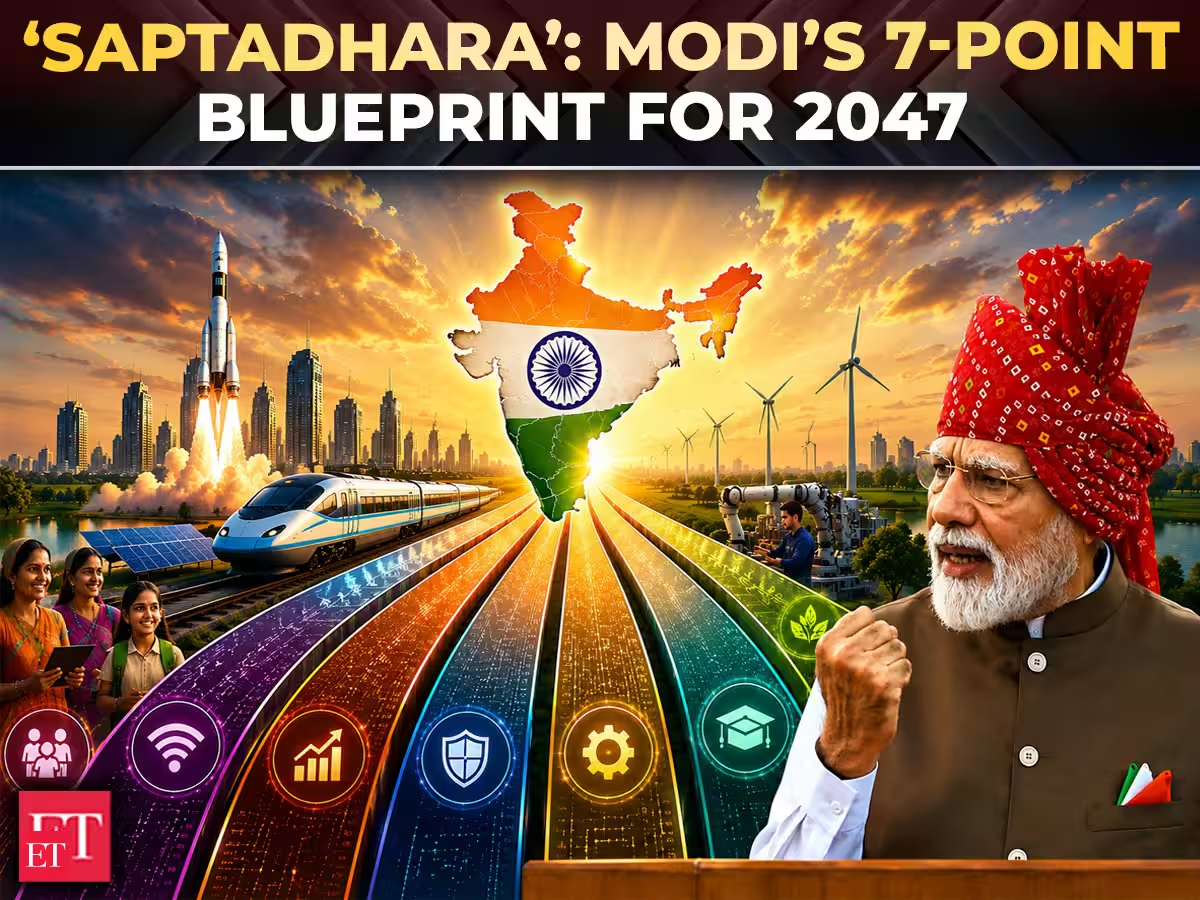
While there is general agreement that the term Viksit Bharat denotes a developed country, it is still necessary for public policy purposes to break down the concept to know what it entails.Follow us on GoogleAn Indian flag is pictured in the pocket of a police officer's uniform as he attends a rally in support of the Indian armed forces, following the ceasefire announcement between India and Pakistan, in New Delhi, India, May 13, 2025.(photo credit: Priyanshu Singh/Reuters)ByMOHAN KUMARAUGUST 15, 2026 13:34It is creditable that the Government of India has set a crucial goal for itself: becoming Viksit Bharat by 2047, its 100th anniversary of independence.While there is general agreement that the term Viksit Bharat denotes a developed country, it is still necessary for public policy purposes to break down the concept to know what it entails. What follows is an attempt to do soWhile India can be legitimately proud of being the fourth-largest economy in terms of Gross Domestic Product (GDP) in the world, the fact remains that for a population approaching 1.5 billion, the present GDP of $4.5 trillion is a little below par.So if India must become “Viksit” in the real sense of the term, the GDP must grow significantly to attain at least $10 trillion. This is entirely achievable if we can do a couple of things.India's Prime Minister Narendra Modi addresses his supporters during the launch of Gandhi Ashram redevelopment project in Ahmedabad, India, March 12, 2024. (credit: REUTERS/AMIT DAVE)First, 40% of our GDP is foreign trade, so our share of international trade must simply increase. In particular, our share of global exports, which hovers around 2%, should rise to 10%. Second, our Foreign Direct Investment (FDI), which was just short of $100 billion this last year, must also grow manifold.In order for the above two things to happen, the Government of India must carry out deep-seated economic reforms in areas such as land, labor, power, agriculture, infrastructure, and regulatory obstacles.While there is no question that the GDP must accelerate, that alone is not enough. Growth must be inclusive; it must percolate to the downtrodden people at the bottom of the pyramid.The government has conceived excellent schemes, such as the Pradhan Mantri Garib Kalyan Yojana. But going beyond that, job creation for the youth must become a national mantra for both the Central and State Governments.Since it is not possible for the government alone – or even the organized sector – to provide all the jobs that are necessary, it is vitally important to enable an ecosystem where the youth become entrepreneurs and job creators rather than be mere job seekers.Present levels of economic inequality are unsustainable, and efforts must be made to make the society much more egalitarian.It is well recognized that our education system relies heavily on rote learning, and it churns out thousands of graduates every year who may not be immediately employable. In this context, skilling and re-skilling graduates becomes crucial.The idea of vocational training, industry-academic collaboration and imparting tech skills (including AI) for our graduates must assume mission-mode importance.Spending on education – in both the public and private sectors – must increase exponentially, especially in states that lag the national average. In parallel, Research and Development must be given prime importance in all relevant institutions.A population close to 1.5 billion can indeed be a demographic dividend for India. But that is true only if the population is skilled enough to face the challenges of a knowledge economy.India’s healthcare system is undergoing dramatic transformation, driven by digitalization and by infrastructure expansion. But challenges remain on account of rising medical costs and a growing chronic disease burden.The government has undertaken significant efforts such as Ayushman Bharat and Ayushman Arogya Mandir schemes, which have made a big impact on providing healthcare in the country.Medical college seats have more than doubled since 2014 in an attempt to bridge the doctor-patient gap. Successful attempts have also been made to promote India as a global hub for medical tourism.Despite all this, serious challenges remain.Public spending on healthcare still lags desired levels. India also runs the risk of becoming the global capital for heart disease and diabetes.India therefore needs to continue its massive transformation of public health infrastructure to make it accessible, affordable, and quality-driven for the vast majority of its population.The National Health Mission is doing a commendable job. It simply needs to be strengthened and streamlined.India can follow a low-carbon pathway to a high-income economyIndia must not emulate the ways of either the industrialized countries that have followed a high-carbon pathway to development or indeed that of China, which even today burns more coal than the rest of the world put together. India is the only major economy today that potentially has the possibility of following a low-carbon pathway to a high-income economy based on sustainable development.And India must do it not just because the world wants it to, but because the people of this country deserve it as a matter of right.India is well positioned to become Viksit Bharat by 2047, but the country needs to be in mission mode, and a whole-of-government approach is required to make sure that no stone is left unturned in this national endeavor.By any reckoning, the next 20 years will be the most crucial period in India’s history.The writer is a former Indian ambassador to France and is currently dean/professor at O.P. Jindal Global University. His views are his own.Follow us on Google
Viksit Bharat 2047: India’s roadmap to become a developed nation | The Jerusalem Post
While there is general agreement that the term Viksit Bharat denotes a developed country, it is still necessary for public policy purposes to break down the concept to know what it entails.
904 words~4 min read