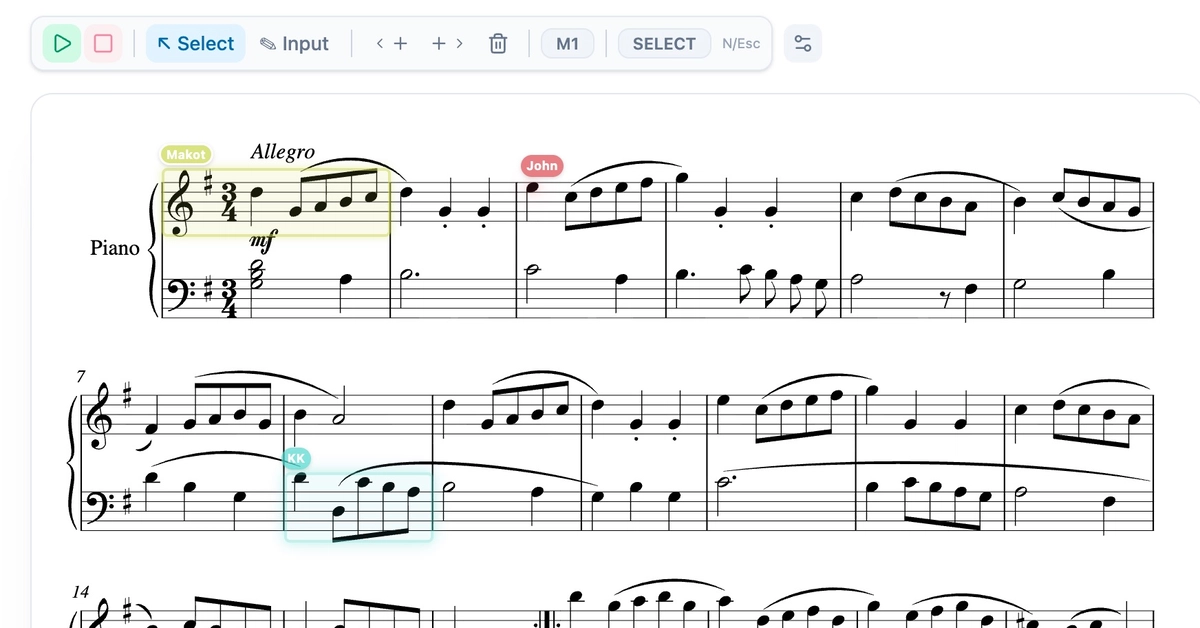
I wanted a "Google Docs for sheet music": open a browser tab, start writing notation, share a URL, and have someone else edit the same score with you in real time. Nothing like that existed. MuseScore, Finale, and Sibelius are all excellent, but they're desktop apps built for people who already know notation software inside out.
So I built ScoreTail, a browser-based score editor, mostly alone, with a lot of AI-assisted development. This post is about the parts that turned out to be genuinely hard: the MusicXML format, real-time collaborative editing over CRDTs, and rendering performance.
The AI-driven development bet
MusicXML is a huge spec — pitch, duration, voices, staves, backup/forward, divisions, ties, slurs, ornaments, tuplets, lyrics, chord symbols, dynamics, repeat structures. Implementing all of it solo, the traditional way, is a multi-year project.
Late last year I made a bet: let AI (Claude Code, ~90% of the code; Antigravity, ~10%) write most of the implementation, while I focused on defining what "correct" means — architecture decisions and test cases — rather than typing every line myself.