Cancer prevention opportunities are rare. When one presents itself safely during an operation a patient is already having, we have a responsibility to consider it.Dr. Joseph Sakran and Dr. Rebecca Stone
| Opinion contributorsShow Caption
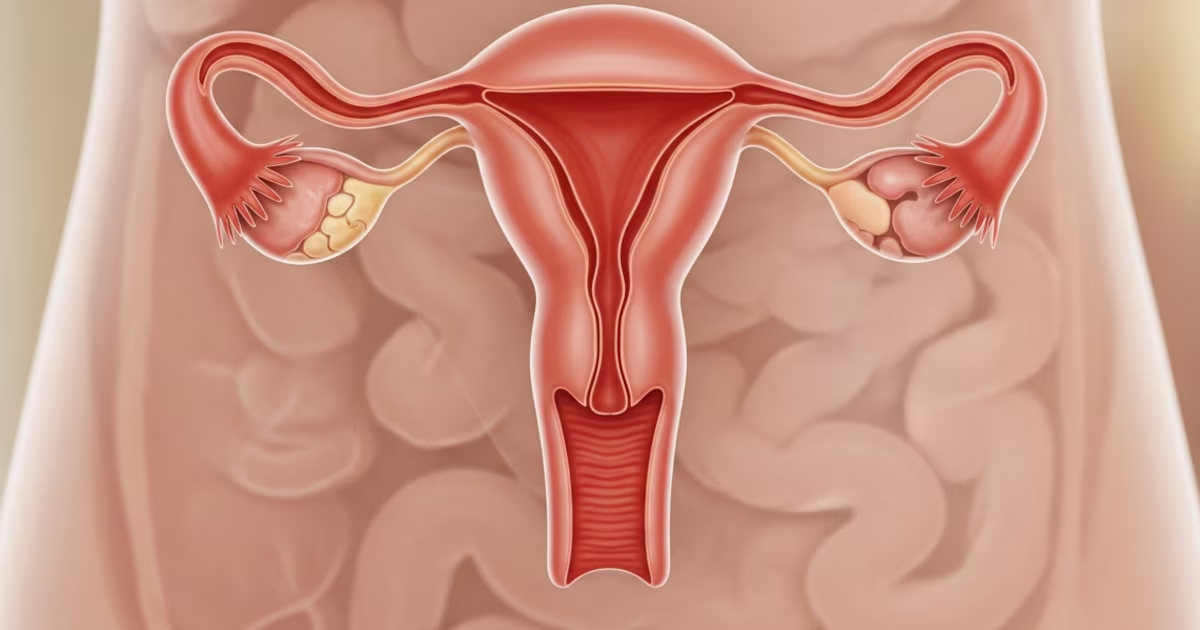
Two surgeons recently scrubbed in for the same patient. Her story appeared in The New York Times – one of the first times a national audience has seen what this choice looks like in an operating room.She had come in for a painful inguinal hernia. One of us, a general surgeon, repaired it. Then, at her request, the other, a gynecologic oncologist, removed her fallopian tubes.The first procedure relieved pain she already had. The second was chosen by the patient to proactively reduce her roughly 1% lifetime risk of a cancer long known as "the silent killer." It took a few extra minutes. But the small time investment represents one of the most consequential shifts in our approach to eliminating ovarian cancer.2 in 5 women are diagnosed with ovarian cancer only after an ER visitIn July, researchers writing in BMJ Oncology reported that 2 in 5 women are diagnosed with ovarian cancer only after symptoms become severe enough to require an emergency room visit.The ratio is alarming because it means that the window for early diagnosis had already closed. Women diagnosed in the emergency room face a threefold lower odds of having early stage, potentially curable disease.Many had felt unwell for months: bloating, abdominal pain, a constant need to urinate. The kind of vague, "ordinary" symptoms that women learn to dismiss month after month and year after year. The kind of symptoms that many doctors chalk up to chronic urinary tract infection or too much gluten. But for women ultimately diagnosed with ovarian cancer, these symptoms are the "calling cards" of a disease that has already spread to millions of tumors covering nearly every surface of the abdomen. It is instinctive to ask how we might catch this cancer sooner. For decades that instinct has driven serious effort: blood tests, imaging, large screening trials. None of it has lowered the death rate from ovarian cancer. This dead end is not a failure of effort but a mismatch between the tool and the disease.Here is what reset the compass. Many of the deadliest ovarian cancers do not begin in the ovary. They begin in the adjacent fallopian tubes, the narrow passages that carry an egg toward the uterus and that serve no known purpose once a woman has finished having children.We can outsmart ovarian cancer – by removing fallopian tubesPreventing ovarian cancer by removing the ovaries has always been possible in principle, but it exacts a heavy toll. The ovaries produce hormones that protect bone, heart and brain. Surgical menopause in a younger woman carries lasting costs – increased risk of fracture, heart attack and dementia with aging.Post-reproductive fallopian tube removal – called salpingectomy – does not require the same sacrifice. For a woman finished with childbearing, it means parting with a fertility organ that has no other known purpose, and it cuts her risk of the most common, deadly form of ovarian cancer by 50%. A 2026 cohort study from British Columbia reported an even larger reduction – close to 80% – for high-grade serous ovarian cancer, the deadliest and most common form.Removing the tubes during a hysterectomy, or in place of a tubal ligation, has become standard gynecologic care. The question is what happens outside the gynecologist's operating room.Every day, women electively undergo surgery for hernias, gallbladder disease and colorectal conditions when they are already under anesthesia and a surgeon is already in the abdomen. For women who have completed childbearing and who want ovarian cancer prevention, these operations could also be the moment to significantly lower the risk of a cancer that is now known to come from the fallopian tube, not the ovary, has no effective screening test and remains largely incurable.There are legitimate reasons why access to salpingectomy has not broadened beyond gynecology: Surgeons elsewhere may not be trained to perform it, the counseling takes time no one has budgeted and, until recently, the procedure could not even be billed properly.None of these is a scientific problem. They are problems of training, time and reimbursement – the ordinary machinery of medicine that determines whether a proven idea ever reaches a patient. These barriers are not trivial, but they are surmountable.Over the past five years, we have systematically worked on running down these problems. In this marathon, the time is nearing when the last mile will require surgeons across specialties to ask a second question before operating – not only how do we fix what brought this patient here, but what else can we offer her to thoughtfully and safely reduce her future risk of cancer. We can prevent ovarian cancer. Women deserve the option.This is something women should be able to choose, after a conversation most of them have never been offered. Cancer prevention opportunities are rare. When one presents itself safely during an operation a patient is already having, we have a responsibility to consider it.This movement has a name. Outsmart Ovarian Cancer – launched across Johns Hopkins Medicine, Memorial Sloan Kettering Cancer Center, Massachusetts Institute of Technology and MD Anderson Cancer Center, with support from Break Through Cancer and the American Cancer Society – has a single goal: making concurrent salpingectomy, the removal of the fallopian tubes during another planned post-reproductive operation, a routine and reimbursable part of care rather than an aspirational idea.The patient we cared for recently came in expecting relief from a hernia. She got that. She also left with the peace of mind knowing she faces a substantially lower lifetime risk of ovarian cancer. She will never know whether that decision was one that spared her. Neither will we.That is the paradox of prevention. Its greatest successes are invisible. No patient celebrates the heart attack that never happened. No family gathers to mark the stroke avoided. And no one is thanked for the cancer that never formed.Medicine has long measured itself by its ability to rescue people from disease. It should also measure itself by the disease that never occurs.For ovarian cancer, the only thing better than a cure is never needing a cure in the first place. The choice we've hoped to offer women is finally within reach. Making sure every woman has this choice to make belongs to all of us.Dr. Joseph Sakran, a general/trauma critical care surgeon and executive vice chair of surgery at Johns Hopkins Medicine, is a lead surgeon in the national Outsmart Ovarian Cancer campaign. Dr. Rebecca Stone, professor and director of gynecologic oncology at Hopkins, champions the Outsmart Ovarian Cancer campaign with Dr. Kara Long at Memorial Sloan Kettering Cancer Center.