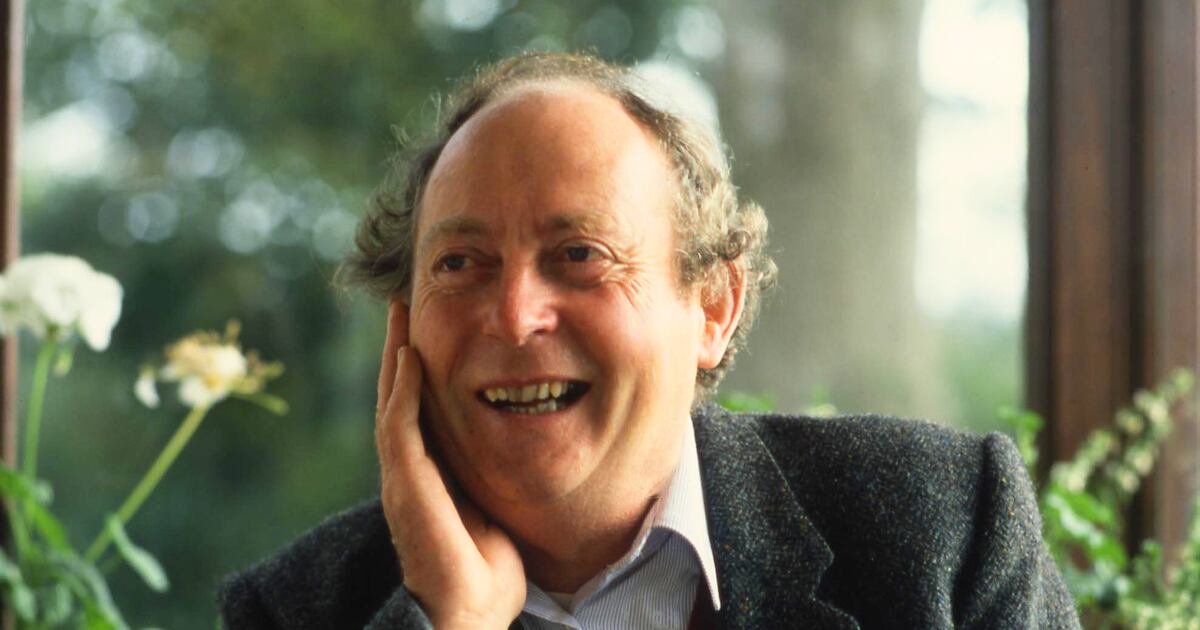
Leitrim writer’s archive features words of praise from Seamus Heaney, Brian Friel and Colm Tóibín, while Claire Keegan and Anne Enright also speak of his influenceJohn McGahern photographed near his home in Co Leitrim in 1990. Photograph: Frank Miller Eamon MaherSat Aug 15 2026 - 06:00 • 5 MIN READMany writers fade into oblivion shortly after their death, while a select few exert an even greater captivation on their readers. The latter applies to John McGahern, who died 20 years ago. As part of a College of Arts, Social Sciences and Celtic Studies fellowship at the University of Galway, I have been reading letters McGahern received from fellow Irish writers that are held within his literary archive at the university. The extent to which he was the quintessential writer’s writer is striking. For example, Nobel laureate Seamus Heaney, on October 21st, 1992, after reading McGahern’s Collected Stories, wrote: “And I just think I should reiterate to you also how your work makes us all carry our writing (and reading) heads a little higher. The book of stories is a real landmark.” Similarly, Brian Friel, in a letter dated April 11th (no year given, but most likely 1984), expressed his appreciation: “I’ve just finished The Leavetaking and still in the heat of the read want you to know how impressive I think it is. It was very right of you to return to the territory you staked out and claimed in the earlier books; because it is your territory where your unique memory-imagination become quickest.” The emphasis on place was a preoccupation of McGahern’s, as well as of Friel’s. Claire Keegan draws closely on her Wexford roots in works such as Foster (2010) and Small Things Like These (2020). Keegan has regularly been compared to McGahern and has cited his first novel, The Barracks (1963), as a vital book that taught her what good writing is. The raw realism the two writers deploy to describe various aspects of rural Irish life is a shared feature of their writing.Responding to a number of books that Colm Tóibín sent him to read, McGahern regularly exhorted the emerging writer not to stray from his native Enniscorthy, as when the novels moved to foreign settings they didn’t have the same authenticity. For his part, after reading That They May Face the Rising Sun (2002), Tóibín (8 February, 2002) acknowledges being amazed “by the sheer calm beauty of the sentences, but also by the fact that I cannot think of another book like it”. [ Claire Keegan: ‘I failed English in the Leaving Cert’Opens in new window ]He then makes the following observation: “I suppose the intensity arises from an overwhelming sense in the novel that something precious is now lost and that it can be recovered by being named and set down in ink, and thus the writing becomes a vital form of recovery.”For McGahern, “naming” and repetition constituted a kind of prayer and in this, his last novel, a paean to his beloved mother, he wanted to give thanks and to immortalise the glory of nature and the goodness to be found in people.Colm Tóibín sent a number of books to John McGahern for him to read. Photograph: Nick Bradshaw/The Irish Times On September 8th, 2005, Tóibín offered this enthusiastic response to McGahern’s Memoir in another letter, noting the importance of distinguishing between life and fictional representation: “The memoir throws great light on the novels, but the light is also thrown the other way. It is clear to anyone who has read your fiction and now reads this that these things have mattered to you in a way which is mysterious and unfathomable ...”Tóibín was clearly anxious to better understand McGahern’s particular aesthetic and perhaps how to emulate it. The Co Wexford writer is renowned in his own right and yet seems to place McGahern on a much higher plane than himself. Likewise, Donal Ryan admits to being a disciple of McGahern, although reading Amongst Women almost put paid to any aspirations he had to become a writer, as he explained in an article in The Irish Times.“How could a book be this good?” he said. “Existence is inchoate and incoherent and senseless. How could this representation of existence feel so resolved, so correct, so like it hadn’t been written at all, but alchemised from flesh to paper and ink; how could this Moran character have seared his mark so indelibly on my consciousness?”[ Donal Ryan: ‘I am a big ball of anxiety. I believe in myself as a writer, but nothing else’Opens in new window ]Many of us are relieved that Ryan persevered with his writing, as he has produced work that rivals that of any of his contemporaries.Writing in the New York Review of Books (2024) on the occasion of a new American edition of The Pornographer, Anne Enright hailed McGahern as “the pre-eminent Irish writer of his generation”, adding: “His voice could be lyrical, but it was bare of sentiment and sometimes somber ... A realist who rarely intruded himself upon the page, by the last he had erased himself entirely.” Anne Enright hailed John McGahern as 'the pre-eminent Irish writer of his generation'. Photograph: Dara Mac Dónaill/The Irish Times While recognising these wonderful literary gifts, Enright wondered as to the extent to which episodes in The Pornographer drew heavily on McGahern’s relationship with Joan Kelly in the 1960s, which resulted in the birth of their son Joseph in England. Of course, McGahern would argue that a writer should never stick closely to the facts, which is the job of a journalist, and should, rather, reimagine real-life events through the transformative lens of the imagination. Enright remains somewhat sceptical, however, writing: “It may be that the writer himself was unable to see what he had put on the page.” Finally, the Belfast writer Brian Moore wrote to McGahern on June 27th, 1990, to convey his admiration for Amongst Women: “It brought me back to my grandparents’ farm in Donegal in the 1920s, to the family Rosary and all those feelings country people have for the place they call home.” This shows how the customs and rituals of rural Ireland that McGahern delineated in his work assume a universal dimension: he succeeded in making of one place an everywhere, or certainly a place writers like Moore could identify with.The comments from this sample of Irish writers show the reverence McGahern inspired in them. Equally, when asked, he was prepared to offer advice, some of which could be cutting but it always came from a deep knowledge of what constitutes good literature. One of McGahern’s oft-repeated phrases that strikes a chord is: “I write to see and the seeing is through language.” By this he meant that writing was his way of understanding the world. If he continues to fascinate 20 years after his death, it is precisely because his vision still resonates with readers as well as with many of his fellow writers.Eamon Maher is co-editor, with Kathleen Costello-Sullivan, Derek Hand and Barry Houlihan of The John McGahern Companion, which has been published recently by Peter Lang.IN THIS SECTION
The Writer’s Writer: A dive into John McGahern’s literary archive shows his huge impact
Leitrim writer’s archive features words of praise from Seamus Heaney, Brian Friel and Colm Tóibín, while Claire Keegan and Anne Enright also speak of his influence
1,187 words~5 min read