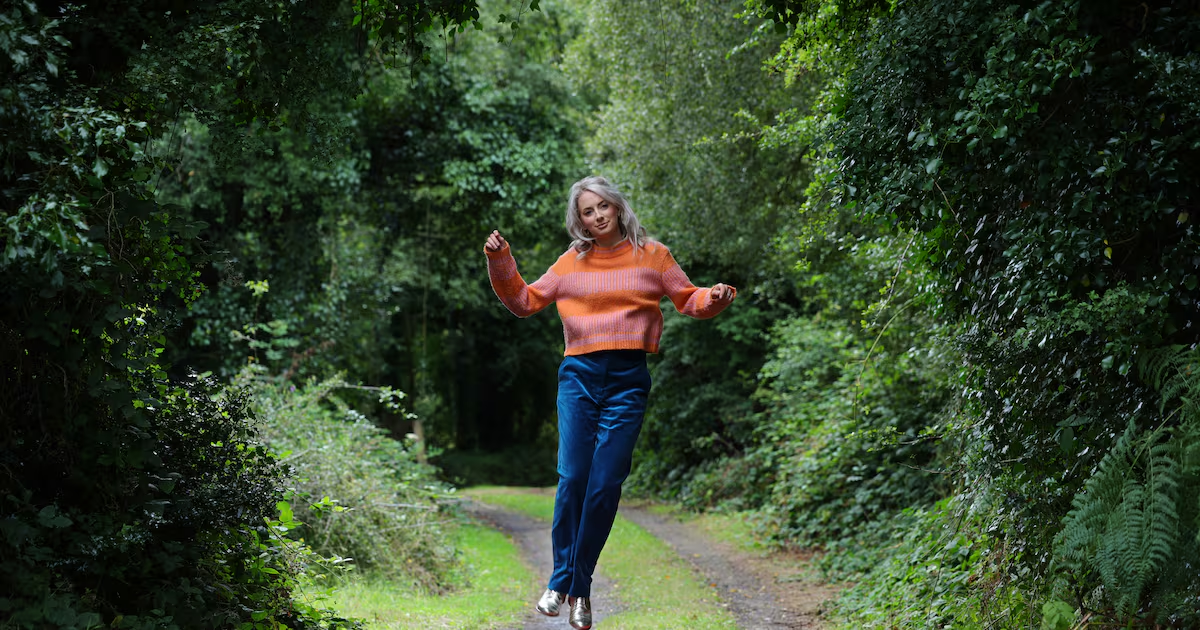
In the village of Drumsna in Co Leitrim, Edwina Guckian is dancing in her big sunlit kitchen. It’s for demonstration purposes, because I keep asking her questions about dancing and sometimes it’s easier for her to just to show me than to explain. She has lived here all her life, apart from a small period when she studied music and English and then pursued an MA in education in St Patrick’s, Drumcondra. Her brother is working with sheep (“escape artists”) in the field next door. Her aunt and uncle are the next house on the road. Her parents also live nearby.Guckian is the enthusiastic brain (and feet) behind The Devil’s in the Dancehall, an exhilarating, softly political dance event featuring the Gralton Band (led by singer Cathy Jordan and musical director Stephen Doherty), a host of professional dancers and actors re-creating an under-siege Irish dancehall in the 1930s with a script by Vincent Woods and a hall full of dancing punters. I experienced a version of it at the Róise Rua festival in Arranmore, off the coast of Donegal, in May.She was worried, she says, that that one was too early in the day. “We notice that people love to come in and dance when it’s dark out,” she says. “It’s amazing how the light affects people dancing. We spent a lot of time with our lighting man, Michael Cummins, designing lighting that’s really subtle and low so you can see, but you also can’t fully see. I think it gives people a freedom and confidence just to dance and move. And also, there’s that element of coming into a hall from the dark … There’s devilment there. You can cause trouble in the dark and leave again.”This is probably why the church had it in for the whole dance thing. Later she takes me down the road to the monument in the townland of Effrinagh where Gralton’s Hall once stood. This was created by Jimmy Gralton, who returned from the US to bring dancing and socialism to de Valera’s Ireland only to find himself being denounced from the pulpit, ostracised by much of the community and ultimately having his dancehall burned to the ground in 1932. Gralton was the only Irish-born person ever to be deported from Ireland. “He had acquired an American passport or visa [so] they said, ‘He’s an undesirable alien; he’s actually American.’ It’s just crazy, isn’t it?” This was the subject of Ken Loach’s film Jimmy’s Hall, on which Guckian worked as a choreographer. She had been obsessed with the story ever since she read the short book My Cousin Jimmy by her neighbour, Jimmy’s cousin Margaret Gralton, who her mother would drive to the shops and bingo. “It was black and white with Maggie Gralton, so this book is exactly black and white,” she says. “It’s factual. There’s no taking sides. And I remember reading that as a 12- or 13-year-old, going, ‘I can’t believe that nobody told me this story’.”It was an era with priest-led protests against jazz music, and a moral panic about the behaviour of young women. Dancehalls popped up all over the country – many lasting for decades but most now derelict or else housing cows or tractors. The music that was played there in the 1930s was a wonderful hybrid – recaptured by Guckian and her musicians – of traditional music and New Orleans jazz. “They’d play tunes like Yes! We Have No Bananas and they’d play the chorus, and go into ...” She sings the melody of a traditional reel. “They wouldn’t even bother with the verse.”The State published the Carrigan Report in 1931, ostensibly to formulate a legislative response to underage prostitution, but it also came to conclusions more generally about what was causing, in Guckian’s words, “the downfall of Irish society … The three main things that came out of that was: motor cars, dancing and dancehalls.” She thinks about that. “You know how it feels when you’ve got really good music and you dance and people are suddenly dancing closely and they never got the chance to dance closely?” So the establishment was right about the corrupting influence of dancehalls? She laughs. “They were.”When she was growing up nobody spoke about what happened to Jimmy Gralton, so she went out gathering stories from those who remembered him. “I used to ask all these questions as a child after reading that book, but it still felt like something you shouldn’t be talking about. When I got involved in the film, I still had some local people saying, ‘What are you doing getting involved in that? You shouldn’t.’” The Devil's in the Dancehall fuses a traditional dance hall with elements of theatre. Photograph: Enda O'Dowd Edwina Guckian hauls her stage, a door she uses to dance on. Photograph: Bryan O’Brien Her grandfather, Hughie Guckian, told her how businesses and families supportive of Gralton were boycotted, how people were said to have been cursed because of their association with Gralton and how Fr Joe Cosgrove denounced him from the altar and told people to throw mud and stones at his supporters. “He remembered standing there, seeing everyone just picking up sods of muck and dirt and throwing them at the Graltons.”When Edwina was asked to dance in the church on St Patrick’s Day, she could hear Hughie laughing from the back of the church. “Fr Cosgrove is rolling in his grave,” he said.[ Irish dancehalls then and now: reviving a cultural cornerstone in DonegalOpens in new window ]And yet, when she took Ken Loach and screenwriter Paul Laverty to see her grandad, he clammed up about the whole thing. “No, I don’t remember that now,” he said. She laughs. “I was fit to kill him … And he said, ‘Well, you know what, Edwina? I don’t know if I’ll meet Fr Cosgrove again or not some day.’ Fr Cosgrove still had control.” She sighs. “I’d love to go back and meet him and give him a good kick in the shins.”The Carrigan Report led to a law, the Public Dancehall Act of 1935, that required people to get a licence signed by local gardaí and a local priest if people were going to be dancing on their premises. “That made it illegal to gather people to dance anywhere without a licence, whether it was your home, a crossroads, in a barn, a field, a dancehall,” she says. “It killed house dances. There are ridiculous stories on the extreme side of things of the church coming in and throwing instruments in the fire. Imagine throwing a set of pipes or a fiddle in the fire.”That law is still on the books. Guckian and her collaborators play on this. They advertised some of the earlier Devil’s in the Dancehall events as “illegal”, recreating a modern version of some old Leitrim Observer articles in which Fr Cosgrove denounced the dancehall for being “a temptation of the flesh and a threat to the moral fibre of our youth”, adding that “where jazz is played, sin is never far behind.” Some people with far-right associations leapt on this, seemingly in agreement with the Leitrim Observer article of nearly a century before. Guckian and many other local artists had campaigned against an event in the area that they worried would become a platform for anti-immigration sentiment. “It was really horrible,” she says. “We have a really diverse community: people who have chosen to make Leitrim their home, and people who’ve had no choice but Leitrim has to be their home, and we’ve embraced all of them into our community as they have embraced us. So then when I started running the dance hall events and the illegal ‘No dance licence’ thing, [some people] turned on that. They tried to get it shut down.”From boxing priests to trotting foxes a look back at Ireland's dancehalls. Video: Enda O'Dowd Guckian dances in the sean-nós style, a field traditionally dominated by men, which involves a loose, improvised form of Irish dancing to accompany musicians at trad sessions. Sean-nós dancers, unlike those in the more common form of Irish dancing, follow their own instincts and feel free to swing their arms. “My family all danced and played music, so it was just there,” she says. “If somebody was playing in the kitchen you’d get up and dance with them for enjoyment, not a show-off kind of thing, and it’s just always been like that.”Edwina Guckian demonstrates sean-nós dancing near her home in Drumsna, Co Leitrim. Photograph: Bryan O'Brien Edwina Guckian demonstrates sean-nós dancing near her home in Drumsna, Co Leitrim. Photograph: Bryan O'Brien She is a spectacular dancer. When people see her perform, they often say: “Oh, my dad used to do that, but we always thought he was just drunk.” She laughs. “That freedom of them just randomly jumping out and dancing. Sometimes it’s in sessions where they might be playing themselves, and the music kind of gets too much for them, and they want to just dance.” It’s far less rule-bound than the Irish dance you might be more familiar with. “In sean-nós you haven’t a clue what you’re going to do, and when you’re finished you don’t know what you did.”When she’s teaching it to children she teaches is it as a series of discrete moves, “like Lego bricks” they can incorporate into a dance as they feel fit. She has seen children she taught to dance practising their steps in line in the local shop. Some of her older students are now dancers in the Devil’s in the Dancehall themselves. Sometimes in a chipper late at night she’ll meet a young adult she once taught and they’ll do a performative dance for her. “It’s all still in there,” she says.She’s interested in dance as a living tradition with roots in the past. She recently spent time in Donegal, at the aforementioned Róise Rua festival, interviewing older dancers about the lost steps of a dance called the Maggie Pickie. “There are 40-something steps at least. Joe McGuigan from Derry is the man who taught me. I have about 23 [of the steps] now.” McGuigan, she says, spent a lot of time trying to get steps out of one older woman who had been keeping them to herself. She laughs. “People are really possessive of steps.”Guckian believes our tradition of dancing for pleasure was stolen from us by a confluence of church and the State. “I got the Markievicz Award to research this, and the more documentation I started reading, the more a rage grew inside me,” she says. “And I’m not an angry person. All I could think of was that this is what my grandparents, particularly my grandmothers, were listening to, this crap being preached from the pulpit.” She could also see that people really want to dance. “When someone goes to a wedding … the next day you’ll say, ‘Well, how was the wedding?’ and they’d be like, ‘Great, the band were brilliant.’ They had a great night dancing.”When government tries to repress art, she says, it becomes clear that self-expression is a political act. And it’s political because it’s ultimately about collective joy and connection. Right now, she can see people have a strong desire to reconnect to community and reconnect to nature. “When you look at our folk customs and traditions, a lot of them come back to the land,” she says. Crossroads dances, for example, were often linked to the harvest. She and her neighbours have revived crossroads dances locally as well as the tradition of mummers and straw boys going house to house through the 12 days of Christmas – particularly, she says, to people who might be a little isolated.Edwina Guckian. Photograph: Bryan O’Brien Edwina Guckian's dance shoes. Photograph: Bryan O'Brien There are more Devil’s in the Dancehall events coming up in September and beyond, and Guckian is planning an installation in Carrick-on-Shannon based on her research. The local community is also fundraising to build a new dancehall on the site of Gralton’s original. They should have drawings from the architect soon. It’s a mark of the latent power of the church that she has heard that at least one person has vowed, already, never to dance there.[ Dancehall days: ‘He asked me to dance. Now we’re married 42 years’Opens in new window ]But Guckian loves to dance and wants everyone to discover the joy of it. “Being able to just move freely and not care, that’s what [The Devil’s in the Dancehall] is designed for,” she says. “It’s so lovely. And it’s such a selfish project. I want to dance to this band. I want to just dance and not care and have loads of people dance and not care. So basically, I’m throwing my own party for me every night. I have the time of my life.”Edwina Guckian will be joined by 14 traditional musicians and dancers for a celebration of Lúghnasa for all ages at Burton’s field (adjoining St Patrick’s National School in Curtlestown) as part of the Shaking Bog festival in Co Wicklow on August 23rd at 1.30pm. shakingbog.ieThe Devil’s in the Dancehall tour begins in Cork this September, visiting Bere Island before heading to Cork City Hall for Culture Night. From there it travels to old dancehalls in Kerry, Mayo, Roscommon, Limerick, Offaly, Kildare, Clare, Galway and Sligo. For full tour details, see edwinaguckian.com
‘People say: my dad used to do that. We always thought he was just drunk’: The revival of sean-nós dancing around Ireland
Dancer and choreographer Edwina Guckian on The Devil’s in the Dancehall, how angry her research into the show made her, and the liberation of dance
2,231 words~10 min read