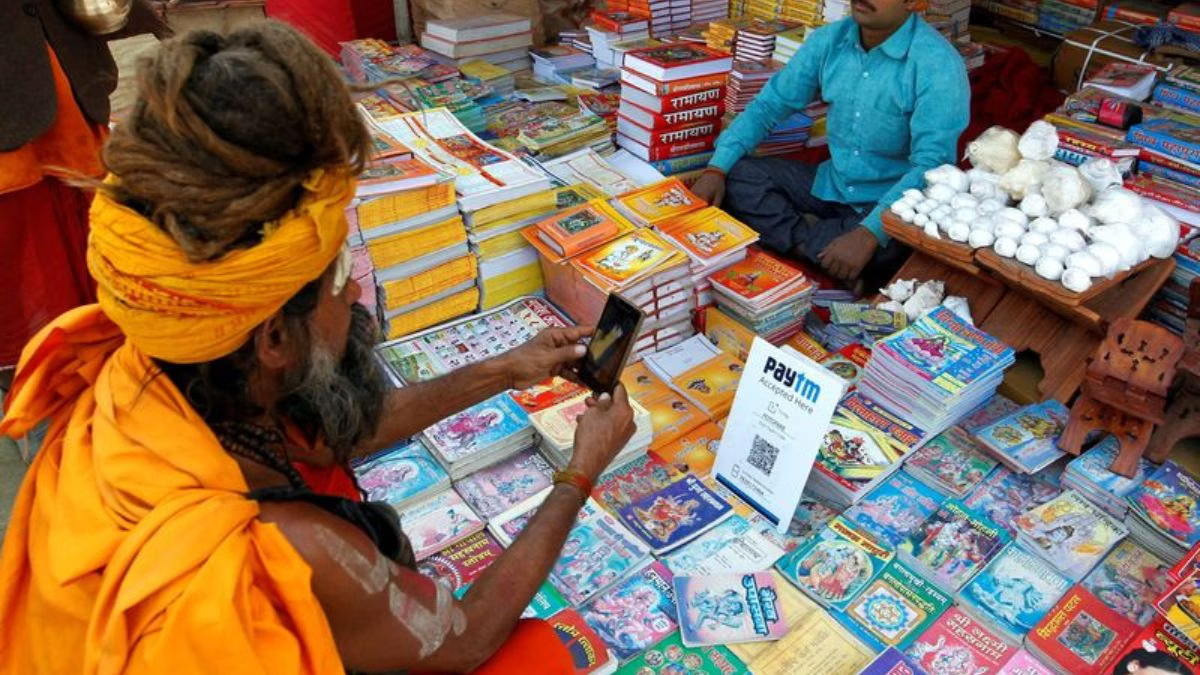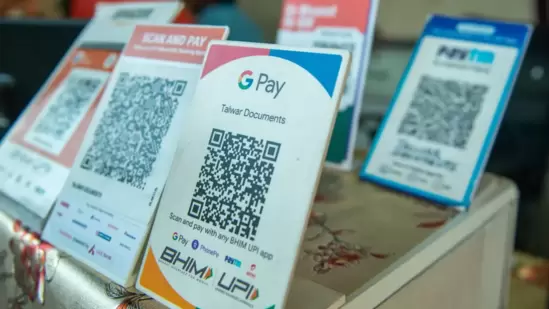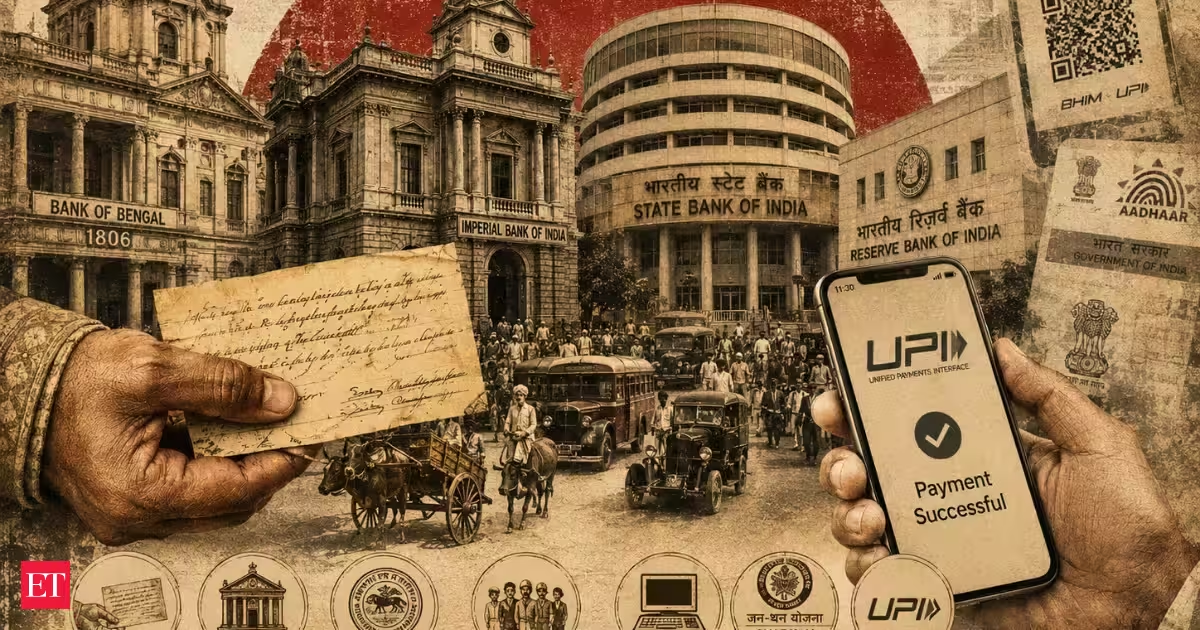
Today, a QR code can move money across hundreds of kilometres with a few taps on a phone. As India enters its 80th year of Independence, that simple transaction is the latest chapter in a centuries-old story of how money has travelled across distance.Go back several centuries. Somewhere along India’s sprawling trading routes, a merchant needs to send money to a distant town. There is no bank to walk into, no machine to withdraw from, no electronic network waiting to carry the payment. And yet, the money can move. A hundi — passed through a trusted network of merchants and bankers — carries the instruction to pay, allowing value to cross hundreds of kilometres without the coins themselves travelling with it.Also read: 79 years of an India on the rise as its households dream biggerThe two transactions could hardly look more different. One happens in seconds on a screen; the other depends on paper, people and reputation. But the economic algorithm is remarkably similar: how do you move value across distance without physically moving the money itself?For centuries, India has kept finding new ways to answer that question. The journey has run from hundis and indigenous bankers to colonial banks, nationalised branches and electronic transfers, and eventually to debit and credit cards, ATMs and UPI [Unified Payments Interface].Before banks, India already had a financial networkA hundi was not simply an old-fashioned piece of paper. The Reserve Bank of India describes it as a credit instrument that evolved in India and says its use was most widespread in the 12th century, continuing into modern times. Hundis served three purposes: remitting funds from one place to another, borrowing money as credit instruments, and financing trade as bills of exchange.They came in different forms. A darshani hundi was payable on presentation, while a muddati hundi was payable after a stipulated period or on a specified date. A jokhami hundi tied payment to the safe arrival of goods. The system worked because the instrument was backed by networks of merchants and indigenous bankers who understood one another's credit and reputation.ET OnlineHundis: India's earliest remittance systemHistorian Tirthankar Roy places such financial arrangements within a much larger commercial economy. His An Economic History of India 1707–1857 examines the transition from the late Mughal economy through the rise of British power, including the evolution of markets, commerce and indigenous economic institutions. His later work, The Economic History of India, 1857–2010, follows that transformation through colonial rule and the post-Independence period.Also read: Sabse bada rupaiyah! The rupee's journey to becoming truly IndianClaude Markovits, in The Global World of Indian Merchants, 1750–1947, takes the story closer to the merchants themselves. His research on trading communities such as the Shikarpuris examines how Indian merchant networks operated across borders, moved capital and maintained business relationships far from their home bases.The hundi was not an early version of UPI. But it addressed a problem that has survived every technological revolution: getting money from one place to another without making the cash itself undertake the journey.Then the British began building another financial architecture alongside these indigenous systems.The Bank of Bengal was established in 1806, followed by the Bank of Bombay in 1840 and the Bank of Madras in 1843. The three Presidency Banks were amalgamated in 1921 to form the Imperial Bank of India.The next institutional shift came on April 1, 1935, when the Reserve Bank of India began operations under the RBI Act, 1934. Its original responsibilities included regulating banknote issue, maintaining monetary stability and operating the country's credit and currency system. The RBI was nationalised on January 1, 1949.By 1947, India had two financial histories running alongside each other: indigenous networks of credit and remittance, and a formal banking system that had grown under colonial rule.ET OnlineColonial banking takes shapeThe republic takes banking to the massesAfter Independence, the question changed. It was no longer only about how money moved; it was also about who could enter the system through which it moved.The Imperial Bank was transformed into the State Bank of India in 1955. Then, on July 19, 1969, the government nationalised 14 major commercial banks. Six more were nationalised in 1980. The RBI records that at Independence India had 97 scheduled private banks, 557 non-scheduled private banks and 395 cooperative banks.The physical expansion that followed was enormous. RBI data show that bank branches increased from 8,262 in 1969 to 59,752 by March 1990. The central bank describes the 1970s and 1980s as a period of phenomenal expansion in the banking network across the country.The Lead Bank Scheme, Regional Rural Banks and priority-sector lending were part of that wider effort to take formal finance into rural areas and towards sections that had historically had limited access to institutional credit.ET OnlineBanking reaches the massesBut the bank branch was still the centre of the transaction. If money had to move, someone often had to walk into a branch, fill out a form, hand over a cheque or wait for paper to move between institutions.Then the systems began to change.Also read: 79 years of work, ambition and the making of modern IndiaWhen the money stopped needing paperThe transition to electronic payments came in stages.The RBI's electronic funds-transfer systems emerged in the 1990s. RTGS [Real-Time Gross Settlement] went live on March 26, 2004, initially for inter-bank transactions; customer transactions were opened up shortly afterwards.NEFT [National Electronic Funds Transfer] followed in November 2005, giving bank customers a nationwide electronic mechanism for transferring funds. The Payment and Settlement Systems Act, 2007 then gave India a statutory framework for regulating payment systems.NPCI [National Payments Corporation of India] was incorporated in 2008 as an umbrella organisation for India's retail payment systems. IMPS [Immediate Payment Service] followed in 2010, bringing immediate, round-the-clock interbank fund transfers to multiple channels.The significance of these changes was easy to miss because payment infrastructure is largely invisible. But each system removed another physical barrier between the payer and recipient.ET OnlineFrom paper to electronics paymentsStill, there was a problem.Digital payments could not become truly mass-market unless people had bank accounts to pay from.The next layer of India's financial infrastructure addressed exactly that.The Pradhan Mantri Jan Dhan Yojana was announced on August 15, 2014 and formally launched on August 28 that year, with the aim of expanding access to basic banking, deposits, remittances, credit, insurance and pensions.By July 22, 2026, official PMJDY data showed 58.84 crore beneficiaries, with ₹3.11 lakh crore deposited in their accounts and 41.01 crore RuPay debit cards issued.ET OnlineFinancial inclusion builds the foundationAadhaar added a digital identity layer. Mobile connectivity provided the access point. Together, Jan Dhan, Aadhaar and mobile — the JAM architecture — created conditions in which financial services and government transfers could increasingly move digitally.And then came UPI.Then money became instantNPCI's UPI was launched on April 11, 2016, with then RBI Governor Raghuram G Rajan conducting the pilot launch in Mumbai. Twenty-one member banks participated in the pilot. NPCI described UPI as a common platform for immediate push and pull payments, allowing users to connect multiple bank accounts through a single interface.The system was built on what had come before it. IMPS provided the immediate-transfer foundation; banks provided the accounts; mobile phones provided the interface. UPI added interoperability, allowing participating bank accounts to communicate through a common payments layer.The first version of UPI was modest compared with what followed. By August 25, 2016, UPI-enabled apps had begun appearing on the Google Play Store.A decade later, the scale is difficult to ignore.UPI processed 23.66 billion transactions worth ₹29.88 lakh crore in July 2026, according to NPCI data reported by The Economic Times.ET OnlineThe UPI revolutionBut the remarkable part is not simply the number of transactions. It is how much invisible infrastructure sits underneath a payment that takes seconds: bank accounts, branches, identity, mobile connectivity, electronic clearing, settlement systems, common standards and a national retail-payments network.That is why India's UPI story does not begin in 2016.It begins with the merchant who could settle a distant payment through a hundi. It runs through indigenous bankers and trading networks, through the Presidency Banks and Imperial Bank, through the RBI and the expansion of formal banking after Independence. It passes through nationalisation, rural banking, electronic funds transfer, RTGS, NEFT and IMPS before arriving at Aadhaar, Jan Dhan and the smartphone.The hundi disappeared from everyday transactions. The problem it solved did not.The technology kept changing. The economic question remained the same: how to make value move safely, reliably and across distance — until, eventually, India made it possible with a tap.
Independence Day 2026: The road to UPI — India’s payments revolution was centuries in the making
Indias payments ecosystem has evolved dramatically, from hundis and merchant networks that moved value across long distances to formal banking, electronic transfers and the digital infrastructure behind UPI. Each technological leap solved the same fundamental challenge: enabling money to travel securely and efficiently without physically moving cash from one place to another.
1,415 words~6 min read