Story audio is generated using AI
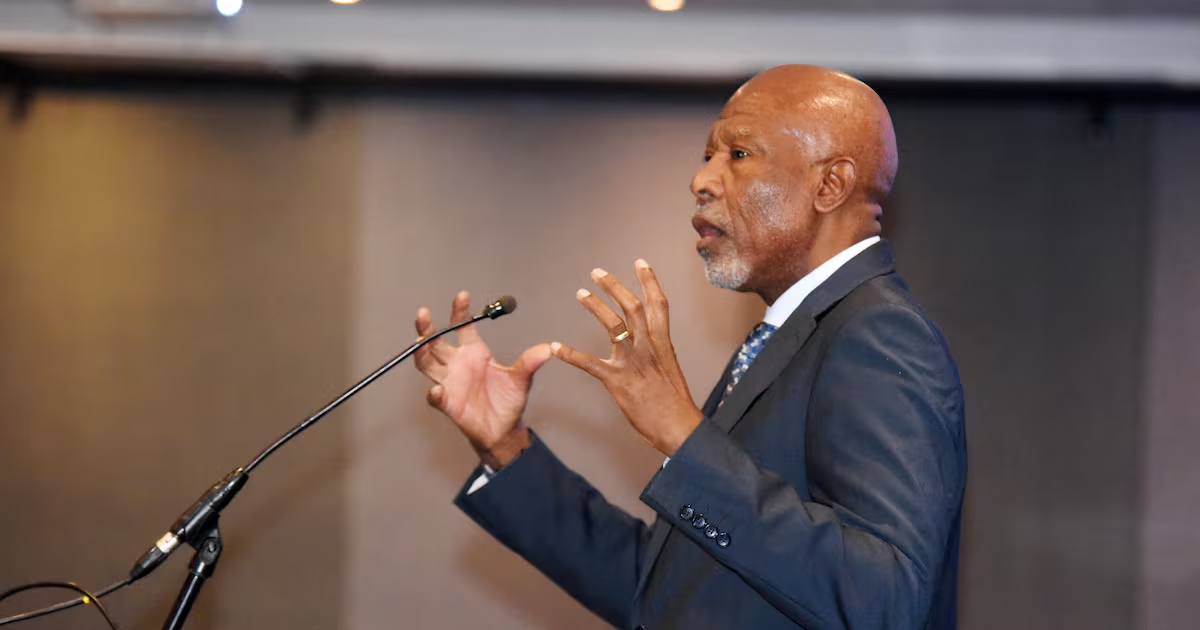
The Payments Association of South Africa’s (Pasa) wide-ranging powers, predicated on the notion of self-regulation and managing its members and the clearing activities within the national payment system, will soon come to an end as the South African Reserve Bank (SARB) moves to reduce the use of cash-estimating reforms.Historically focused on price and financial stability, the central bank under govenor Lesetja Kganyago has streamlined its strategic focus areas to include payment system development as one of its top priorities.The Reserve Bank’s 2030 strategy elevates payments to a core pillar, alongside price and financial stability, with the custodian of South Africa’s monetary policy estimating that faster, cheaper digital payments could trim the economy’s R30bn annual cash management costs and widen access to underserved households and businesses.This strategic pivot will bring an end to Pasa’s hegemony over the national payment system, in its 30th year of existence. To this end, the Reserve Bank this week notified the market that it will from next month cease to recognise the entity as the payment system management body (PSMB).“Structural and operational challenges associated with the PSMB model necessitated the SARB’s decision to withdraw the recognition of the Pasa as a PSMB,” the notice reads.“This notice serves to inform stakeholders that the recognition of Pasa as a PSMB will be withdrawn, effective 2 September 2026, and to communicate the transitional arrangements that will apply to the authorisation and registration of payment clearing house system operators, system operators, and third-party payment providers.”Pasa, led by Ghita Erling, was established in 1996 and recognised as a PSMB three years later. The association operates as a non-profit funded by its members, which are the country’s banks, with a mandate to organise, manage and regulate members’ participation in payment systems in a safe and efficient way.Rule-making in the national payment system, the backbone of South Africa’s economic activity, will move mainly to the Reserve Bank and PayInc, while licensing, authorising and registering payment institutions will move to the Reserve Bank.The central bank owns 50% of PayInc, an automated clearinghouse. The remaining 50% is collectively held by participating commercial banks, including major legacy shareholders alongside newly subscribed direct bank shareholders.PayInc is the provider of PayShap, the immediate digital payment platform used by most of South Africa’s largest banks.Arif Ismail, head of the national payments system department at the Reserve Bank, said the institutional reform is crucial for establishing a new balance in the country’s payment system. “Historically, SARB issued high-level directives and policy frameworks, while day-to-day scheme operation, rule-making and ecosystem co-ordination were handled by industry bodies. While this structure served a stable, bank-centric environment, it is no longer suited to an era where digital payments must reach all South Africans, particularly those who remain underserved or unserved and rely heavily on cash,” Ismail said.“This shift is not about eliminating cash. SARB’s vision is a cash-smart society, where cash remains available but is no longer the primary instrument for daily transactions. Heavy cash usage is costly, inefficient and limits inclusion. Widespread digital adoption has the potential to increase GDP by 0.5%, a material impact in a low-growth economy.”This shift is not about eliminating cash. SARB’s vision is a cash-smart society, where cash remains available but is no longer the primary instrument for daily transactions.— Arif Ismail, head of the national payments system department at the Reserve BankPasa, in its latest annual report, hints that withdrawal of its PSMB status might not signal the end of the body through acknowledging that the report was prepared in the context of significant change within South Africa’s payments ecosystem and uncertainty regarding the association’s future institutional role.“Pasa was tasked by its members to explore this future role, drawing on international benchmarking and extensive stakeholder engagement, without presupposing a single outcome,” it said.Some of the scenarios Pasa is exploring include:A stand-alone, private-sector payments association;Integration of payments co-ordination into an expanded financial-sector association model;A more fragmented representative landscape, with multiple bodies serving different constituencies; andCloser institutional alignment with PayInc, recognising its emerging role as the National Payments Utility.Business Times