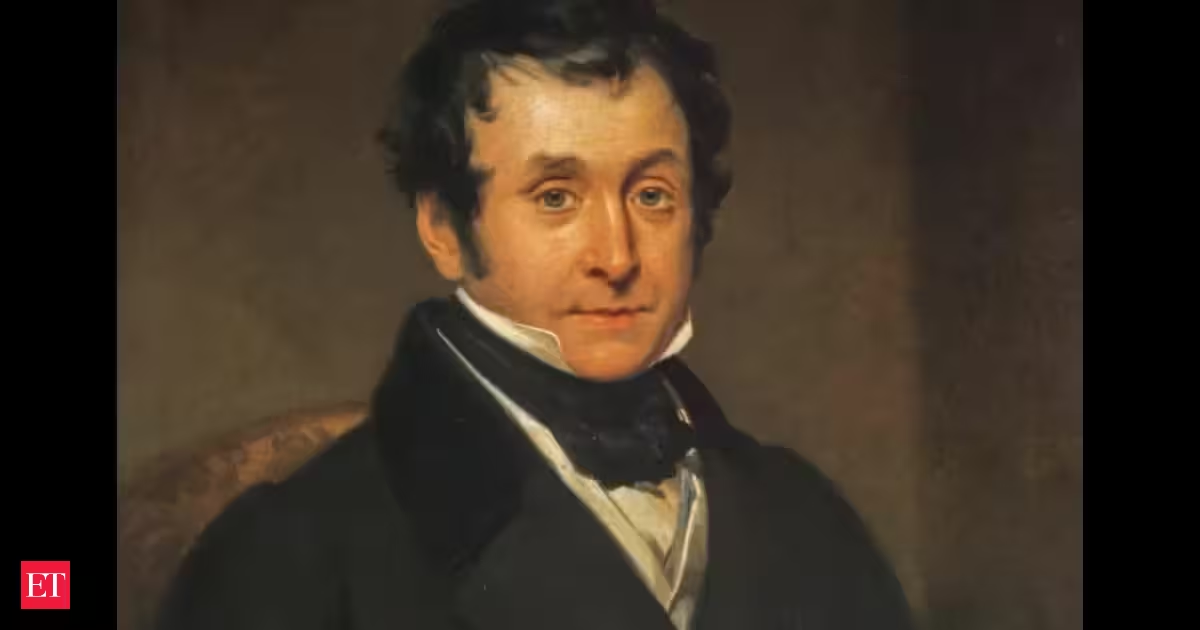
A person may be gone from your daily life, yet somehow still be present in the smallest things. A familiar song can bring back someone you lost. An old photograph can suddenly make a distant moment feel close again. Sometimes, a lesson taught years ago quietly shapes a decision you make today. It raises a difficult question: What remains of a person after they are no longer here?Perhaps it is not only their possessions, photographs or achievements. Sometimes, what survives is far less tangible: a memory, a kindness, a story, or an influence carried forward by someone else. That enduring idea lies at the heart of today’s quote by Scottish poet Thomas Campbell.Quote of the Day by Thomas Campbell: “To live in hearts we leave behind is not to die.”Also Read: Quote of the Day by 'Goodnight Moon' author Margaret Wise Brown: ‘Quietness is an essential part of all awareness. In quiet times and sleepy times, a child can dwell in thoughts of his own…’Why Thomas Campbell’s quote on love and remembrance matters todayPeople are constantly encouraged to measure their lives through achievements, followers, photographs and public recognition. Campbell's words point toward a quieter form of permanence. A person's influence does not necessarily disappear when their life ends. It can continue through the people they loved, the values they taught and the memories they left behind.This idea is especially relatable when someone loses a parent, friend, partner or mentor. Grief often changes the relationship rather than simply ending it. The person may no longer be physically present, but their words, habits and influence can remain part of everyday life. A familiar expression, a recipe, a piece of advice or even a particular way of looking at the world can keep someone emotionally present.What Thomas Campbell’s quote means in real lifeCampbell's line suggests that death does not necessarily erase a person's presence from the lives of others. Someone can continue to "live" through memory and influence. The people we encounter leave impressions on us, sometimes without realizing how deeply those impressions will last. Their presence can become part of who we are.That does not mean grief disappears. Remembering someone can sometimes make their absence feel even sharper. But memory can also become a form of connection. The way a person treated others, the things they taught and the moments they shared can be carried forward. In that sense, a life can continue to have meaning through the lives it has touched.Who was Thomas Campbell?Thomas Campbell was a Scottish poet born in Glasgow in 1777, the youngest son of Alexander Campbell. His family had links to the Campbells of Kirnan in Argyll, while his father was involved in a Glasgow trading firm with interests in Virginia. The family suffered financial losses following the American Revolutionary War.Campbell showed an early talent for classical studies and poetry. He studied at Glasgow High School and the University of Glasgow before moving to Edinburgh in 1797. There, he supported himself through private teaching and writing and became acquainted with several prominent intellectuals and writers of the period, including Sir Walter Scott and Francis Jeffrey.His major breakthrough came in 1799, when The Pleasures of Hope was published. The poem became an immediate success and established Campbell as a significant literary figure in Britain. His early reputation was considerable, with figures such as Lord Byron and Francis Jeffrey ranking him highly among contemporary poets.Campbell later traveled through continental Europe, where he wrote or developed several of his best-known poems and lyrics, including Hohenlinden, Ye Mariners of England and The Soldier's Dream. He also wrote The Exile of Erin and The Battle of the Baltic.Thomas Campbell’s legacyCampbell's literary reputation changed considerably during his lifetime and after his death. His patriotic poems were once among his most celebrated works, but changing attitudes toward nationalism, empire and political culture contributed to his gradual decline in prominence. Although he was briefly reevaluated in the 20th century, he is now generally regarded as a less central figure in the British poetic canon than contemporaries such as Wordsworth, Coleridge, Byron and Scott.Yet Campbell's work has not disappeared entirely. His poetry continues to be remembered for its memorable language, patriotic themes and emotional treatment of war, loss and human experience. His connection to political causes was also significant. His sympathy for Poland, particularly after the Russian capture of Warsaw in 1831, led him to help establish the Literary Association of the Friends of Poland in London.Campbell also made contributions beyond poetry. He edited The New Monthly Magazine, produced Specimens of the British Poets and played an active role in the development of the University of London. He served as Lord Rector of Glasgow University from 1826 to 1829, defeating Sir Walter Scott in the election.His later years were marked by personal tragedy and declining health. His wife died in 1828, one of his sons died in infancy, and his other son suffered severe mental illness. Campbell increasingly withdrew from public life and died in Boulogne in 1844. He was later buried in Westminster Abbey.
Quote of the Day by Thomas Campbell: ‘To live in hearts we leave behind is not to die’ - Scottish poet’s powerful words about love, loss and the people we leave behind
Thomas Campbell's quote is on living on through memories and influence. His words suggest that a person's presence continues after their physical departure. This idea resonates deeply when experiencing loss and grief. Campbell, a Scottish poet, achieved significant literary recognition in his time. His legacy includes patriotic poems and contributions to education.
839 words~4 min read