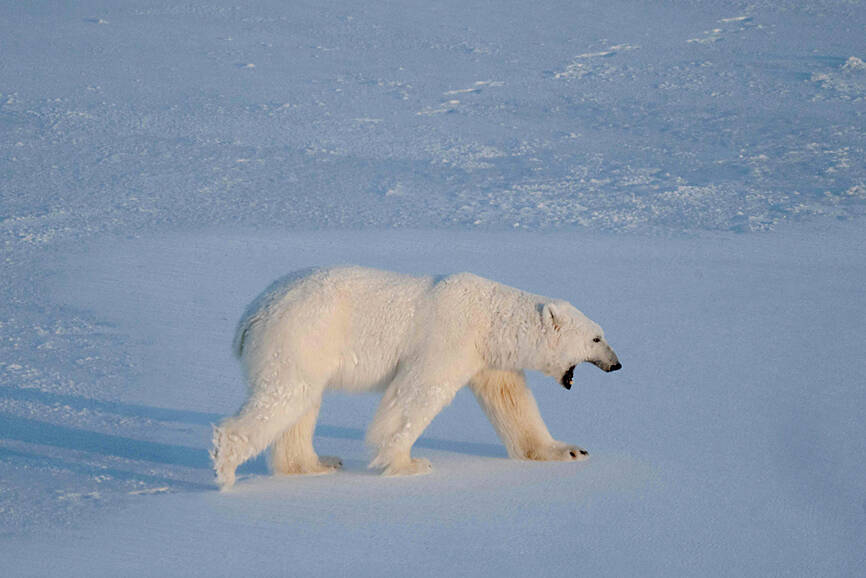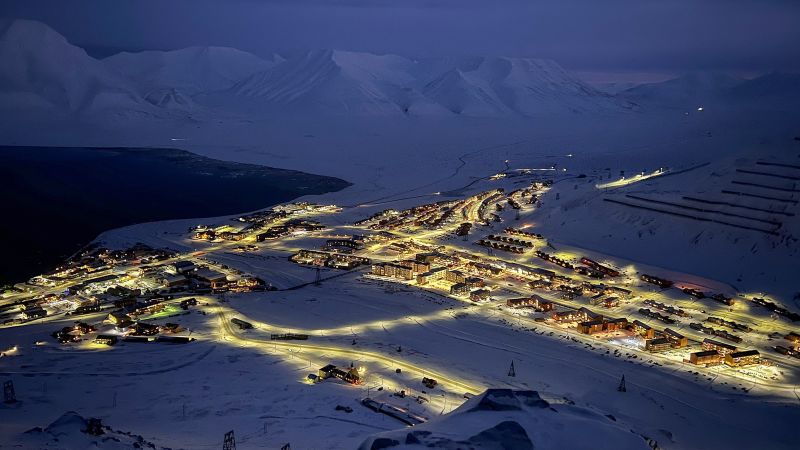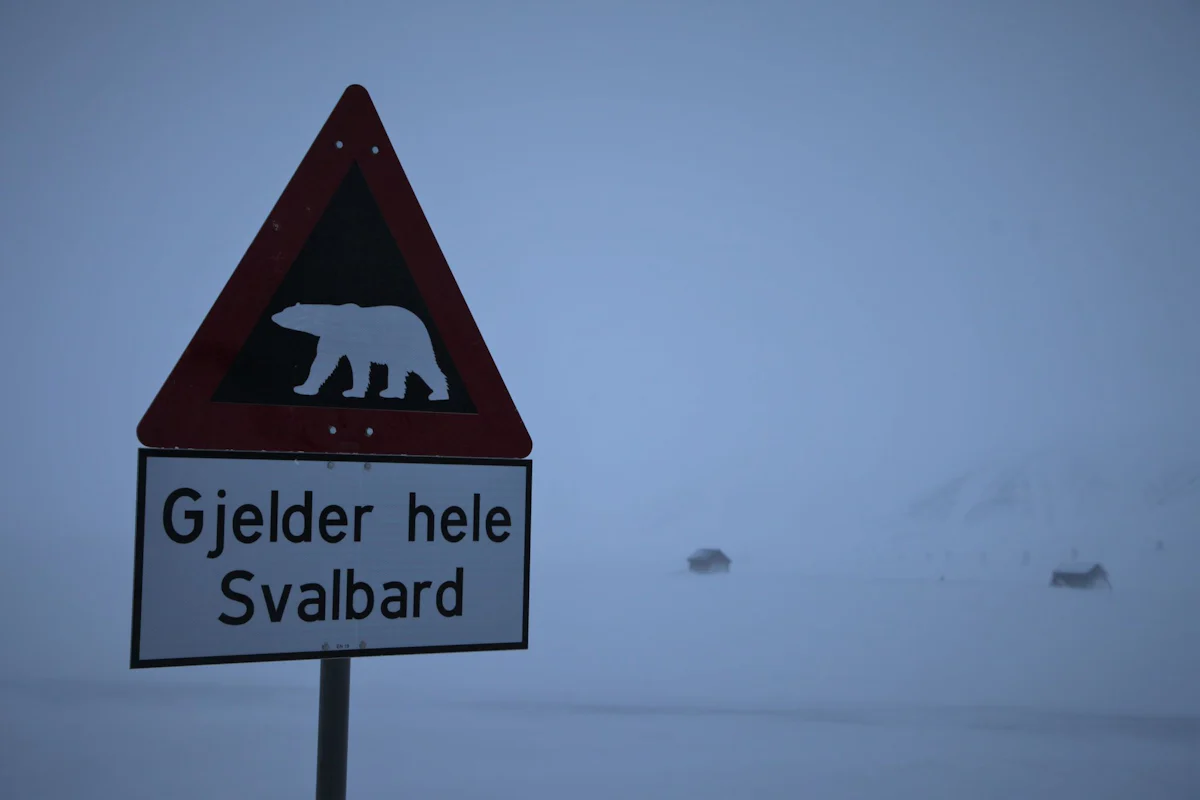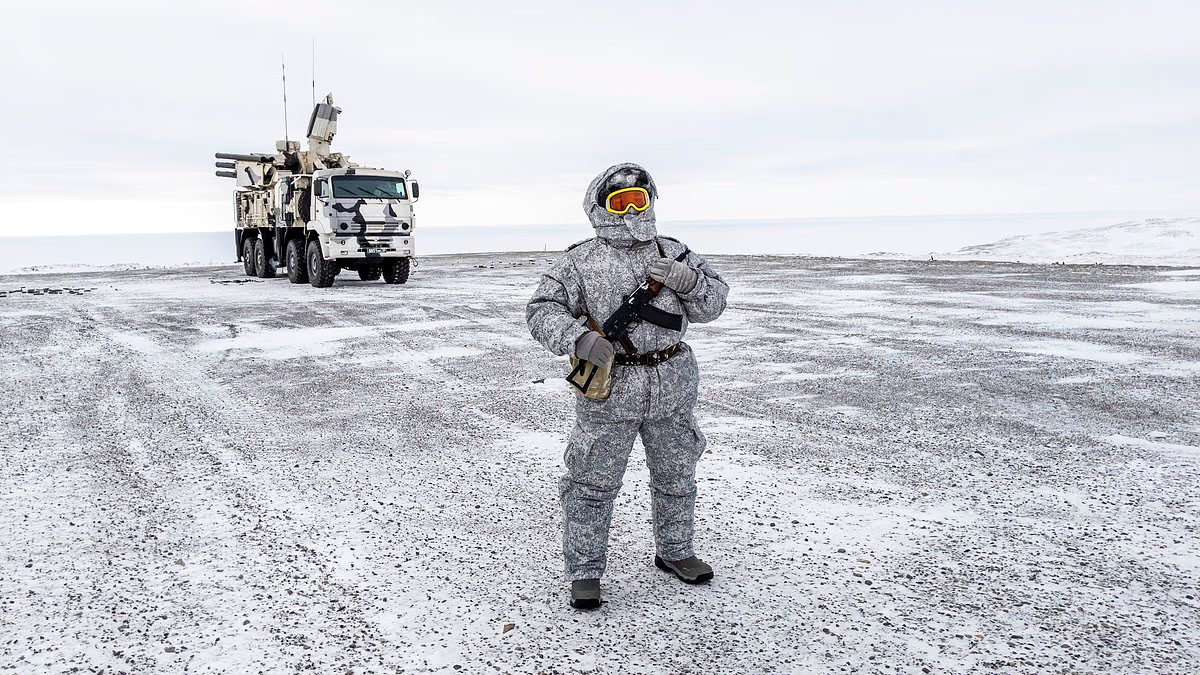
On Spitsbergen there are so many polar bears that it’s against the law to leave town without carrying a gun.The only inhabited island in the Svalbard archipelago, Spitsbergen is Norwegian territory.But 30 miles from its capital, Longyearbyen (population 2,000), lies the town of Barentsburg, which is home to a community of Russian miners.There the Moscow-owned Arktikugol company oversees a desultory coal-mining operation. The coal it produces is poor quality, and the cost of extracting it high, but the mine provides an invaluable excuse for the Kremlin to maintain a unique toehold within a Western sovereign territory.And in the months and years to come I predict that this obscure Arctic outcrop, 800 miles south of the North Pole, will play a key role in Russia’s plan to destabilise the Nato alliance.Spitsbergen may be a burgeoning tourist destination – it has its own annual music festival – but it could also serve as the flashpoint that sparks World War III.Steady on General, I hear you say. But we only have to look back at the recent history of Russian aggression to see how such a disaster could play out.Before the annexation of Crimea in 2014 and the invasion of Ukraine eight years later, Vladimir Putin staged attacks by mercenaries and special forces against Russians living in those regions. He then declared that, to protect these people, he had no option but to order military intervention. Longyearbyen, in Spitsbergen, lies in Norwegian territory and has a population of 2,000 Thirty miles from Longyearbyen lies Barentsburg, home to a community of Russian miners General Sir Richard Shirreff spells out the arctic threat that could come from SpitsbergenThis is just the sort of justification he will use for seizing Spitsbergen. He will claim Russian miners are under attack by their Norwegian neighbours and need protection.To make the lie more credible, and to give his armies of social media trolls some material to help give credibility to their fake reports, he will make sure the miners really do come under attack.And on a frontier Arctic island where everyone has a gun, some will probably be killed.A small, well-rehearsed, Russian airborne operation, involving special and maritime forces will take control of Spitsbergen within a few hours and martial law will be imposed immediately.The question then is – what does Nato do?The simmering conflict between Nato and Russia is now at its most volatile for decades. Last week, after a drone laden with Semtex explosives was discovered close to a cargo plane at Germany’s Leipzig airport, Western surveillance sources warned that Russia is planning a series of attacks to test Nato’s resolve.This echoes warnings from the American intelligence network to their counterparts in Britain’s security services earlier this month that the Baltic states are under threat.Putin is not bluffing. With his back to the wall after more than four years of war in Ukraine, and with domestic discontent growing, he is desperate for ways to cling to power. A soldier holds a gun as he patrols the Russian northern military base on Kotelny Island in the Arctic in 2019 Last week, a drone laden with Semtex explosives was discovered close to a cargo plane at Germany’s Leipzig airportFull-on war with Europe will help him in two ways – by undermining our determination to support Ukraine and by uniting the Russian people against a common enemy, Nato.The Baltic countries, which share a 600-mile border with Russia and its vassal state Belarus, are understandably nervous.Lithuanian defence minister Robertas Kaunas warned this week that Moscow is planning ‘false flag’ attacks, to make it appear as though Ukraine is committing terrorist acts in Europe.‘We have data that Russia is considering conducting unconventional kinetic attacks on critical infrastructure in the Baltic region,’ he says. ‘It is likely that Russia could use Ukrainian-made drones for this purpose.’That tallies with the incident at Leipzig airport on August 4: the drone armed with high explosives appeared to be Ukrainian, but it was almost certainly planted by Russia.An Antonov cargo plane packed with ammunition bound for Kyiv was parked nearby and only a faulty detonator in the sabotage drone prevented a huge explosion that could have caused a devastating loss of life.Meanwhile, two men believed to be in the pay of Russia – Ukrainian national Roman Lavrynovych 22, and Ukrainian-born Romanian national Stanislav Carpiuc, 27 – were jailed in June for arson attacks on a house and a car linked to Sir Keir Starmer, while he was Prime Minister.Last month, during a bombardment of Ukrainian targets, a Russian cruise missile overshot the border and crashed into a field 50 miles inside Poland. On Spitsbergen there are so many polar bears that it’s against the law to leave town without carrying a gunAll this evidence of Putin’s intention to provoke war with Nato is backed up by satellite images released in June that show a Russian military build-up at five strategic points along its borders with the West.Tracts of forest are being razed for a base at Petsjenga, high above the Arctic Circle, 110 miles northwest of the strategically important port of Murmansk and just seven miles from the Norwegian border.Around 4,000 Russian troops are already based there, but new barracks are under construction that could accommodate 10,000.About 375 miles to the south, at Kandalaksha on the border with Finland, a base is being built to house an artillery brigade. The chief of Finland’s defence intelligence service, Major General Pekka Turunen, has warned that since his country joined Nato in 2023, Russia has increased its military presence along the border.The same is true in Kaliningrad, the Russian enclave on the Baltic coast between Lithuania and Poland, and on the border with Estonia.When I wrote my novel 2017: War With Russia a decade ago, I believed the most likely trigger point was in the Baltic states.It was all too plausible that Russia would engineer a series of ‘false flag’ attacks, blaming Nato forces for atrocities they themselves carried out, such as the killing of Russian-speaking demonstrators in Latvia by snipers.Putin will be counting on dissent and panic among the Western allies in response to whatever incursion he finally settles on.It will be a serious test of Nato’s resolve and one he expects us to fail. And he will be right, at least in part.It seems highly unlikely that the United States will honour its obligation under Article 5 of the North Atlantic Treaty, a promise it made in 1949 to treat any attack on one Nato country as an attack on all member countries.I predict that President Donald Trump will refuse to send troops to assist in any military operation to rescue Spitsbergen. He might well crow about it and claim that Russia would never have dared act if Greenland had been ceded to the US, as he demanded last year. Europe refused to give up territory then, and now – he is likely to say – Europe must pay the price.He is already badly letting down the Ukrainian cause. This week there was an intriguing development in Russo-US relations when a former US Marine called Robert Gilman, who had been arrested while travelling through southwestern Russia by train a month before the invasion of Ukraine, was returned to the US.He has spent the last four and a half years in a Russian jail after being charged with drunkenness and assaulting a police officer and his family say he was in poor health due to the cruel treatment he was subjected to by his captors.Trump framed his release as a diplomatic masterstroke, saying: ‘Russia asked for no one in return – no exchange took place.’To which the only logical response has to be: pull the other one Donald.So what was Russia’s price? One rumoured possibility is that the Kremlin extracted a promise from Washington that it would turn down Ukraine’s request to allow it to manufacture Patriot missiles, its best hope of bolstering its air defences against ballistic missile attacks.Kyiv has never been in more dire need of interceptor missiles. With its stocks now virtually entirely depleted, the citizens of Ukraine’s capital are living in terror of nightly attacks.I have many friends there, and one of them told me last week she is more frightened than at any time since Putin’s demented war began.Russia is firing ballistic missiles at both Kyiv and Zaporizhzhia, 350 miles to the southeast, targeting civilian buildings with psychotic ruthlessness in a bid to destroy Ukrainian morale.These supersonic rockets fall from outside the Earth’s atmosphere and can be travelling at more than 5,000mph by the time they make impact.Such is their speed – one commentator described them as arriving in the time it takes to deliver a pizza – that the residents of these cities often have just five minutes’ warning, at best.Sometimes the first they know of an attack is when a missile explodes. The carnage they cause is colossal.But America has used up such vast quantities of munitions in its disastrous war on Iran that there is no hope that the US will supply Patriots to Kyiv. It simply has none to spare.Ukraine’s only hope in the short term is for other Nato nations with Patriots to give what they can while Trump grants it a licence to manufacture them.But, as we have seen, this prospect is looking more unlikely than ever.We cannot count on his support against a Russian incursion in the Arctic either.Nor can we be sure that every other Nato country would stand shoulder to shoulder with Norway. Hungary’s commitment to the alliance is untested since Peter Magyar ousted long-time president Viktor Orban – a friend of Putin – earlier this year.Portugal, Spain and Italy are all struggling with a surge of illegal migration that leaves little room to deal with other crises.All those countries, our long-term allies, would be justified in accusing the UK of lacking visible commitment too.Since Andy Burnham became Prime Minister a month ago, he has said next to nothing about defence.Labour’s most prominent advocate of re-arming, former Defence Secretary John Healey, is now the Chancellor of the Exchequer – an appointment that has had the effect, incidental or not, of making it much harder for him to argue that Britain urgently needs to increase its defence spending. He’s now the man who has to balance the books.I am utterly certain that, if Russia does invade Spitsbergen – or stage any other land grab – Britain will be at the forefront of the Nato response.Norway is a valued friend of Britain and our Commando forces train constantly with their Norwegian counterparts, and our Arctic warfare units are among the best in the world.But I’m also deeply concerned that, in a shooting war with Russia, we will suffer badly.We do not have the air defences, the naval forces, the ammunition, the military reserves or anything else needed to ward off attack.At least one Russian warship is now constantly stationed off the British coast. Russian drones, probably launched from trawlers, have buzzed our RAF bases, photographing every inch of them.We are desperately vulnerable. Britain will never shirk its duty to support its Nato allies.But we have relinquished much of our ability to defend our own cities and our own people.Putin is looking for an excuse to start a war with us and is making no secret of it.If he succeeds in his aim of provoking Nato into a chaotic, ill-coordinated war, the destruction and loss of life we have seen in Ukraine could well be inflicted on Britain too.General Sir Richard Shirreff is former Deputy Supreme Allied Commander Europe, Nato
The charming Arctic island is where Putin could start WWIII
On Spitsbergen there are so many polar bears that it's against the law to leave town without carrying a gun. The only inhabited island in the Svalbard archipelago, Spitsbergen is Norwegian territory.
1,922 words~9 min read