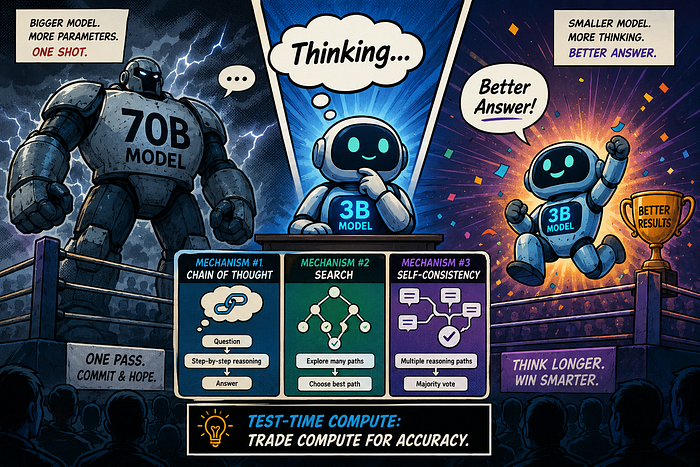
For the past few years, the prevailing narrative across the machine learning landscape has been straightforward: Scale is all you need. Add more layers, ingest trillions of tokens, burn more compute, and artificial general intelligence will naturally emerge.
While scaling laws have undeniably produced remarkable conversational fluency, anyone who has deployed Large Language Models (LLMs) in real-world workflows knows the reality: Bigger models are not necessarily smarter—they are often just more eloquently wrong.
A model with hundreds of billions of parameters can still fail at basic deterministic logic, hallucinate non-existent API endpoints, or produce generic, templated responses when confronted with complex domain problems.
To build genuinely intelligent software systems—and to shape AI into a tool tailored to an individual’s exact workflow—we must shift our focus from brute-force scale to architectural reasoning, verification loops, parameter tuning, and dynamic context grounding.
1. Deconstructing "Smart": What Does Intelligence Mean in Software?