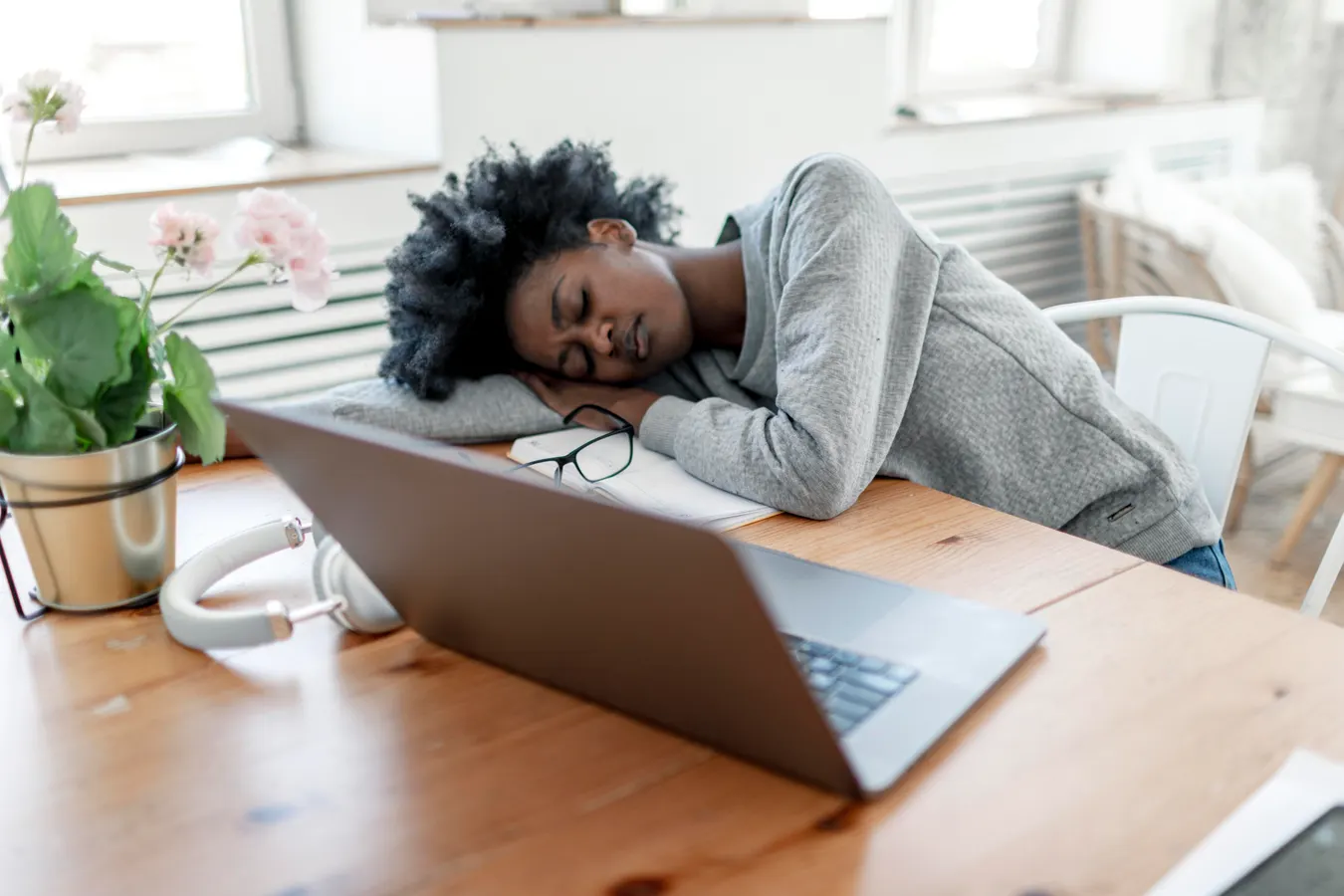
A morning news anchor made headlines after a video of her falling asleep during a live broadcast went viral.gettyRecently, a Memphis morning news anchor named Dominique Dillon made headlines after a video of her falling asleep during a live broadcast went viral. Dillon told TODAY, “I opened my eyes, and it was cutting to the next shot and I was like, ‘Oh my goodness, I can’t believe this just happened to me.’” Despite the embarrassment that Dillon felt, she received an overwhelming amount of support online, with many relating to her experience. On TODAY, Dillon shared that she is a mom of a 2-year-old and an 8-month-old and that she was barely able to get sleep because her husband was working a double shift and her 8-month-old was teething. Although few people will have a viral workplace moment like Dillon’s, her experience is not unique. What’s worse, women experience more negative effects from not getting enough sleep compared to men, according to a 2024 study. Brain health professional and corporate wellness expert Candy Calderon explained how women are more impacted by sleep deprivation than men. “The negative effects of sleep loss appear to build faster in women and take longer to recuperate from. Sleep loss puts women at a higher risk of cardiovascular and metabolic disorders, insulin resistance, which raises the risk of diabetes, and even higher dementia risks.”Women experience more negative effects from not getting enough sleep compared to men.gettyCalderon, who is the founder of CEO Wellness Club, went on to explain, “If we ask, ‘Why could women be more affected than men?’ Then hormonal changes might be the reason. The menstrual cycle, pregnancy, postpartum, perimenopause, and menopause. Men don't go through any of it. As women, we can do everything right and still be handed a decade of broken sleep and the health consequences to match. In at least one controlled study, a single night of sleep loss measurably impaired women's working memory while leaving their self-assessment intact, meaning they were impaired and had no idea. Men in that study showed neither effect. What I'd add,” Calderon said, “is that these are small studies. Sex differences in sleep have been chronically understudied.”“What happened to Dominique is an illustration of what High-Functioning Survival Mode™ can look like in real time,” explained researcher and strategist Dr. Samantha-Rae Dickenson. “It’s what can happen when functioning and pushing through is no longer enough to supplement depletion and insufficient support. It can look like a nervous system remaining in a state of survival because the demands of work, life and caregiving are continuous without any space for restorative rest. You keep showing up, and saying you’re fine, until your body has the final say.”MORE FOR YOUDickenson also shared, “We frame moments like these as relatable, and they are. But they also point to how pervasive this pattern is for so many high-functioning women, and especially Black women. High-Functioning Survival Mode™ is the nervous system state and mechanism behind being outwardly successful and high functioning while internally depleted. And women are not only rewarded for operating this way, but it’s often expected. It has been normalized as being strong, resilient, successful, a good mom, dependable, while juggling multiple things all at once, without room or enough support to get the type of restorative rest you need.”Structures are necessary both inside and outside of the workplace to address this issue.gettyStructures are necessary both inside and outside of the workplace to address this issue at a systemic and societal level. Calderon explained, “None of this is new. I see similar cases in aviation, medicine, and shift workers all the time where fatigue is treated as an operational risk with rules attached. Most companies respond to exhaustion with resilience workshops, but you cannot train someone out of a sleep deficit. The improvements need to be structural, and when I say structural, I mean things like adapting the calendars, the shifts, the leave policy.”Calderon went on to say, “Building a real ‘return to work’ runway for women [is important]. The first 90 days after maternity leave shouldn’t include pre-dawn or overnight shift assignments if there’s a way around it. Separating recovery time from PTO seems like a sensible action point as well. In my workshops, I train managers to spot sleep deprivation impairments, which I think is something every organization should implement to better support their team members and ensure productivity. Self-reporting rarely works because people in sleep debt are often unreliable narrators of their own capacity.”“The test I give companies is simple,” Calderon shared. “Name one thing on your calendar that changed because of what you know about sleep. If the answer is nothing, you have a wellness program, not a well-being strategy.” It’s imperative that organizations introduce infrastructure to ensure that employees, especially those who are more likely to be sleep deprived such as women and Black women, in particular, are considered in wellness programs and that the onus for rest is not solely put on them.
The Anchor Who Fell Asleep On Air Exposed A Bigger Workplace Issue
A viral clip of a sleeping news anchor reveals a bigger workplace issue: women, especially Black women, are running on chronic sleep debt with little structural support.
831 words~4 min read