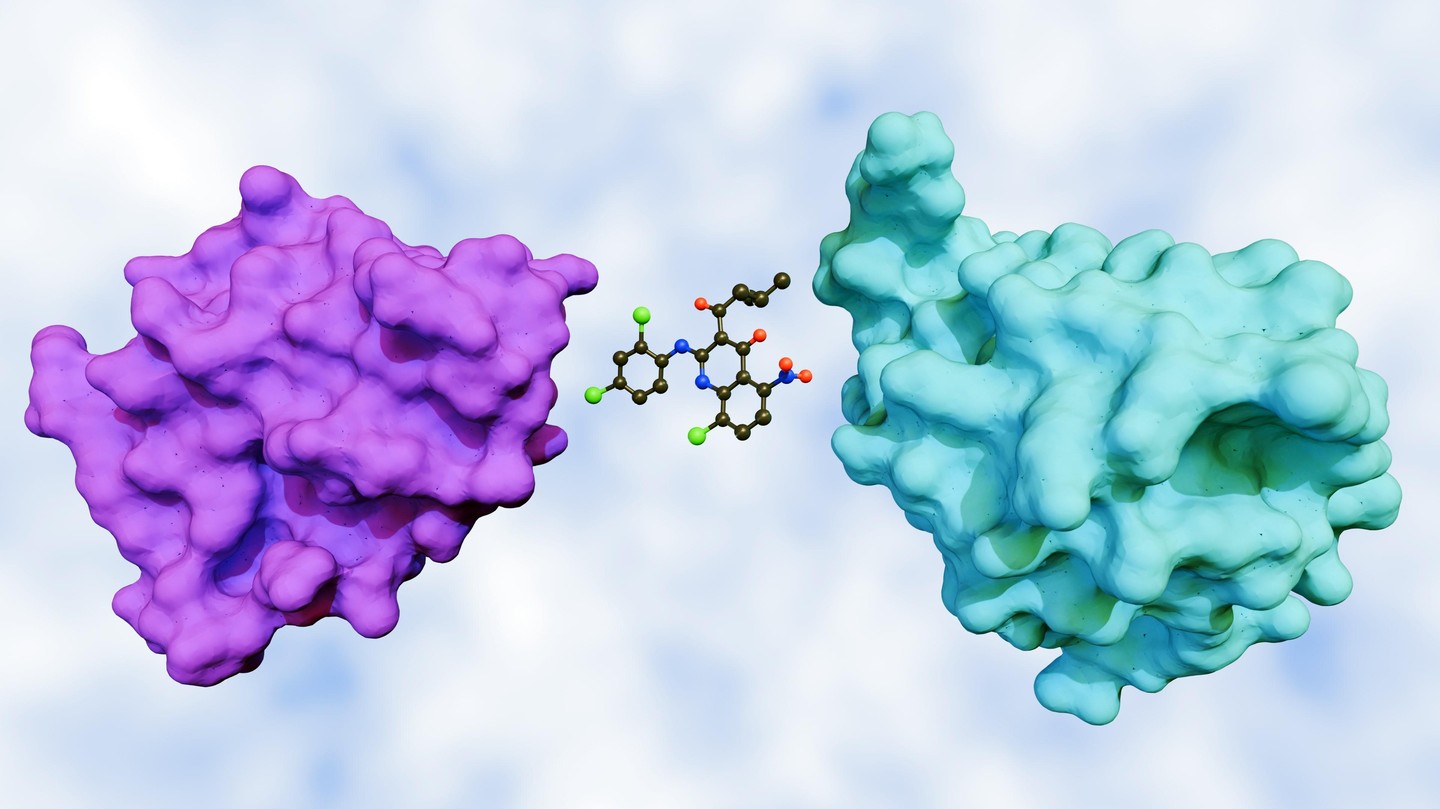
EPFL researchers have combined artificial intelligence with large-scale experiments to identify proteins that will serve as starting points for new molecular glue degraders, a new class of drugs currently transforming cancer therapeutics.Cells have systems for identifying and removing proteins they no longer need. Some drugs known as “molecular glue degraders” (MGDs) can exploit this process by forcing a protein into contact with the cell’s disposal system, which would normally ignore it. Flagged as waste, the target is then destroyed.An example is the protein IKZF1, which leukemia tumors exploit to survive. The MGD binds to a cellular recycling enzyme and reprograms its surface, allowing it to trap and label a target protein with chemical tags that signal the cell to destroy it.One of the enzymes MGDs work through is called CRL4CRBN. It belongs to the family of “E3 ubiquitin ligases”, enzymes that act as the cell’s quality-control matchmakers by tagging specific unwanted proteins for destruction.MGDs could potentially target proteins that conventional drugs struggle to reach. The problem is that scientists do not yet know the full range of proteins that can be recruited by systems such as CRL4CRBN, or how to design molecular glues that act selectively on one target.Finding proteins within reachResearchers at EPFL, from the groups of professors Nicolas Thomä (Paternot Chair in Cancer Research) and Bruno Correia (Laboratory of Protein Design and Immunoengineering), focused on proteins that bind CRBN, which is the part of the CRL4CRBN enzyme that recognizes the protein target. Crucially, they focused on proteins that bind CRBN but are not necessarily degraded in the presence of a molecular glue, as these weak interactions could provide starting points for developing new degraders.The study is published in Nature Biotechnology.Testing thousands of interactionsThe researchers first used a method called GluePCA to test thousands of induced protein interactions in parallel. The system uses yeast cells and links the interaction between two proteins to cell growth. If an MGD brings a candidate protein and CRBN together, the cells grow and produce a measurable signal.The team began with zinc fingers, small structures found in many proteins, including transcription factors that regulate gene activity. They identified more than 210 zinc fingers that showed dose-dependent binding to CRBN in the presence of the MGD pomalidomide, which is currently used to treat multiple myeloma.Many of the strongest binders were already known targets of MGDs. Other, weaker binders had previously been reported as degraded only after the molecular glue was optimized. Structural and genetic studies also showed that neighboring zinc fingers can strengthen or weaken these interactions, which helps explain how MGDs can favor one protein over another.Searching protein surfaces with AIThe scientists then expanded the search using MaSIF-mimicry, an AI-based method that compares protein surfaces across an entire proteome (the entire list of proteins of an organism). Rather than looking for similar sequences or overall structures, MaSIF-mimicry searches for small surface regions resembling those used by known CRBN targets.The computational search identified more than 7000 candidate protein domains. The researchers narrowed these down and experimentally tested 1959 top candidates with GluePCA. They found six known CRBN substrates and 43 previously unreported protein domains that bind pomalidomide.Some candidate proteins appeared to bind CRBN in ways that differ from the structural motif usually associated with these drugs. The researchers identified these proteins using MaSIF-mimicry due to their similarities at the local interface level. This suggests that MGDs could potentially reach a broader range of proteins.Starting points for new drugsFinally, the scientists screened RNF39, a binder identified by their workflow, against a focused library of 960 MGDs and found a novel MGD for it. More broadly, their approach identifies proteins that already show some affinity for the CRBN molecular glue complex, making them promising starting points for developing new MGDs.“These findings give us a real head start to systematically drug proteins long-considered undruggable; one of the central goals of EPFL's Center for Molecular Design in Medicine (MDM) is mapping out new starting points for molecular glue degraders and turning them into viable therapeutic strategies,” says Professor Nicolas Thomä, who is also the Center’s Director.Other contributorsFriedrich Miescher Institute for Biomedical ResearchUniversity of BaselBarcelona Supercomputing CenterThe Barcelona Institute for Science and Technology (BIST)Wellcome Genome CampusUniversitat Pompeu Fabra (UPF)Institució Catalana de Recerca i Estudis Avançats (ICREA)FundingEuropean Union Horizon 2020 research programSwiss National Science FoundationSwiss Cancer ResearchThe Mark Foundation for Cancer ResearchNovartis Research FoundationEMBOSpanish Ministry of Science and InnovationReferencesPius Galli, Shuhao Xiao (肖书豪), Yanxiang Meng, Alexander Hanzl, Alexandra M. Bendel, Regina Baur, Jacob D. Aguirre, Anna M. Diaz-Rovira, Maximilian R. Stammnitz, Georg Kempf, Lukas Kater, Kenji Shimada, Ye Wei (韦业), Andreas Scheck, Dominique Klein, Simone Cavadini, Ben Lehner, Guillaume Diss, Bruno E. Correia, Nicolas H. Thomä. Proteome-wide identification of the druggable CRBN interactome. Nature Biotechnology 13 August 2026. DOI: 10.1038/s41587-026-03237-7
New drug targets for molecular glue degraders
EPFL researchers have combined artificial intelligence with large-scale experiments to identify proteins that will serve as starting points for new molecular glue degraders, a new class of drugs currently transforming cancer therapeutics.
789 words~4 min read