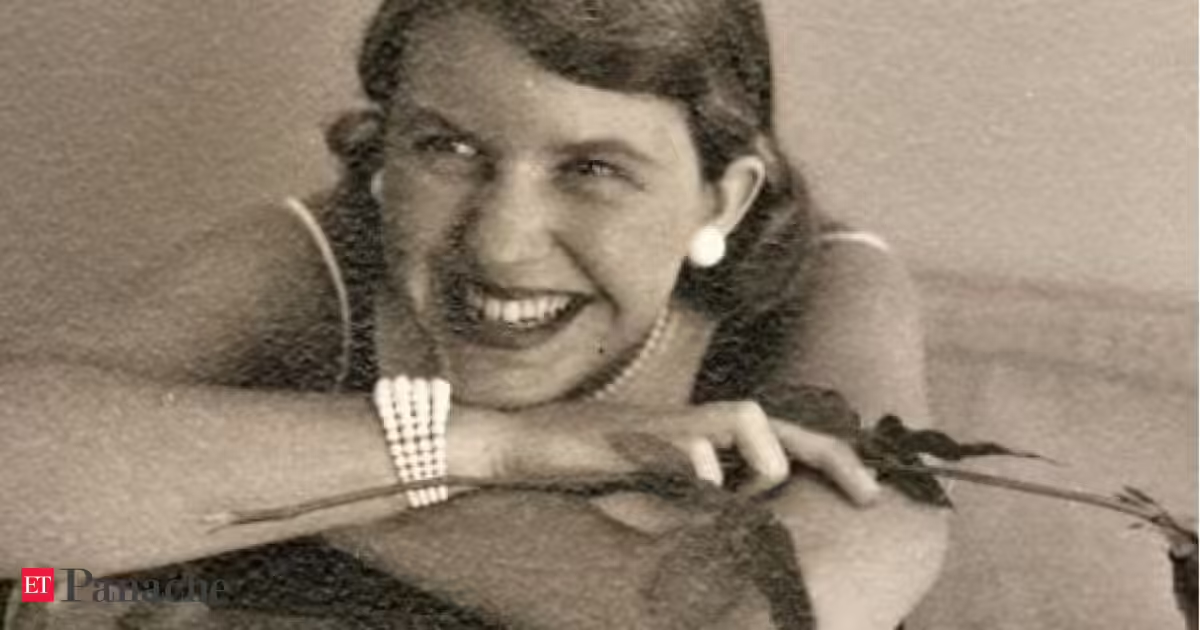
Modern life is full of things competing for our attention, yet genuine attention has become strangely difficult to give. We scroll past photographs without really looking at them, listen to conversations while thinking about the next thing we need to do and move through familiar places without noticing what has changed.Susan Sontag had a very different prescription for living: look harder, listen longer and remain curious. In a 2003 commencement address at Vassar College, the celebrated writer and intellectual urged graduates not to let routine and obligations shrink their experience of the world. Her advice was energetic rather than solemn: do stuff, be curious, pay attention, and stay eager. The passage has endured because it turns attention from a passive mental function into a way of being alive.“It’s all about paying attention. Attention is vitality. It connects you with others. It makes you eager. Stay eager.”Who was Susan Sontag?Susan Sontag was one of the most influential American writers and public intellectuals of the 20th century. Born in 1933, she became known not only for novels and essays but also for her criticism of literature, photography, film, politics and contemporary culture.She studied at the University of California, Berkeley, the University of Chicago and Harvard, and initially pursued an academic life. But in her twenties she moved decisively toward writing. According to the National Book Foundation, she taught philosophy and theology before deciding to devote herself full-time to literature. Her first novel, The Benefactor, was published in 1963.Sontag quickly became associated with a generation of writers who challenged conventional ways of thinking about art and culture. Her 1964 essay “Notes on ‘Camp’” helped bring the concept of camp into mainstream cultural discussion, while her collection Against Interpretation and Other Essays established her as a formidable critic.Her work was unusually broad. She wrote fiction, essays, criticism, plays and screenplays, and also directed films. Her books included The Benefactor, Death Kit, The Volcano Lover, In America, Against Interpretation, On Photography and Regarding the Pain of Others.Her novel In America won the 2000 National Book Award for Fiction, while her earlier work had already made her a National Book Award finalist in 1967.Meaning of the quoteThere is an urgency to the language. Sontag does not say attention is merely useful. She calls it “vitality”, something connected to life itself. That is a striking idea because attention is usually treated as a limited cognitive resource. Sontag instead treats it as an expression of our willingness to participate in the world.To pay attention is to tell something or someone: you matter enough for me to notice you. That can mean listening carefully when somebody speaks instead of preparing our response. It can mean observing a city rather than merely passing through it. It can mean reading a difficult book without immediately deciding whether we like it.For Sontag, attention creates connection. When we pay attention to another person, we become more receptive to their experience. When we pay attention to art, we allow ourselves to encounter something outside our existing assumptions.Attention produces curiosity, and curiosity produces movement. Once we start noticing things, we begin asking questions.Why Sontag's words feel especially relevant todaySontag's 2003 advice predates smartphones, infinite scrolling and the modern attention economy, yet it feels almost uncannily contemporary.The problem today is rarely a complete absence of things to look at. It is the opposite: there is too much competing for our attention.We can be exposed to thousands of images and headlines in a single day while remembering almost none of them. We can communicate constantly while failing to listen closely. We can document experiences so quickly that we sometimes barely experience them.Sontag's answer was not to withdraw from the world. It was to engage with it more intensely.More memorable quotes by Susan Sontag“I haven't been everywhere, but it's on my list.”“My library is an archive of longings.”“Interpretation is the revenge of the intellect upon art.”“To photograph is to appropriate the thing photographed.”
Quote of the day by Susan Sontag: ‘It’s all about paying attention. Attention is vitality. It connects…’ – American author on why paying attention can make life richer, more curious and more alive
Susan Sontag, an influential American writer, advocated for deeper attention in life. She urged people to look harder and remain curious about the world. Her message remains relevant today amidst constant distractions and information overload. Sontag believed paying attention connects us with others and fosters vitality. This approach encourages a more engaged and meaningful experience of existence.
655 words~3 min read