An agent makes six tool calls, picks the wrong one on step four, and the final output is garbage. You stare at your logs. You see the input. You see the output. Everything in between is a void. That's the black box problem with agentic LLM workflows, and it's the reason I started looking at Langfuse seriously.
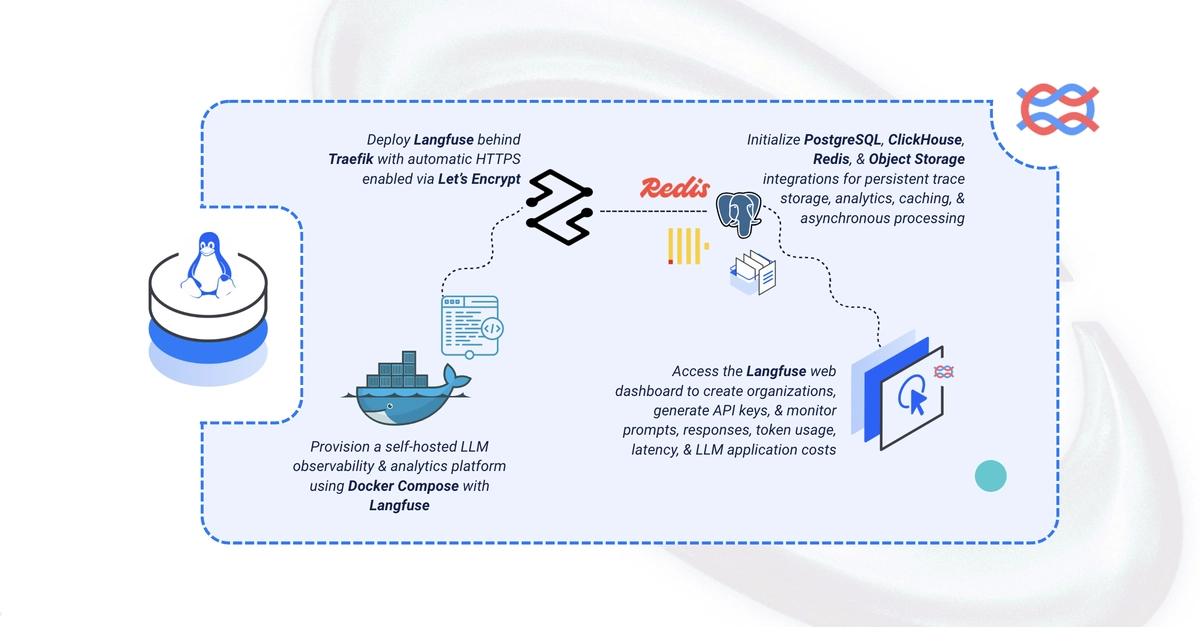
If you're running multi-step agents (LangChain, custom loops, or any orchestration layer), you need per-step tracing with enough context to reconstruct why the agent chose what it chose. Langfuse gives you that. But getting it wired up correctly, especially in a self-hosted Kubernetes environment alongside other observability tools, has a few sharp edges worth knowing about.
Observability Sprawl: The Failure Mode Nobody Talks About
Before I get into Langfuse itself, I want to talk about a failure mode I see constantly with LLM tooling: observability sprawl.
Here's how it usually plays out. You spin up Dify because it has a nice agent builder. You add Opik because someone recommended it for evaluation. You deploy AnythingLLM for RAG experiments. Each tool has its own Postgres database, its own PVC, its own memory footprint. Before you know it, you've got three separate platforms that each capture some traces, and none of them give you the full picture.