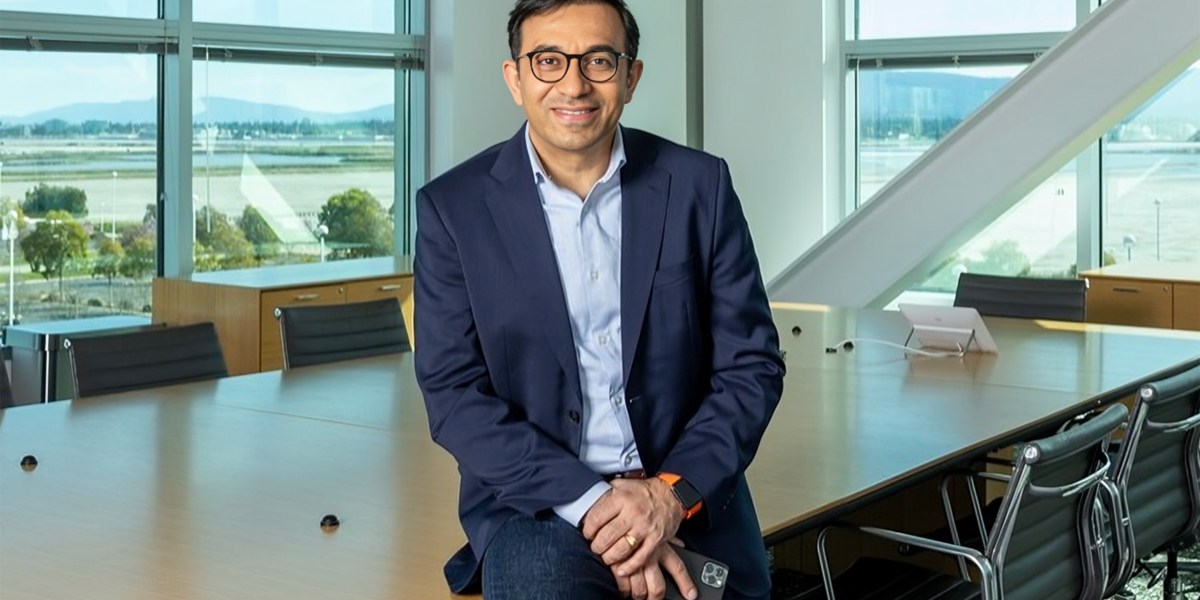
This year, data management and analytics platform SAS is among the first in the software space to celebrate the milestone of 50 years in business. Over the decades, the company has reinvented itself several times to keep up with technology—yet still provide strong analytics and data—and is now using AI to deepen its research.I caught up with SAS Vice President of Applied AI & Modeling R&D Udo Sglavo—who has been with the company for almost half of its lifespan—on the sidelines of the SAS Innovate conference in Washington, D.C. last month. He told me the secret to the company’s longevity is relatively simple: They’ve always focused on the problem, and then how technology could be used to solve it. We talked about how companies are using AI to solve their business problems—and why humans will always be a vital component. An excerpt from our conversation is later in this newsletter. Until next time. This is the published version of Forbes’ CIO newsletter, which offers the latest news for chief innovation officers and other technology-focused leaders. Click here to get it delivered to your inbox every Thursday.Artificial IntelligenceMeta CEO Mark Zuckerberg in July.Kevin Dietsch/Getty ImagesAs big AI models are getting unwanted attention for seemingly going rogue and hacking other online platforms, Meta CEO Mark Zuckerberg (whose company disclosed an AI hacking incident last week) released a 6,500-word essay about the possibilities AI creates for the future. The manifesto includes Zuckerberg’s philosophy on AI, which he thinks should be democratized through open-source releases. “The key to a positive future for everyone is achieving a balance of power that favors individuals,” the essay states. “The solution is to ensure that superintelligence is broadly distributed to empower people.”Zuckerberg writes that AI should be built for everyone—not just businesses. For the U.S. to maintain dominance, he believes in a more collaborative approach between government and AI developers, allowing businesses to release new models when they are ready, while giving the government the knowledge and resources to work with companies and mitigate risks during development. Distillation—creating smaller AI models by transferring knowledge from larger ones—should be looked upon more favorably by the U.S. as well, he writes, saying it enshrines “the principle that you can learn from anything that you observe.”He goes on to describe affordable services for all that Meta is building: Agents to help plan your personal life, top-notch creative tools, access to Ph.D.-level teachers in all subjects. Things that are all possible through AI and are optimistic enough to obscure the uncomfortable reality of AI’s potentially harmful abilities made clear in the last few weeks. Forbes senior contributor Michael Posner writes that AI scientists today are finding themselves in the same position as nuclear scientists on the Manhattan Project 80 years ago: Racing to develop something vitally important for the nation, but trying to continually sound the alarm about potential consequences all the way. Potential consequences aside, people are adopting AI en masse. Google reported this week that its Gemini AI assistant crossed 1 billion active monthly users, and is the fastest-growing product in the tech giant’s history. Nearly two-thirds of those users speak directly to Gemini, while one in five use live camera feeds and screen sharing for real-time problem solving. From The HeadlinesRecent M&A deals and partnerships in the industrial AI space show that many big players—including Siemens, Schneider Electric, Honeywell, ABB, Emerson and Rockwell Automation—are positioning themselves to further revolutionize industry through AI-directed intelligence and automation, writes Forbes senior contributor Gaurav Sharma. These deals—which range from acquisitions of risk intelligence startups to software providers to humanoid robots—are more groundwork for already-dominant players to expand their offerings and capabilities. The deals also allow niche startups to scale their technology to a much larger business segment.AI-powered humanoid robots are also set to take their places alongside people in industrial facilities. Agility Robotics Chief Business Officer Daniel Diez told Forbes senior contributor John Koetsier that its Digit V5, which will begin deployment in December, will be “the world’s first cooperatively safe robot, a robot capable of working in close proximity with people and ensuring their safety at the same time.” The robot, which will begin working in bulk material handling, will not need to be fenced off from human workers, like the current generation of industrial robots, the company says. If Agility—which Koetsier writes is set to go public later this year through a merger with a special purpose acquisition company—can prove humanoid robot safety in a notoriously difficult workspace like a warehouse, the door opens to many other uses.Bits + BytesThe High ROI Of Boring AISAS Vice President for Applied AI and Modeling R&D Ugo Sglavo.SASSAS Vice President for Applied AI and Modeling R&D Udo Sglavo has always seen the possibilities technology offers for solving enterprise problems, but he also sees many companies with the wrong kinds of use cases and attitudes around AI. I spoke with him about how businesses should approach AI disruption and integration. This conversation has been edited for length, clarity and continuity. At an event earlier this year, you said you come back to the AI applications that are boring. Why are boring applications the best ones to solve for?Sglavo: In my mind, this is the one opportunity where there is a real opportunity for return on investment—and we can do this very fast. Here’s what I mean by boring: Imagine you are a medical expert looking at scans of patients for tumors. Day in, day out, you get all these scans. In the majority of these scans, there’s no tumor. So the question is, why would we bother an expensive expert to look at those boring cases? Don’t we want that expert to look at the edge cases? Where the system is not clear, it may flag something as suspicious, but it’s not the decision-maker. The decision maker remains a human. But for the cases where there’s no indication whatsoever, the system can be the decision maker. When I call my bank now and I’m asking for a certain activity and they are like, ‘We don’t need a human to get involved in this. The system can take care of it because it’s such a repeatable, well-recognized pattern. There’s no risk for the bank.’ If I want a cashier’s check, in the past, I had to walk into the bank, talk to a person, and that person probably is bored by the fact that I only want a cashier’s check. These are boring cases where I believe we can make people’s lives easier. We can value their time much more by saying, ‘Now you can spend more time on customer interactions where emotions have to play a role, where I have to understand your situation. And a machine will not do that because a machine is a machine.’With AI in the workplace, there has been a lot of disruption in terms of staffing and organizational structures. Do you think we are getting close to the stage where the massive disruption will settle down, or will it continue as AI gets better?AI is here to stay. There will not be a point in time where we will agree as a society to turn off all these AI systems. That quantum leap has happened. Now the question is, of course, how do we deal with it? In general, since AI will not go away, the disruption will not go away either. Certain jobs—and you have to be honest about this—may no longer be needed in the future. I’m always skeptical when I’m hearing claims that you can run an entire enterprise by just using AI and agents. Even if that could be true, it would be the wrong thing to do as a business leader. Because we are responsible not only to provide people with access to means and participate in growth. We also depend on them to be consumers. It’s unbelievable that we could become a society where you get your ‘allowance for the day.’ I’m always saying you can’t predict the future of AI. We need to build it. And now industry is in charge. We have to ask: How do we envision enterprises working in the future?It will be like a plane. We know there’s an autopilot that is extremely powerful. It can probably take us from A to B with no problems. The question is, would you go on a plane when there's no pilot? My answer is no. I want somebody to be there who can take over, because there will be instances where human intelligence is still superior, or where an emotional decision needs to be made. Those machines are all just ice cold. They will basically do what they think is the right thing based on the historic data they have. Human-in-the-loop is a reality which we talk about every time we go to customer cases. Suppose you can automate all these boring cases. What about the rest? Who is in charge? How can we make responsible decisions you can trust, which are explainable, which you can rely on? The next step after that is, of course, what do you learn from that? How do you know what matters? Which of these decisions do you maybe want to change? Or this is where you want to learn from interacting with reality. AI learns to play chess. There's no uncertainty in chess. It's a deterministic game. The way AI learned AI was by interacting with a player. Reinforcement learning is how you train an AI model by interacting with a system. This works very well with games. It doesn’t work with businesses.What advice would you give a CIO who is trying to get their enterprise to make the best use of AI?Connect with business. In a lot of companies, there’s still this divide between business and IT. It’s more like who’s in control? Who drives whom? We see shadow IT: Business is not happy with what IT has implemented, so to shortcut it, they implement their own system. Break down the silos. Talk to each other and start with the business question in mind. That’s the lesson for IT: It really needs to be driven by the business use cases. Once you understand that, build the technology ecosystem which supports your businesses. Get your data architecture right. Now is the time to build the foundation for all these intelligence models, which we want to build on later, because nothing has changed. If you don’t get the data layer and the data architecture, it doesn’t matter how smart and intelligent your models are.Get your decision architecture right. Don’t just think about data and models. Also think about how the results of the models are going to be used later from a technology point of view. What is your decision architecture? How can you explain decisions? If the regulator comes in and says, ‘I see you declined 10% of your credit applicants. Can you explain why?’ You don’t want to say, ‘We don’t know because it’s hidden somewhere.’ Strategies + AdviceIt seems like enterprise AI software solutions are increasing by the day, but a recent survey shows that for 51% of software providers, fewer than one in four customers use their applications. Providers need to build what companies want, and companies need to know how best to use what’s out there. Here are some ways to narrow that gap. Vibe coding is becoming more popular across all departments and businesses, but well-meaning users can inadvertently introduce vulnerabilities through AI-generated code. Here are five checks to ensure vibe-coded apps are secure.QuizWhat is the name of the company that made the software top AI producers used to test their models—and discovered their unauthorized hacking?A. IrregularB. IrreplaceableC. IrrationalD. IrritantSee if you got the answer right here.
Why AI Will Always Need Humans
Also in the Forbes CIO newsletter: As AI hacks systems, Zuckerberg delivers optimism; industrial AI deals flourish; Agility’s robots get ready to work alongside humans.
TL;DRAI
SAS and Zuckerberg confirm: AI amplifies humans. Industrial M&A and Agility humanoid robots (Dec 2026) signal enterprise automation trend. ROI emerges in 'boring' tasks—medical screening, filtering. IT leaders pivot budget toward pragmatic use cases, not hype.
1,959 words~9 min read