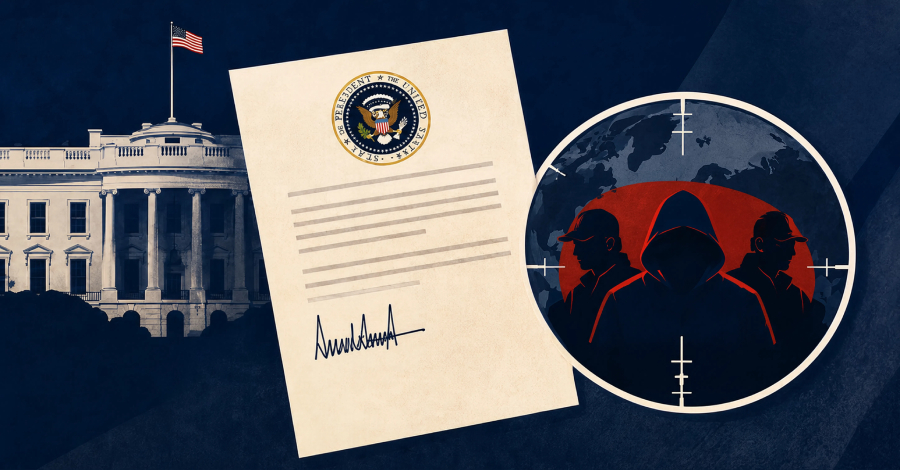
Donald Trump is allowing government agencies to contract private cybersecurity companies to carry out operations against cyber-enabled transnational criminal organizations (CE-TCOs).The US President signed a memo on Wednesday confirming a strategy hinted at earlier this year, saying participating companies can support national operations against criminals, including cyber surveillance and technical disruptions of their networks.The latter, described as "Cyber Effects Operations," covers activities that cause "the manipulation, disruption, denial, degradation, or destruction of information systems, networks, physical or virtual infrastructure controlled by information systems, or information resident thereon."
Although the memo establishes a distinction between cyber effects operations and cyber surveillance missions, it acknowledged that the latter will also inevitably involve some disruption or manipulation of systems in order to carry out the surveillance.
Surveillance operations are designed for intel gathering, either to support further snooping or for later use in cyber effects operations, with the intent of remaining undetected.Trump described CE-TCOs as "any foreign group that conducts cyber-enabled crime against the United States Government, a United States person, or United States interests."Crucially, the definition excludes entities directly associated with, or operating wholly on behalf of, foreign governments. No stepping on TAO's toes, of course.Participating companies will undergo "rigorous vetting" and will be subject to "strict operational procedures," the memo adds. The operational procedures are to be drawn up within 60 days and codified by program executive directors working with the Homeland Security Council.Companies wishing to be called up for service will have to demonstrate that they have the technical capabilities to carry out the required operations, and be willing to prove this each year via annual evaluations.Program managers must ensure that the operational procedures open opportunities for highly resourced, large organizations, as well as "smaller, more agile companies" that may prove useful for "specialized or discrete tasks."The Justice Department will also play a role in authorizing operations, particularly those targeting US residents or raising domestic legal issues.