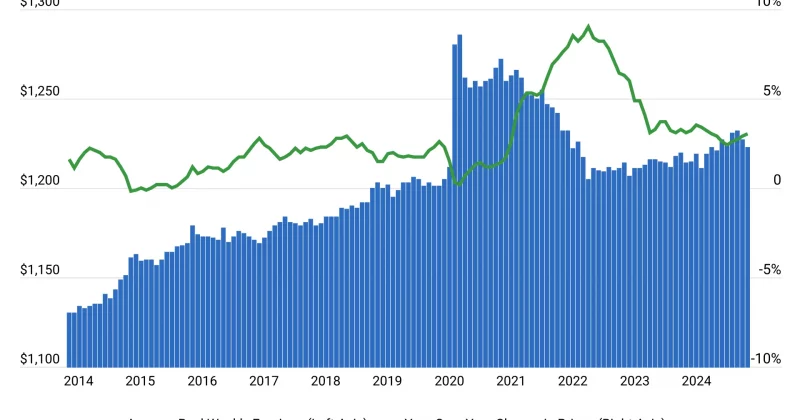
The first of this week’s two big inflation reports came out Wednesday morning. The consumer price index report was pretty good: Both the annual increase and core inflation (that’s CPI excluding food and energy) dipped 0.1%. They now sit at 3.4% and 2.5% year-over-year, respectively.That data suggests underlying inflation pressures may be tapering off. So, maybe the Federal Reserve won't have to raise interest rates when the Federal Open Market Committee meets next month.But just as the stock market is not the economy, the Fed's interest rates aren't either. Holding Wednesday’s inflation report up against last Friday’s jobs report reveals that prices have been rising faster than wages over the past year. So, despite lessening inflation pressure, the average American household’s buying power has slipped by about 0.1%.Analysts’ reactions to this news are all over the place. One faction said things could be worse.“The economy seems like it’s kind of cruise control,” said Connel Fullenkamp, an economics professor at Duke University. “Everything's kind of working — maybe not wonderfully — but it's still kind of chugging along.”Unemployment isn’t terrible. Energy prices are elevated, but stable. And Fullenkamp said that a main driver of this cruise control economy is that people just keep spending.“There's still enough people in the economy who are doing well enough who don't feel like they have to give up the habits that they've become accustomed to in terms of consumption,” he said. “And there are enough of them to keep spending to keep the prices marching up.”Then, there’s the more pessimistic view: Inflation is still higher than wage growth.“The cost of living is rising at a pace that feels genuinely uncomfortable,” said Justin Wolfers, a professor of economics and public policy at the University of Michigan.Wolfers said that Wednesday’s numbers didn’t reveal any major new problems — but that just means it’s more of the same bad news.“Prices are rising and wages aren't keeping up, and so therefore the amount of stuff you can buy with your paycheck has literally fallen over the past year,” he said. “That's not the way things are meant to be.”So, life is more expensive, and people are still spending money.Which is only possible “because everybody's spending every dollar that they have,” said Gary Brode, founder of the research and advisory firm Deep Knowledge Investing.Credit card debt is up, savings are down. That is why, Brode said, the vibe check from businesses — like the stock market setting records — and the one from consumers look totally different.“Wall Street was celebrating how great [it is that] it's less likely that the Fed will raise rates — which technically is true,” he said. “[But] I think for an average person, this is a bad print.”Brode said life isn’t going to feel any less expensive any time soon, and more reports like this one are likely on the way. So, the only way consumers can make the spending feel less bad is to do less of it.
Inflation has slowed, but wage growth hasn't caught up
The net result is that the average American household’s buying power has dwindled by 0.1% over the past year.
494 words~2 min read