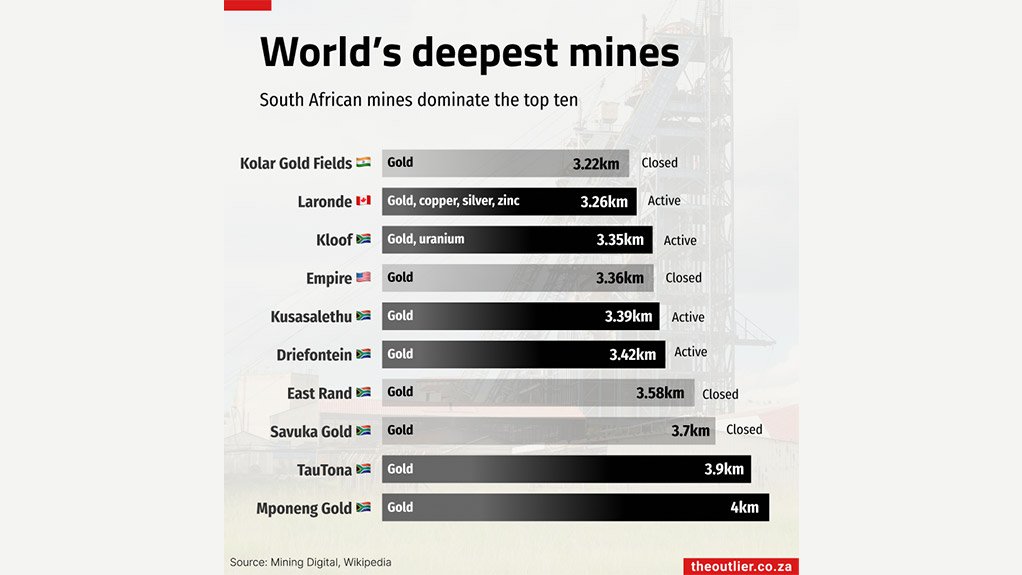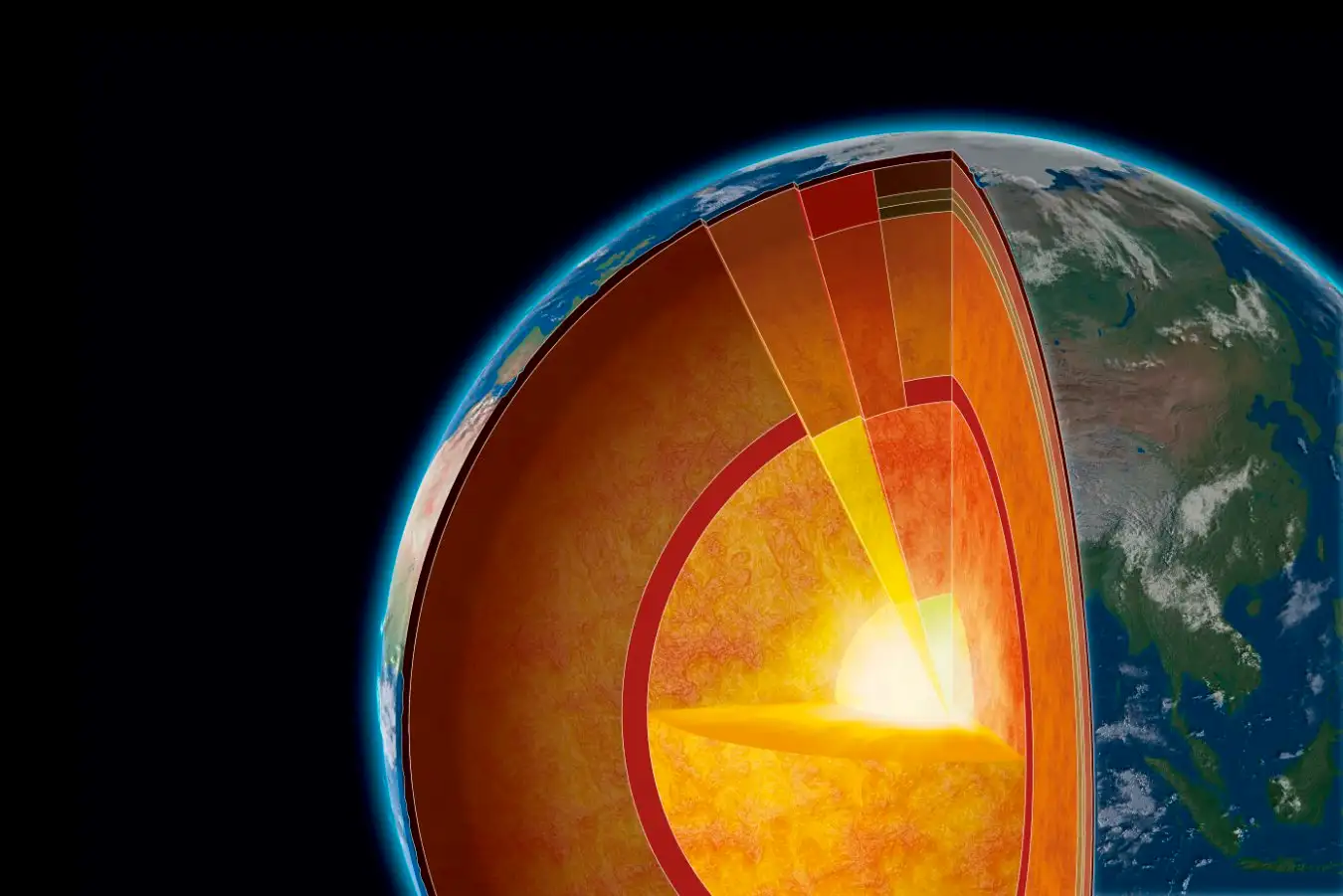
In March, I accompanied an international team of scientists on an expedition to one of the deepest places that humans have ever visited, a few hours outside Johannesburg, South Africa. Before sunrise, we drove to the entrance of the Moab Khotsong gold-and-uranium mine, joining a line of workers who were relieving the night shift. Security was tight; for years, mining companies have struggled to keep out illegal miners called zama-zamas, who sneak underground and collect ore at great danger to themselves. When guards finally cleared us and our gear, we walked through rotating gates into what resembled a suburban office park. At its center was a boxy concrete tower—a mine shaft that would carry us nearly two miles down into the earth.The scientists had come not for precious metals but for something even more elusive: what they call dark oxygen. On Earth’s surface, plants and algae produce plentiful oxygen from sunlight and water, allowing us to live and breathe. At one time, scientists didn’t think that significant quantities of free oxygen, or O2, would be found anywhere else on the planet, in part because O2 reacts aggressively with other elements. “O2 is way less abundant in the universe than diamond,” Emil Ruff, a microbial ecologist and the expedition lead for the trip, told me. But, over the past few years, small quantities of free oxygen have been detected in a range of deep places, far removed from the light of the sun. Ruff and his colleagues hoped to collect new samples of ancient water in the mine. They suspected that oxygen was playing an unrecognized role in powering underground life.We were issued boots, helmets, and reflective coveralls strongly reminiscent of the music video for the Beastie Boys song “Intergalactic.” So costumed, we passed through another checkpoint, into a room filled with headlamps and emergency oxygen packs. A poster on the wall explained what to do in the event of a cave-in: pull a tab to inflate a bag with a few crucial minutes of breathable air. “We’re embarrassingly dependent on oxygen,” Karen Lloyd, a University of Southern California biogeochemist, who was there to research how underground microbes respond to seismic activity, said. Many of the subsurface microorganisms she studies don’t breathe oxygen, as we do, instead using sulfur or iron compounds that leach from the rock to drive their metabolism.Once everyone was suited up, we clambered into a three-story-tall lift called the Cage, which ferries thousands of workers up and down the shaft each day. I tried not to think about the void—seven times the height of the Empire State Building—beneath us. If we fell in, I calculated, a full minute would pass before we hit the bottom. The operator pulled down a gate with a clang, plunging us into darkness. We began to drop.Enterprising scientists have been conducting research in Moab Khotsong for many years, but the mine became particularly valuable to biologists after an earthquake struck nearby in 2014. A group of Japanese geoscientists soon started drilling toward the fault line under the shaft. After half a mile, extremely salty radioactive water started flowing out of the borehole. This water, in turn, attracted researchers who investigate the deep biosphere—the poorly understood microbial ecosystems in the earth’s crust—which has been estimated to contain ten to fifty per cent of the biomass on Earth. Tullis C. Onstott, the late Princeton geobiologist who authored “Deep Life: The Hunt for the Hidden Biology of Earth, Mars, and Beyond,” told colleagues that he’d spent twenty-five years searching for water like what was found in Moab Khotsong. “It’s totally separate from the surface world,” Thomas Kieft, a microbiologist who worked with Onstott, told me. “It’s totally separate from photosynthesis.”Geochemical measurements suggested that the water had been separated from the surface for at least 1.2 billion years—more than a quarter of Earth’s history, since before animals and plants existed. Yet it turned out to be full of life. Onstott and his colleagues showed that slow-growing cells in the brine fed on hydrogen molecules, which were produced when radioactivity split water into its constituent “H”s and “O”s. The team also found hints that oxygen was present in the brine, and even a bit of genetic evidence to suggest that underground microbes might be capable of using it. But oxygen was never the focus of their research, because deep, dark environments are usually assumed to be oxygen-free zones.Then, while working with the government of Canada to monitor groundwater, in 2023, Ruff and his colleagues detected O2 in deep wells beneath Alberta. This was very odd. Much of this oxygen had not come from the atmosphere, and there was no sunlight or plant life down there to produce it. Any stray O2 molecules should have been quickly gobbled up by chemical reactions with rocks and fluids, or by microbes. “Nobody in their right mind would look at ancient groundwater and think, Let’s look at oxygen,” Ruff told me. “But we found it accumulating.”The implications were electrifying. O2 is the essential ingredient in the chemistry of large and complex life-forms. It’s what’s known as an electron acceptor, which means that it steals electrons from other compounds. When we light a fire, O2 steals electrons from the fuel, releasing heat. When we eat food, O2 steals electrons from sugars and fats, releasing energy that powers our bodies. No other compound can unlock as much energy—and any creature that goes without O2 has to make do with less. (Ruff quoted the Nobel Prize-winning biochemist Albert Szent-Györgyi: “Life is nothing but an electron trying to find a place to rest.”)If such a useful molecule was abundant underground, the researchers reasoned, then the deep biosphere might be even more diverse and widespread than expected. And whatever was generating dark oxygen might also be found on planets or moons beyond Earth. “We started digging,” Ruff told me. His team soon discovered trace amounts of oxygen in deep groundwater from around the world. They found DNA from aerobes—microbes capable of using oxygen—in places that sunlight could never reach. Other microbes seemed to produce their own dark oxygen, perhaps to extract energy from hydrocarbons such as methane, much as drag racers inject nitrous oxide into their engines to boost horsepower. Last year, Ruff and five other investigators won a multimillion-dollar grant from NASA to extend their investigations on a sort of dark-oxygen world tour. Moab Khotsong was their first and deepest stop.Once the Cage was moving at full speed, it raced down the shaft at nearly forty miles an hour. It was a remarkably smooth ride, apart from a faint rattle and whoosh each time we passed an underground level. Our ears popped; the researchers chuckled nervously. Cool water began to drip from the ceiling. Finally, about four thousand feet below the surface, the lift slowed at our first stop.Before we could visit the super-salty radioactive brine at the bottom of the mine, we had to collect a baseline sample of groundwater that was not a billion-plus years old. We exited the Cage, ducking through a curtain of falling water, into a high tunnel. No natural rock was visible here; the passageway had been plastered over with mottled concrete and lined with air pipes. It smelled of rotten eggs and concrete dust. At first glance, it seemed utterly devoid of life.Bennie Liebenberg, a former geologist at the mine who was serving as our guide, has the plodding, slightly wide-eyed manner of someone who has spent a lot of time underground. He previously facilitated the drilling of the borehole after the earthquake, and has been the mine’s liaison with scientists ever since, helping convince higher-ups that the chance to solve profound environmental mysteries was worth the occasional disruption to mining operations. In his office, he keeps a copy of “Deep Life” that Onstott inscribed: “You have been a blessing to our cause. Eternally grateful.”Liebenberg led us to a wall where water was gushing out of orange pipes. It had been flowing this way since the shaft was drilled, decades earlier. “They tried to seal it, but couldn’t,” he said, in a clipped Afrikaans accent. The water here was shallow enough to have been connected with surface flows tens of thousands of years ago, and it still contained oxygen. Thus, it would give the scientists a point of comparison with the billion-year-old brine below. Before the researchers could start sampling it, though, a deafening roar suddenly filled the tunnel. Scott Wankel, the team’s lead geochemist and a researcher at the Woods Hole Oceanographic Institution (W.H.O.I.), had accidentally kicked a tiny hole in a rusty pipe of compressed air. (“You broke the fucking mine, dude!” Ruff joked later; Liebenberg seemed unconcerned.)We had earplugs, thankfully, but we were no longer able to speak. Instead, for several hours, the scientists mimed awkwardly as they collected samples: No, I don’t need that small bottle, I need the slightly smaller one! Eventually, someone realized that we could write notes to one another, which helped move things along. Lloyd, the U.S.C. geobiologist, gestured for me to give her my notebook.“Did you see the sulfur streamers?” she wrote. I shook my head. She waved me over to a gutter where tufts of blue-gray fibres were fluttering in mine water. “They are giant filaments of sulfide oxidizing bacteria,” she wrote on pages that were getting increasingly wet. Apparently, some bacteria were using oxygen in the tunnel to metabolize sulfur compounds in the water, and that was producing the rotten-egg smell. Single-celled organisms ganged up in filaments, by the tens of millions, to avoid being carried away by the flow.Under another water pipe, Ranjani Murali, a biochemist who was co-leading the expedition, found a film of even larger streamers, along with what appeared to be orange-colored sulfide-oxidizing bacteria. Sujung Lim, who works in Murali’s lab at the University of Nevada, Las Vegas, wiggled her body as though she were a streamer to alert everyone to a cluster that she’d found. Meanwhile, at the other end of the tunnel, Ruff reached a gloved hand into several inches of underwater microbial ooze. Mops of ghostly streamers, some of them longer than my arm, were waving like tentacles atop layers of black muck. When we were back in the quiet of the Cage, he said with a grin: “It was like a kombucha!”A space that had appeared dead and artificial was actually teeming with microorganisms. According to the scientists, the oxygen we were breathing was helping them thrive. In the same way that oxygen helps a fire burn hotter, it was enabling these microbes to unlock energy from sulfur and iron compounds in the water. That’s why the bacteria could multiply to the point that they were visible to the naked eye. But the oxygen here wasn’t a natural resource—it was cycled into the shaft so that miners (and the occasional geobiologist) could breathe. The question remained whether oxygen, a sort of rocket fuel for life, might also be available far deeper in the rock.The next day, we crowded back into the Cage, this time joined by about thirty mine workers who were descending to “the deep level.” When I told a fellow named David that I was impressed by the sheer scale of the mine, he nodded and replied, “There is life underground!” Others chatted nonchalantly in Zulu and Xhosa. This time, the lift sped nearly two miles into the earth. At the deep level, we climbed out and saw several long tunnels that radiate out from the shaft. We were now deeper than anyone on the team had ever been—even Ruff, who had visited deep-sea hydrothermal vents in the Gulf of California. “I’m closer to the center of the earth here than I was in the submarine,” he said.After a few minutes of waiting around, Liebenberg informed us that an underground train wasn’t working, so we’d have to walk the rest of the way. We tramped for about a mile, sweating in heat that emanated from the rock, until we turned onto a smaller passageway. Two workers walked past. “Morning,” one said cheerily.After another half mile, we finally reached a dead end, where the concrete walls gave way to natural rock—the gold-flecked quartzite of the Witwatersrand Basin, which is more than two billion years old. Another half mile beneath us were the water-filled fractures opened by the earthquake, which Liebenberg had dubbed the Onstott dike. Two pipes protruded from the wall; beneath one of them, the rock glistened with crystallized salt and orange-colored microbial mats. The whole site looked to be in desperate need of a plumber. Wankel, from W.H.O.I., quipped, “We’ve come all this way—for this.”The researchers got to work. Wankel turned a valve, and billion-year-old brine sputtered out of one of the pipes. Emeline Vidal, who works in Ruff’s lab, was able to fill up several containers before the water pressure ran down; she planned to sequence DNA from any cells that were present. Wankel focussed on filling airtight cannisters without letting any gases escape; he moved as gingerly as if he were opening a shaken-up can of soda. “It smells less like sulfur and more like fart,” Ruff observed. David Bekaert, another geochemist on the team, used a seventy-thousand-dollar mass spectrometer to find a scientific explanation: there was methane in the water, likely a signature of microbes eating hydrogen and CO2.The whole group gathered around as Carolina Fernandes Moreira de Carvalho, another biogeochemist, took a preliminary measure of O2 dissolved in the water. Lit by the circle of headlamps, she held a hypersensitive oxygen probe up to the borehole. Brine filtered through it and filled up a bottle. After a minute, the reading from the probe levelled out, and Fernandes read out the number: 0.09 micromoles per litre. This was an extremely small amount of oxygen—maybe two hundredths of what you’d find in a glass of drinking water—and it would need to be confirmed. But down here, in waters that had been trapped in darkness since before the dawn of plants, there shouldn’t have been any oxygen at all.A few months after leaving the mine, I called Ruff. He had undertaken the expedition as a scientist at the Marine Biological Laboratory, on Cape Cod, but now he was teaching at the University of Bremen, in Germany. His team had confirmed that dark oxygen was “a feature of this ecosystem,” he told me. But it might take years of laboratory work to figure out whether biology or radioactivity was most responsible for creating it, and how any microbes might be using it. The weight of the oxygen atoms, for example, would clarify their origins; the team would use that data, in combination with measures from other underground sites, to estimate the over-all amount of O2 available in the deep biosphere.Still, the researchers were excited. In Las Vegas, Murali and Lim had started a slow process of trying to grow cells from the brine in the laboratory. Vidal, in Woods Hole, had bags of DNA samples on ice, ready to be sequenced. Ruff was permitting himself to imagine animals living off of dark oxygen in new and surprising places. In 2011, Onstott’s team had discovered that, as deep as 2.2 miles into a South African mine, a previously unknown species of nematode was feeding on waterborne bacteria. They named it Halicephalobus mephisto—the devil worm. Maybe dark oxygen would allow for other multicellular creatures to lurk even deeper in the rock.Ruff and the team were careful not to speculate too much, however, in part because of a dark-oxygen controversy that has been swirling around a different part of the planet: the deep ocean. In 2024, a group of scientists reported that lumps of metal on the Pacific seafloor—which happened to be the target of seabed-mining operations—seemed to be producing dark oxygen. Many of the resulting news stories, in Ruff’s view, wrongly credited the metal lumps with oxygenating the atmosphere or helping give rise to life. “It was crazy,” Ruff said of the media coverage. “Everyone was talking about it.” Andrew Sweetman, the Scottish marine biogeochemist who led the work, hadn’t made such claims, but he was still pilloried by fellow-scientists, and proponents of mining accused him of being an anti-mining crusader. (Later this year, Sweetman and his colleagues will revisit the Pacific on a follow-up expedition.)New insights into dark oxygen really could revise the story of life, according to researchers who were not a part of Ruff’s expedition. If dark oxygen keeps turning up in unlikely places, that “probably means that the deep biosphere is more extensive than we thought previously, and has even more cells than we thought,” Devan Nisson, a NASA geobiologist who, as Onstott’s last doctoral student, spearheaded much of the early research at Moab Khotsong, said. The same could be true beyond Earth: access to dark oxygen could enable organisms to survive in shockingly radioactive or salty habitats. “I think that dark-oxygen production—whether biotic or abiotic—will unlock zones of habitability we previously thought beyond that fringe of biology,” Nisson said.Another big question, back on Earth, is what role dark oxygen may have played in the evolution of aerobes—living things that breathe oxygen, like us. In a recent analysis of bacterial genomes, Murali and her colleagues concluded that some aerobes existed before the dawn of photosynthesis. This was on Ruff’s mind as we left the mine together, huffing and puffing on our way back to the Cage. It’s conceivable, he told me, that aerobic respiration was originally a kind of “freak metabolism” that took advantage of dark oxygen generated by radioactive rocks. When photosynthetic microbes began filling the atmosphere with oxygen, about 2.4 billion years ago—a development that would have been deadly for many other organisms—such aerobes would have been ready. It’s even possible that they are ancestors of oxygen breathers like us. If so, then dark oxygen might not be some kind of subterranean aberration. It might be a starting point for life as we know it. ♦
The Mystery of Dark Oxygen
Scientists once thought that life-sustaining oxygen existed only near Earth’s surface. Then they detected it deep underground.
2,984 words~14 min read