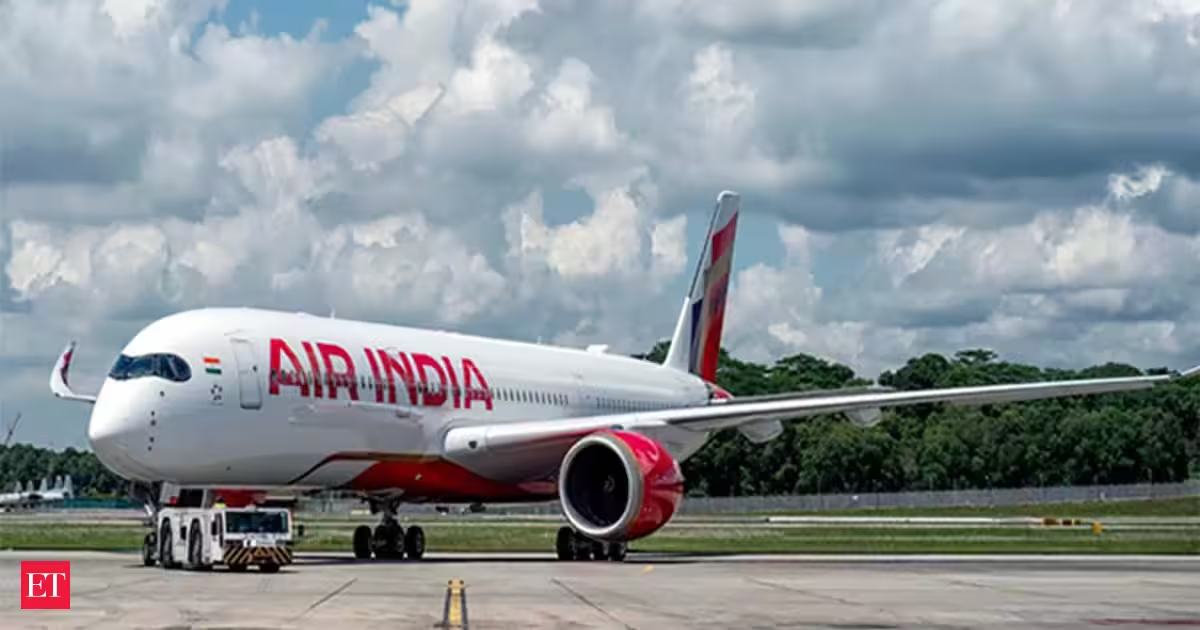
A post-flight Centralised Fault Display System log from an Air India Phuket-Delhi flight that suddenly lost altitude and dropped 300 feet, leaving 24 people injured, revealed a series of warnings linked to the aircraft’s hydraulic systems, flight controls and autopilot.The August 4 incident left 20 passengers and four crew members injured on flight AI2379. (ANI Video Grab)The August 4 incident, which left 20 passengers and four crew members injured on flight AI2379, an Airbus A320 registered as VT-EXO, was classified as serious and led to an investigation by the Aircraft Accident Investigation Bureau (AAIB).The pilot’s initial post-flight drug screening was recorded as “non-negative”, meaning the sample had been flagged for further testing. His confirmatory test later returned positive for cannabis.Multiple warning signs during aircraft plungeThe log, seen by HT, shows nine warning messages appearing within a minute at 9.32am IST, when the aircraft had crossed the Odisha coast after flying over the Bay of Bengal.The warnings indicated low pressure in the Green, Blue, and Yellow hydraulic systems, in various combinations. They also showed low reservoir levels in the Yellow and Blue systems, an autopilot disconnect and an elevator flight-control fault.Notably, the aircraft’s hydraulic systems rely on pressurised fluid to transmit power and operate heavy mechanical components.Two emergency-exit door sensor warnings were then recorded at 9.33am and 9.35am. No additional warnings involving the hydraulic systems or elevator were recorded for the following 43 minutes.An engine anti-ice fault appeared at 10.16am, followed by another autopilot disconnect at 10.52am. Unlike the first disconnect, the second was not recorded alongside any hydraulic warnings. The log does not provide a reason for the disconnect.The pressure readings changed across different system combinations within the same minute, rather than showing a single system failing and remaining in that state. This could indicate a temporary event, such as a sharp vertical movement or sudden loss of altitude. Such an event can briefly move fluid inside the hydraulic reservoirs, based on a reading of the log by HT against standard A320 fault-code references.A sustained mechanical fault would likely have generated additional warnings, including messages indicating that the issue had recurred.Flightradar24 data places the altitude change within the same minute as the cluster of warnings. The aircraft was flying at 36,160 feet when an altitude anomaly was recorded at 9.33am IST. It then descended to around 35,800 feet, representing a loss of about 360 feet, according to Flightradar data.Pilot slept 30-35 minutes during flightThe pilot told investigators that he slept for 30 to 35 minutes during the flight, went to the washroom and then returned to stand behind the first officer, according to two people familiar with his account to the AAIB.They said he was talking about the air conditioning system when the altitude event occurred and that he was thrown to the cockpit floor. The first officer was operating the aircraft, while the commander was acting as the pilot monitoring, the two people said.A cabin crew member seated in the observer seat, which a departing pilot is required to assign when leaving the cockpit, helped the commander back up, the people said. This was the first detailed account from the cockpit crew about what happened aboard flight AI2379.The complete sequence of events inside the cockpit could not be independently confirmed by the pilots' accounts to investigators.
Hydraulic pressure, autopilot disconnect: Turbulence-hit Air India Phuket-Delhi flight logged 9 warnings in a minute
Air India Phuket-Delhi flight: Warnings indicated low reservoir levels in the Yellow and Blue systems, autopilot disconnect and elevator flight-control fault. | India News
547 words~2 min read