Jung Min-kyung
Since 2017, I have covered South Korea’s political and economic landscape as a reporter, with a focus on foreign affairs, inter-Korean relations and security.As a foreign affairs reporter, I closely follow developments from the Ministry of Unification, the Foreign Ministry and the Defense Ministry, tracking shifts in diplomacy, military policy and North Korea’s evolving posture. My work focuses on the intersection of geopolitics, security and policy decisions shaping the Korean Peninsula.Earlier in my career, I also reported on South Korea’s financial sector, covering banking, markets and regulatory developments—experience that continues to inform my understanding of how economic policy intersects with national strategy.
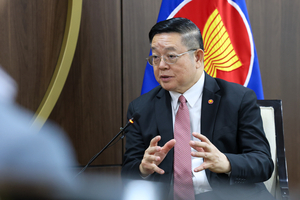
ASEAN Secretary-General Kao Kim Hourn speaks to a group of Korean reporters at the ASEAN Secretariat in Jakarta on Aug. 8, 2026, during a media exchange program organized by the ASEAN-Korea Centre. (ASEAN-Korea Centre) Korea Herald correspondentJAKARTA — South Korea and ASEAN nations should seek deeper cooperation in energy, digital transformation and supply chains to open new opportunities and to expand partnership, ASEAN Secretary-General Kao Kim Hourn says.Speaking to a group of Korean reporters at the ASEAN Secretariat in Jakarta on Aug. 8, the Cambodian diplomat said South Korea and ASEAN member states should use current geopolitical and economic uncertainty to strengthen cooperation in areas where both sides share strategic interests."I think for every crisis, there is an opportunity, side by side," Kao said. "So Korea and ASEAN should work closely together to address a wide range of issues."Energy, he said, is among the most urgent.Citing research by the ASEAN Centre for Energy, Kao said ASEAN's energy demand is expected to increase 2.6-fold by 2045. "And this does not really include the need to build big data centers as required by our Digital Economy Framework Agreement that we have been negotiating," he added.Against that backdrop, Kao called for Korean participation in the ASEAN power grid. The long-term infrastructure project seeks to link electricity networks across ASEAN member states, allowing surplus power — including renewable energy — to be transmitted from areas of abundance to those facing shortages."We need Korea to work with ASEAN to invest in the ASEAN power grid," he said. "The ASEAN power grid is a mega project that requires almost US$800 billion for long-term investment, to move energy surplus, particularly renewable energy, from certain areas of ASEAN to other areas."The project is envisioned as a key component of ASEAN's efforts to strengthen regional energy security as electricity demand rises alongside population growth, industrialization and the expansion of digital infrastructure.Kao also pointed to nuclear power, including small modular reactors, as one potential part of the region's future energy mix."We have some ASEAN member states already looking at pursuing nuclear energy in order to address the energy demand," he said. "I would say it's good to have small modular reactors in place. And as long as they meet the safety conditions, I'm sure, as long as it serves the energy demand, I think it should be welcomed for member states who are interested in this kind."He stressed that ASEAN would continue to uphold its climate commitments while seeking reliable energy sources to support economic growth."We are not giving up on our commitment under the Paris Agreement on UNFCCC," Kao said. "But at the same time, we need to address the energy demand within each member state of ASEAN, and collectively how we need to address it."Kao said the region's population is expected to reach 700 million before long, while continued economic expansion will place additional pressure on energy supplies."We need to make sure that we have sufficient energy, reliable energy, and clean energy to address our growing needs," he said.Beyond energy, Kao identified digital transformation as another area where South Korea could make a significant contribution, citing the country's strengths in artificial intelligence and emerging technologies."The other issue perhaps maybe we can work (on) between ASEAN and Korea, and that is in the digital transformation," he said. "Because Korea, you are doing so well already, as well as in AI and in emerging technologies."ASEAN is currently advancing its Digital Economy Framework Agreement, or DEFA, to facilitate smoother cross-border digital transactions and deepen integration among businesses across the region.Kao said particular attention should be paid to micro, small and medium-sized enterprises, which account for the overwhelming majority of businesses in ASEAN."For ASEAN, MSMEs constitute 97-99 percent of our economy already," he said, adding that Korea and ASEAN could work together to make trade transactions "smoother, seamless" and support greater inclusion of smaller businesses.He also emphasized the importance of improving connectivity between the two sides, including air links, people-to-people exchanges and port-to-port connections.Economic cooperation between ASEAN member states and South Korea is already underpinned by the ASEAN-Korea Free Trade Agreement and the Regional Comprehensive Economic Partnership.Kao said ASEAN and South Korea are now discussing an upgrade to their bilateral FTA to make it more relevant to the business community."Economic-wise, we are very close together," he said. "ASEAN and the Republic of Korea have a bilateral FTA. And now we are negotiating ... an upgrade to our bilateral FTA, ASEAN-Korea FTA, so to make our FTA even more relevant for our business community."He added that cooperation should ultimately translate into tangible benefits for ordinary people."We need to make sure that all the cooperation at the end of the day will benefit the people of both sides," Kao said. "I think that is the essence." ASEAN Secretary-General Kao Kim Hourn speaks to a group of Korean reporters at the ASEAN Secretariat in Jakarta on Aug. 8, 2026, during a media exchange program organized by the ASEAN-Korea Centre. (ASEAN-Korea Centre) Kao also framed ASEAN's economic strategy as one of consolidation and diversification amid growing uncertainty in global trade.ASEAN continues to engage the United States, which remains a major source of foreign direct investment and an important market and technology partner. Member states are also strengthening economic ties with other partners including Australia, China, India, Hong Kong, Japan, New Zealand and South Korea."For us, the policy of ASEAN is to engage with all of our partners," Kao said. "And we don't choose one partner over others; we engage with everyone. This will serve our interests, particularly ASEAN's interests."He said ASEAN continues to support an open, rules-based multilateral trading system and hopes to deepen cooperation with Washington despite recent tariff tensions.At the same time, Kao highlighted South Korea's role within the ASEAN Plus Three framework, which brings together the 10 ASEAN member states with South Korea, China and Japan."Korea has been a bridge builder among the Plus Three countries," he said, noting that the Trilateral Cooperation Secretariat is based in Seoul.Strengthening the ASEAN Plus Three framework, he added, could also help address regional supply chain challenges.Kao said he ultimately hopes to see the ASEAN-South Korea relationship expand across trade, investment, tourism and connectivity while maintaining peace and stability as the foundation for long-term prosperity."I'd like to see more trade between ASEAN and Korea, more investment for mutual benefit, more tourism cooperation, yes, more connectivity," he said."At the same time, we need to work together to ensure that our region remains peaceful, stable, and secure. Because with peace and stability in our region, we can focus our priority on sustainable prosperity for all our people."