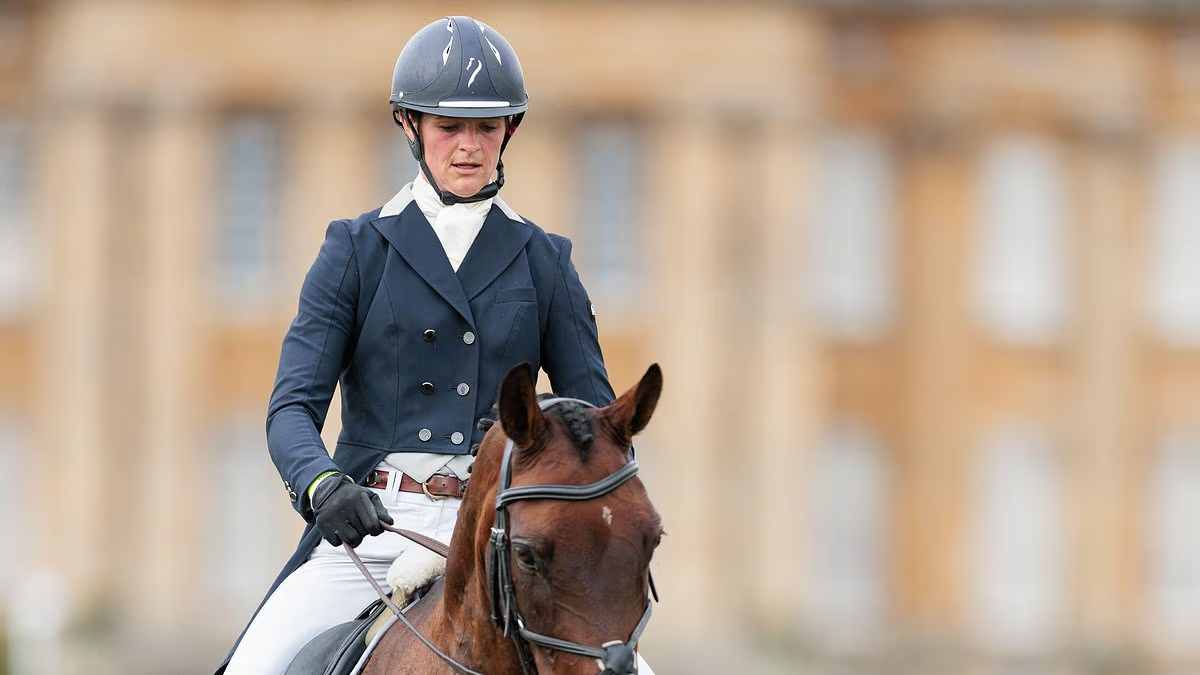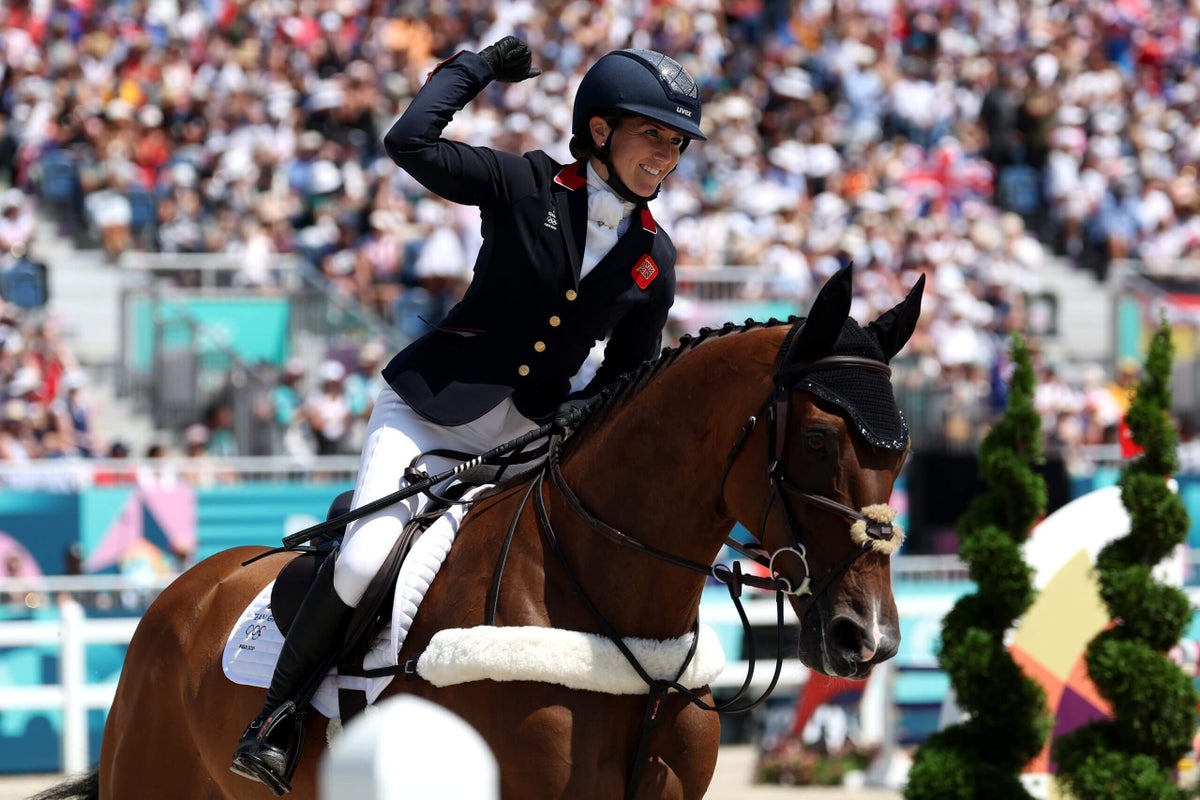
When Laura Collett woke from an induced coma in 2013, she believed she had just been training one of her competition horses over cross-country fences. She felt no pain. She remembered nothing.“I literally thought I’d just had a normal day,” she said. “Everyone was looking at me wondering, ‘What is she talking about?’”The truth was she had cheated death.Collett, then 23, had suffered a rotational fall when a horse she was riding landed on top of her. It had flipped over after hitting a cross-country fence with its chest.The Briton was resuscitated five times en route to hospital. She had a punctured lung, a lacerated liver, broken ribs, a fractured cheekbone, a shattered shoulder. A fragment of bone had travelled through her bloodstream and lodged behind her right eye, permanently damaging her optic nerve.“I didn’t even realise I couldn’t see out of one eye,” Collett, these days one of the world’s best event riders, said. “I went to scratch it and thought, ‘Hold up – why can’t I see?’”Doctors initially told her the vision would return. “They were all really excited because it was such a rare injury,” she said. “I wasn’t quite so excited.”
Later scans revealed the truth. The optic nerve was irreparably damaged. “They just said, ‘Yeah, this is what it’s like now’ very casually.”For some athletes, such trauma could mark an ending. For Collett, now 36, it became the beginning of a new chapter.Hers is a story that begins with a pushchair, a pony, and a mother’s refusal to buy toys for her children.“My mum was always very anti-toys,” Collett said. “She wanted us kids outside. She bought my brother a pony when I was still in a pushchair. But when he got put on it, he was screaming because he wanted to get off, and I was screaming because I wanted to get on. So we swapped, and everyone was happy.”Collett was two years old at that time and has been obsessed with riding ever since.Her mum Tracey, who grew up in New Zealand, was interested in horses, but wasn’t a competitive rider. But what her mum did have was grit, raising her children alone and working three jobs to keep ponies in their lives.“It definitely wasn’t a case of having money,” Collett said. “We bought unbroken ponies, produced them, sold them. As soon as things started to go well, we’d have to sell them to get the money to keep going. It was all I’d ever known.”Collett tolerated school only because it was a gateway to riding. “The deal was always: pass your exams, and you can ride your ponies,” she said.By her teens, she was already one of Britain’s brightest young talents, a prodigy with unusually exceptional feel and temperament.Her list of achievements at such a young age was impressive. Team gold and individual bronze at the 2005 European Championships for ponies at the age of 15; team silver and individual gold at the 2006 junior European Championships (for riders aged 16–18); team and individual gold at the 2007 Junior European Championships and team and individual gold at the 2009 young rider European Championships (for riders aged 19–21). She followed this up with team gold at the 2009 young rider European Championships.After her 2013 accident, Collett spent a week in a coma and only three days awake in hospital before being transferred to Oaksey House in Oxfordshire, England, the Injured Jockeys Fund’s rehabilitation centre.There she relearned depth perception through exercises like throwing and catching balls.“When I started jumping again, the jumps were moving,” Collett said. “I’d come around the corner, see a distance [for the horse to take off from], and then the jump would suddenly appear further away. It scared everyone when I told them.”But her brain adapted quickly.“Once you get your head around this is the new normal, you just carry on. There’s no other option.”Today, she has only a sliver of light perception in one corner of the damaged eye. The rest is black. But since her fall, Collett has achieved more than most would in a lifetime.Her senior career statistics include winning Badminton Horse Trials in 2022, the pinnacle of eventing; victory at Pau, the five-star (top-ranked) event in France in 2020; a win in the five-star at Luhmühlen in Germany in 2023; team gold at the Tokyo Olympics; team gold and individual bronze at the Paris Olympics; team gold at the 2023 European Championships and individual gold at the European Championships in 2025.All of these top-level results have been achieved with the same, once-in-a-lifetime horse — London 52.London 52 is a one-in-a-million horse, according to Laura Collett. The duo are aiming to add more medals to their storied partnership at this weekend’s FEI Eventing World Championships. (Graham Chadwick / Getty Images)The pair met in 2016, when Collett travelled to Germany to look at four-year-old horses she could produce and sell. She tried 15 and none felt right.Then she saw a seven-year-old being exercised in the arena. It was London 52, now known as Dan.“I said, ‘What’s that one?’ The seller replied, ‘He’s not in your budget.’ I said, ‘Just let me have a ride’,” says Collett. “I knew I wanted to buy him before I’d even sat on him — he had a look, the wow factor. He was playful, a bit naughty, but I quite like that.”Collett could only afford a third of the cost so she called Keith Scott and Karen Bartlett, owners of some of her other horses, to help her buy him.Dan had been show jumping up to 1.30m level but lacked the technique to be a pure jumper. He didn’t have a good trot and he wasn’t a natural cross-country horse.“He had to learn everything,” Collett said. “But he had a very trainable brain. He was a worrier as a young horse, so it was all about building trust. He had to believe in me.”(From left) Britain’s Oliver Townend, Laura Collett and Tom McEwen celebrate on the podium after winning Olympic gold in the eventing team in Tokyo. (Behrouz Mehri / AFP via Getty Images)Their partnership grew into one of the most successful in modern eventing, one that came to the attention of the wider sporting world during the Tokyo Olympics, with the COVID pandemic providing an unexpected twist.“COVID was the reason I got to go,” she said of the pandemic which postponed the Olympics by a year. “Dan wouldn’t have been ready in 2020.”As she stood on top of the podium, having won gold at her first Olympics, she remembered the time of her near-catastrophic fall.This week, Collett and Dan head to the FEI Eventing World Championships in Aachen, Germany. Dan is 17 now, seasoned, experienced. Collett believes they can achieve something special together once again.“This last week, everything about him has changed,” she said. “It’s like he knows something big is coming. He’s got that spark back.”Her goal? “Win two gold medals.”She has other aspirations, too, to become world number one, to win more five-star competitions, more medals, a Burghley Horse Trials title, and — her childhood ambition — a hat trick of individual medals at the European and World Championships and the Olympics.But she knows that will require another horse like Dan. “Another one in a million,” she said.