Article
Open access
Nature
(2026) Cite this article
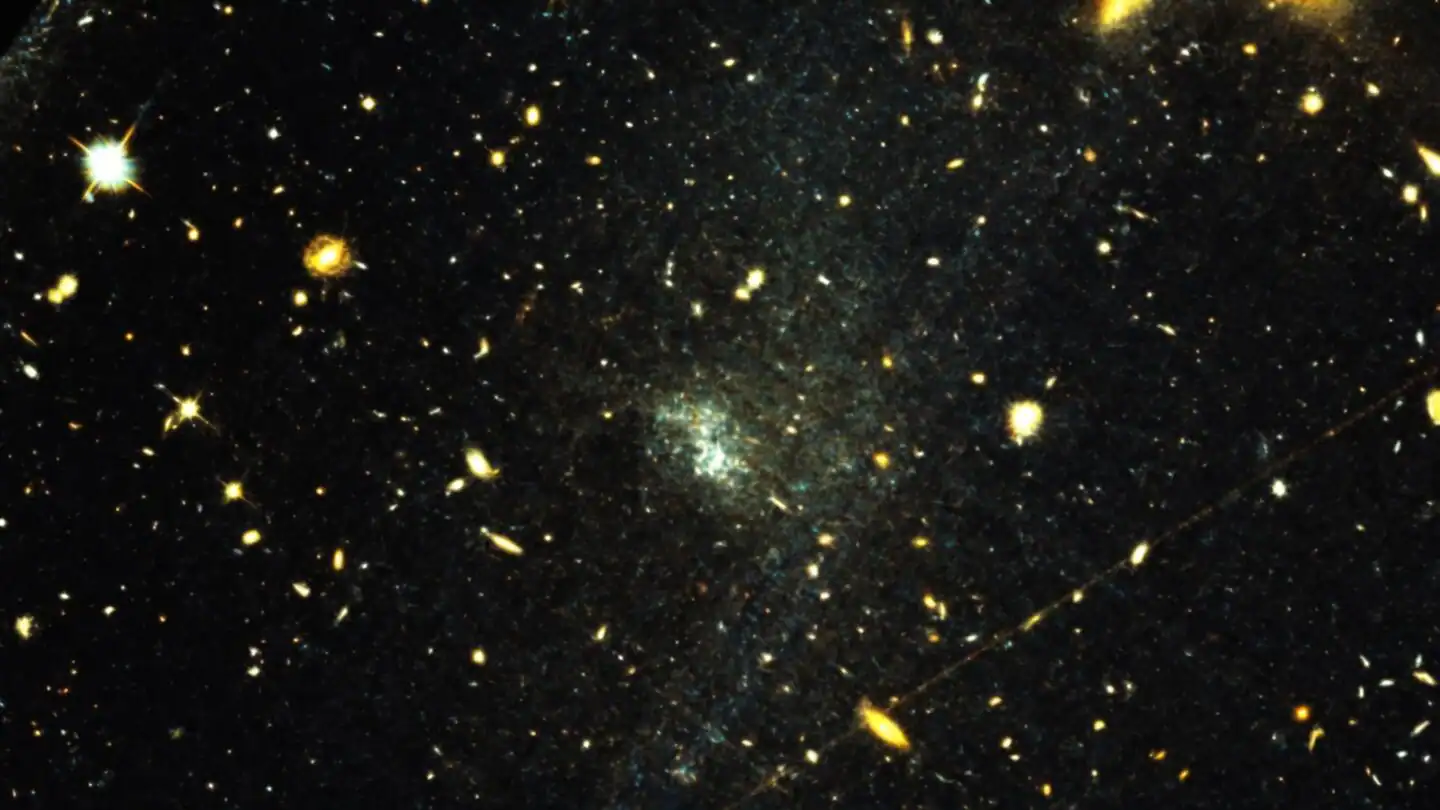
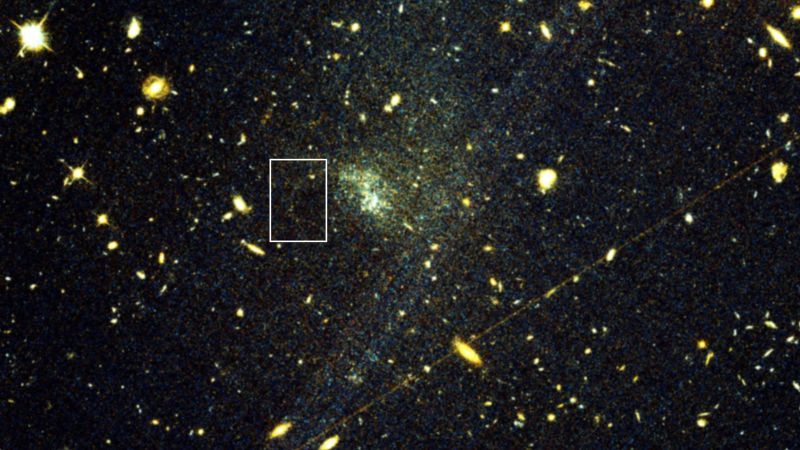
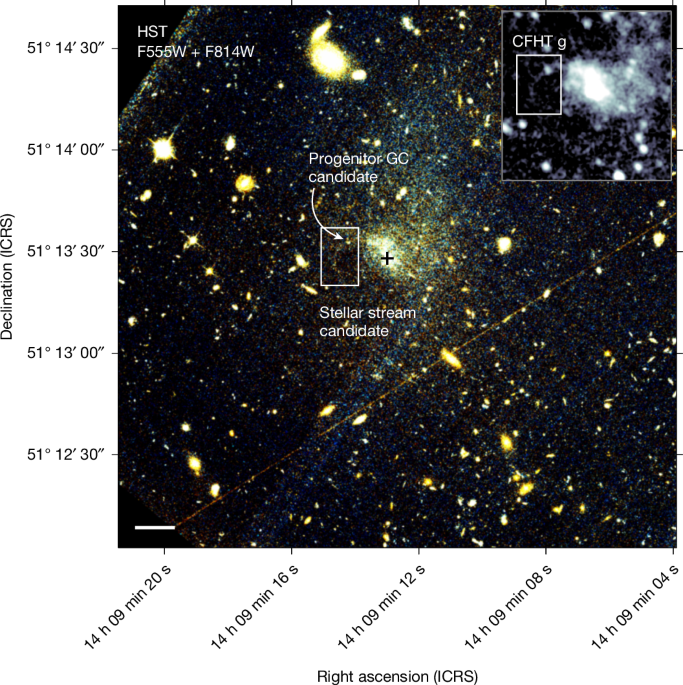
AbstractThe dark matter content of ultra-diffuse galaxies (UDGs) is the subject of considerable debate1,2,3,4,5. Stellar streams, which form when a host galaxy tidally strips stars from an orbiting stellar system, provide a powerful technique to constrain the dark matter content of external galaxies6. The stripped stars form long, thin leading and trailing tidal arms that persist for billions of years. Stellar streams from globular clusters (GCs) are particularly sensitive probes of dark matter halos and substructure7,8,9,10. GC streams are expected to exist in a variety of host galaxy types11,12 but, so far, they have only been observed in the Milky Way (MW). Here we present evidence for the first, to our knowledge, extragalactic GC stellar stream, identified in deep Hubble Space Telescope (HST) imaging of the UDG UGC 9050-Dw1. The stream’s morphology, colour and apparent association with a compact source support the GC progenitor interpretation observationally and we reproduce the observed surface brightness with simulated GC stellar populations. We use generative stream modelling, which fits dynamical models directly to the stream morphology, to constrain the mass of the progenitor and present the first stream-based halo constraint for an UDG. The stream models point to a GC origin and suggest a massive dark matter host halo. By extending the reach of GC stream analysis to external galaxies, this work opens a new chapter in dark matter science.