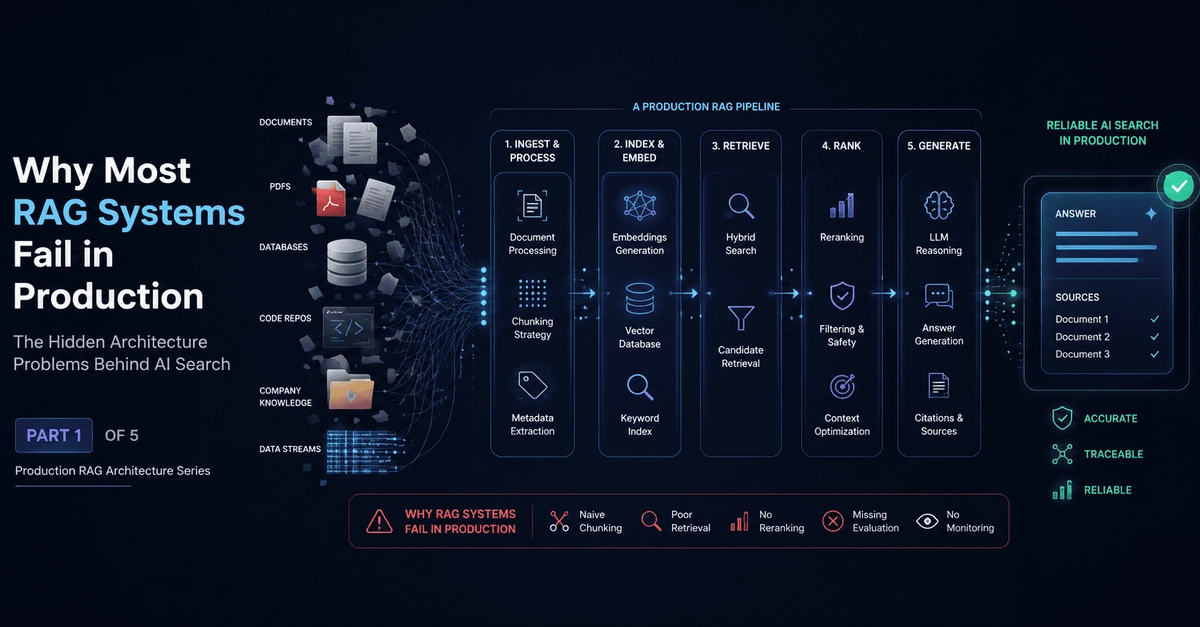
The first two parts of this series covered why production RAG systems fail and how the quality of the data foundation directly affects everything that comes after it. We looked at document ingestion, parsing, chunking, and metadata design—the layers responsible for turning raw information into something a retrieval system can actually work with.
But even perfectly processed documents are useless if retrieval cannot find the right information.
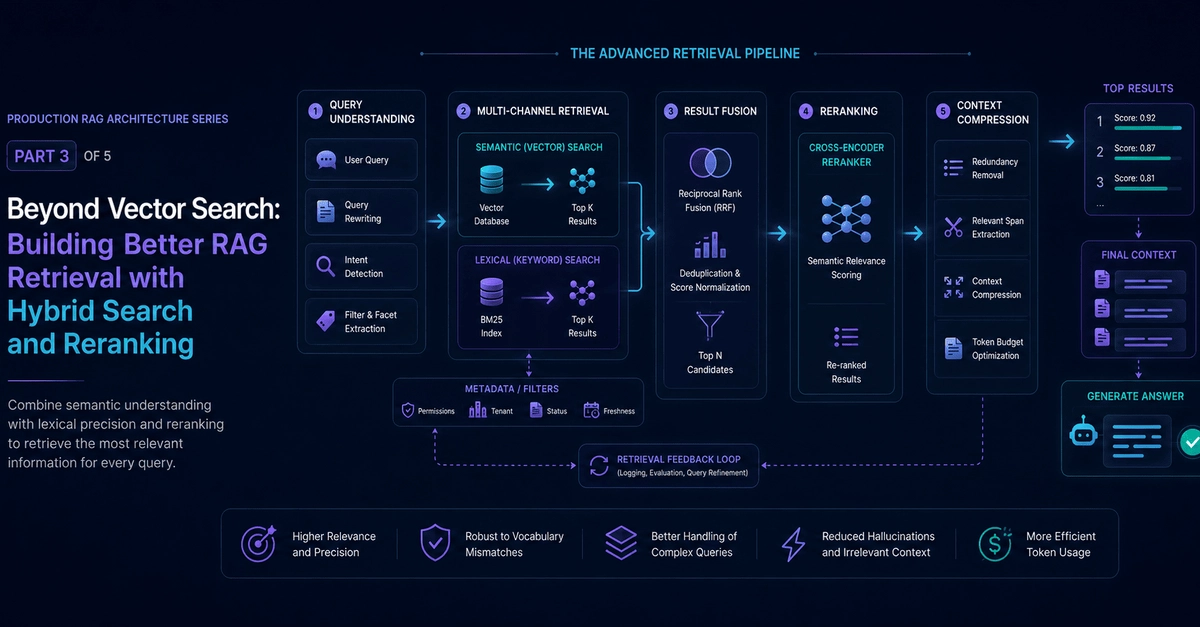
In this third part, we'll move into the retrieval layer itself. We'll look at why vector search alone is often insufficient, how semantic and lexical search complement each other, and how reranking can turn a large set of possible matches into a small set of highly relevant documents. We'll also cover query optimization, metadata filtering, and context compression—key techniques for building retrieval pipelines that perform reliably on real-world queries.
Production RAG Architecture Series
Beyond Vector Search: Building Better RAG Retrieval with Hybrid Search and Reranking (you are here)