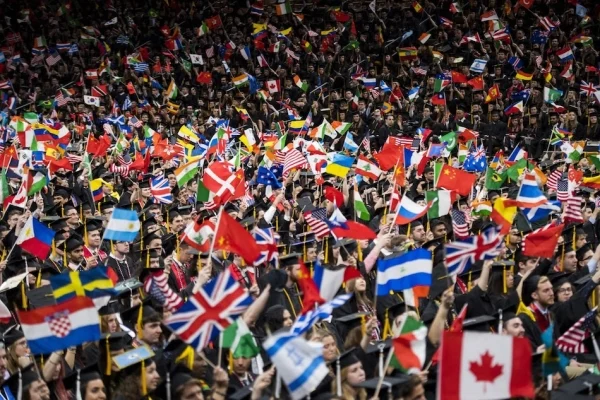
New projections point to a 9.5% drop in overall international student enrollment at U.S. universities this fall.gettyU.S. colleges and universities can expect to see as many as 112,000 fewer international students enrolled in the upcoming year. Based on new projections by NAFSA: Association of International Educators and JB International, that loss translates into a possible $3.4 billion in lost revenue and 40,000 fewer jobs across the nation.The projections are based on data from the Institute of International Education’s (IIE) Spring 2026 Snapshot on International Educational Exchange, which indicates that for the 2026-2027 academic year, 63% of institutions responding to the survey anticipate a decline in theirinternational student enrollment numbers, while only 11% expect an increase and 26% are looking at stable enrollment of foreign students. “The projections underscore what we’ve long warned: U.S. policy and regulations affect where international students plan to invest their future—and their decisions carry significant short- and long-term consequences for U.S. society and economy,” Fanta Aw, executive director and CEO of NAFSA, said in a news release. “All Americans lose when international students and scholars are driven to more welcoming countries. Forfeiting U.S. position as the top destination for global talent hurts students, hospitals, research laboratories, the economies—and carries the real risk that the next big invention will not happen on U.S. soil.”Those figures are in line with other data about declining international enrollment. According to the Association of American Universities Data Exchange, international applications to U.S. doctoral programs for this fall declined by 21%, leading to a 17% drop in international admissions. And the Common App reported that international submissions fell 9% for the 2026-27 cycle. As a result of these trends, the expectation is that roughly 1,057,000 international students will be enrolled at a U.S. college or university during the 2026–27 academic year, down from the 1,169,000 that were estimated to be studying in the U.S. during the 2025–26 academic year. MORE FOR YOUThe recent low point for international students occurred during the Covid-19 pandemic, when the number dropped to 914,000, but it had been on the upswing since then, increasing over the next four admission cycles before peaking in 2024-2025 at 1,178,000 students. That year, international students contributed $43 billion to the economy, supporting 356,000 jobs. By contrast for 2026-2027, international students are exceed to contribute $38.3 billion to the economy and support 294,000 jobs.International numbers began to decline again in 2025-2026, owing largely to several anti-immigration policies enacted by the Trump administration. Secretary of State Marco Rubio called for the deportation of foreign university students who “abuse our hospitality" or engage in a variety of other activities that Rubio had condemned. The Department of Homeland Security threatened the legal status of international students at scores of universities before dozens of lawsuits stopped the attempted deportations, forcing the administration to back down at least temporarily. The Trump administration has issued travel bans against several countries, issued new requirements for visa applicants seeking to study in the U.S., and rejected record levels of visa applications. Last month, the administration finalized a new rule that shortened the time international students could stay in the U.S. to complete their academic program and restricted their ability to change majors and institutions. In addition, the administration continues to threaten that it wants to modify the Optional Practical Training program, an essential tool for addressing U.S. labor shortages in key fields, especially STEM.To address the anticipated decline, NAFSA urged the administration to:prioritize visa interview availability and processing for international students;exempt visa-seeking students as well as J exchange visitors from the current travel ban affecting nationals from 39 countries while maintaining background checks and vetting required for visa issuance; andpreserve Optional Practical Training for all F-1 students.
Projected Loss Of International Students Could Bring A $3.4 Billion Hit
U.S. colleges can expect to see up to 112,000 fewer international students for next year, resulting in a possible $3.4 billion in lost revenue and 40,000 fewer jobs.
617 words~3 min read