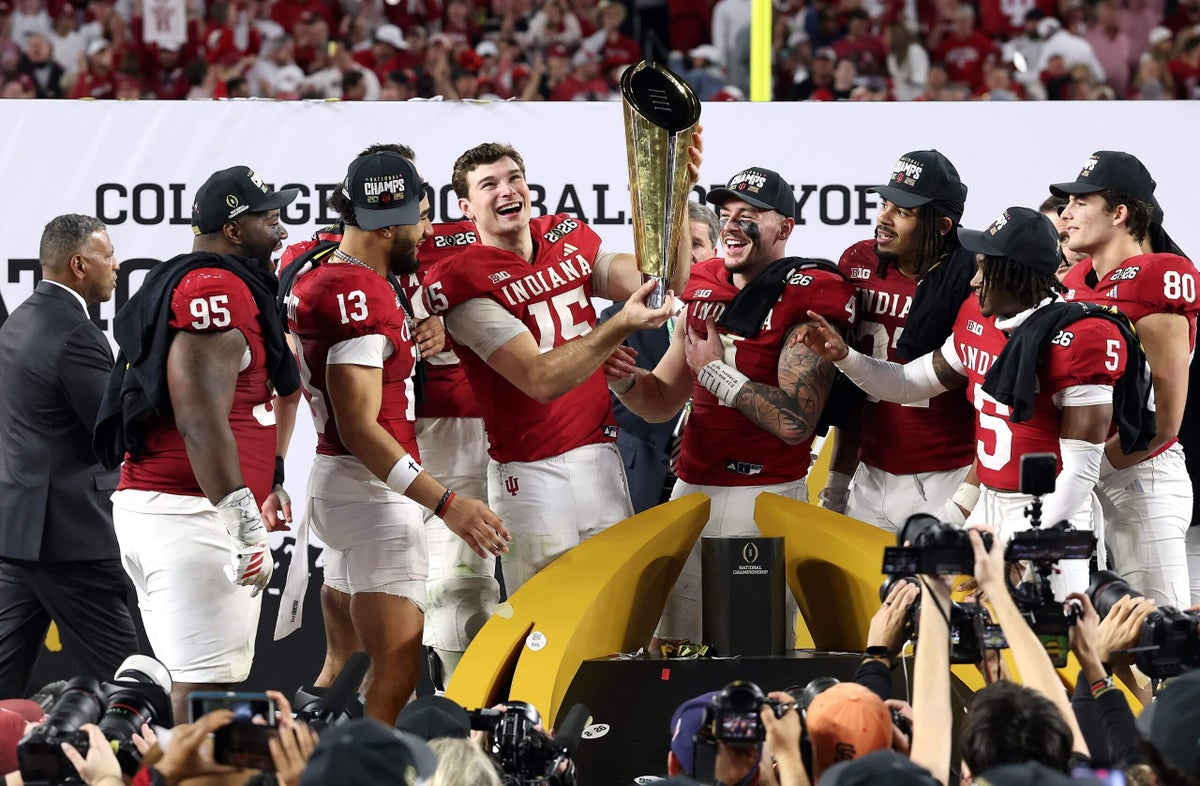
The story goes that when then-Associated Press sports editor Alan Gould declared Minnesota, Princeton and TCU tri-national champions after the 1935 college football season, Gophers fans hung him in effigy.So, yeah, national championships have always been meaningful in college football, no matter how legitimately they were determined.There is a reason the term “mythical national championship” was used for decades, with sports writers and coaches ultimately taking their best guess about who was No. 1 at season’s end.Championship legitimacy has been an evolution. The more the powers that be redesigned the postseason to crown a clear champion, the more emphasis everyone placed on winning it all. Sentiment varies among fans as to whether that development was a positive one.It’s all settled on the field now with a 12-team College Football Playoff.That’s what made Indiana’s breakthrough under coach Curt Cignetti last season so remarkable. Gone are the days when conference bowl tie-ins and convoluted formulas could play as big a role in determining a national championship as the quality of the teams.Why 2026 Indiana is the best national championRalph D. RussoThe Hoosiers’ 16-0 season included five victories against teams that finished ranked in the final top 10 (tied for the second-most among major poll national champions) and six against top-25 teams (tied for fourth). Where exactly major college football’s first 16-0 team since the 19th century ranks among all-time champs is a separate conversation. As good as 2019 LSU? How about 1995 Nebraska or 2001 Miami? You want dominance? Check out Army’s back-to-back championship teams from 1944 and ’45.Place Coach Cig’s Hoosiers wherever you want in the pantheon of college football’s greatest teams. But when it comes to pure legitimacy, Indiana’s national title is unimpeachable. More so than any in college football history.Others may match it, but two years into college football’s expanded postseason era, the Hoosiers have set a standard that can’t be surpassed.In the past, the national title existed almost off to the side in college football.The whole idea of crowning a national champion in such a far-flung sport was raised to stoke debate, not necessarily to settle it.“It created a storm in the Big Ten in general, and Minneapolis-St. Paul, in particular,” Gould told the AP in 1986 about his 1935 proclamation.The next year, the AP poll was born, with Gould welcoming votes from sports writers and newspaper editors all over the country. It was far from the most structured process, but the national title was born. The United Press International, another news wire service, started polling coaches to rank the best teams in college football in 1950.Voting was done at the end of the regular season, an acknowledgment that the few bowl games that existed were more celebratory exhibitions than games that should be factored into determining a champion. Meaningless bowls, you say? Sounds familiar.Not until 1968 did the final AP poll factor in bowls. The coaches poll switched to post-bowl final rankings in 1974. That fact alone makes any national champion from 1936 to 1967 worthy of scrutiny.That’s not to say all those championships are illegitimate. The Mr. Inside (Doc Blanchard) and Mr. Outside (Glenn Davis) Army teams with two Heisman Trophy winners that won consecutive titles in the mid-1940s would be impossible to argue.Both squads went unbeaten. The 1944 team beat opponents by 52 points per game, still an NCAA record for margin of victory. An argument can be made that the 1945 team was just as dominant against better competition. Those Black Knights had an average margin of victory of 40.7 points and beat six teams (in nine games) that finished the season ranked in the AP top 20. That’s as many as Indiana did last season in 16 games with a Top 25 poll. Among national champions, only 2019 LSU (14-0), 2010 Auburn (14-0) and 2022 Georgia (15-0) beat more teams that were ranked in the final poll (seven).
Did Indiana win the most legitimate national title in college football history?
Crowning a national champion has always been inexact in college football. Indiana left no doubt in a way few others have — or could.
1,834 words~8 min read