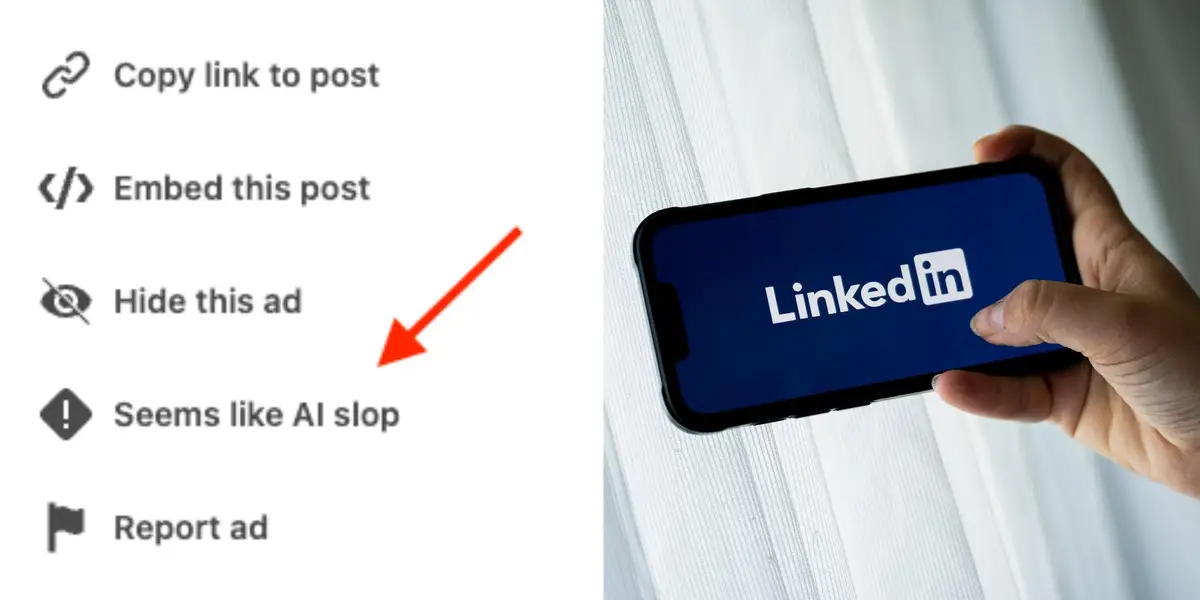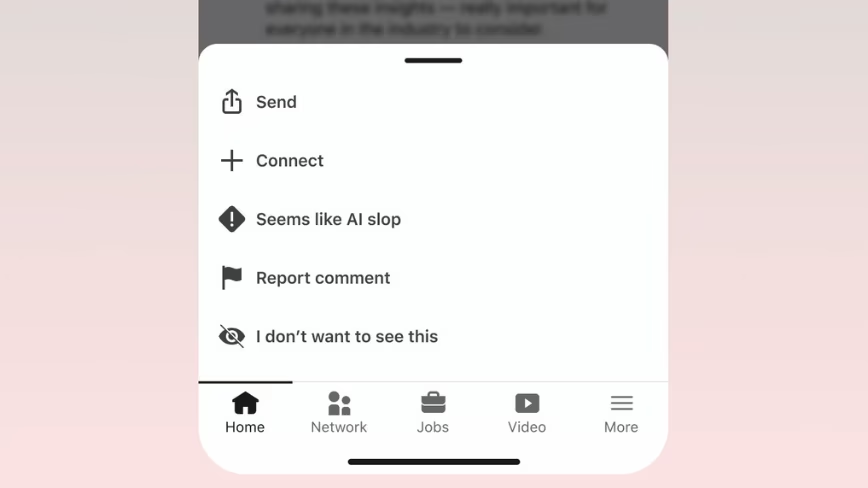
What LinkedIn's AI slop crackdown means for your posts gettySomebody read your last post, clicked the three dots and chose the option that says it seems like AI slop. LinkedIn added that button for some users this week, rolling it out more widely across the month. It works on posts and comments, and Hari Srinivasan, chief product officer of the LinkedIn ecosystem, announced it by calling AI slop "a top priority for all of us."Your writing has one job. The right person reads something only you could have written and makes an inquiry. I grew my LinkedIn to 57,000 followers by experimenting with AI writing and looking at the data. But LinkedIn changed the game and you can’t create lazy posts with AI anymore. You have to be smarter than that. The answer lies in how you write with AI, the words that give you away, and whether you need AI at all. Avoid being flagged by your network. Don’t give anyone the chance to click that button on your post. Here are the seven moves to make before you publish again.LinkedIn's AI slop crackdown in 2026: seven moves that keep your posts on the feedLearn what good writing looks like before AI writes for youYou paste your idea into ChatGPT and publish what comes back, and your reader can tell. Pangram Labs, an AI text detection company, scanned more than a million social posts and found LinkedIn the most AI-saturated platform, with more than 40% of long-form posts fully AI-generated. Take the five posts that piqued your interest last week and work out what made them appealing. At least three will have contained something you have been thinking but haven’t said out loud. This is the nuance an AI model can’t quite grasp, because it doesn’t know you.Write your next post in your notes app before you open any AI tool, and leave the ugly sentences in. Then learn how to really write with AI, so you can tell a terrible draft from a strong one.Learn the signs that give AI awayYour reader spots the pattern before they reach your point. LinkedIn posts made up a third of the items Pangram scanned and nearly two-thirds of everything it flagged as AI writing. Jan Tegze, a director of talent acquisition and LinkedIn instructor, said it in the comments of Srinivasan’s post: "Careful writing reads as fake writing."The giveaways are small. The em dash dropped into the middle of a line. The sentence that sets up one idea only to dismiss it. Words like delve, landscape, journey and quietly. I keep a running list of the words and phrases that give it away, and paste it into every prompt.Read your draft as though you were saying it to a client across a table, and delete every line you would not say. Then delete the summary sentence at the end.Let AI check your words, never choose themLinkedIn is removing the enhance your post tool and replacing it with something that, in Srinivasan's words, "proofreads your words, but does not change your voice."Give the LLM your raw material and make every choice yourself. The voice note from the drive home. The notes you scribbled in the gym. The question your dream customer asked. Ask it to check for spelling, punctuation, sentences that do not make sense, and tell it to change nothing else.Put the rule in the prompt: correct my errors, keep my words. Read the output against your draft and put back anything it smoothed.Treat the slop button as a reach penaltyWhen people mark your work as AI slop, a flag costs you. Posts reported through the new button see reduced reach, in the same way as posts people mark as not interested. The writer gets told privately in their analytics.The coaches and consultants I work with have experienced engagement on their posts fall this year. The feed is being rebuilt around content people stop for. The game has restarted and you need to learn the new one.Open your analytics once a week and look for the flag. When it appears, take the post it applies to, extract the one key message, and rewrite it as the thing you would have said in a voice note.Your comments count as slop tooThe comment box is the bigger problem. LinkedIn blocks hundreds of thousands of automated comment attempts every day, and the new button works on comments as well as posts. But people need to leave comments to play the LinkedIn game, and they don't have time to write them all themselves. Comments are where you build trust with strangers. Quote the line you disagreed with. Add the example from your business experience. Tell them which parts you already tried, highlighting your similarities in a high-energy way.Leave five comments today that no AI could have written, on posts from people you would like as clients or collaborators.Make your own rules while LinkedIn works out its ownLinkedIn is owned by Microsoft, and Microsoft holds roughly 27 percent of OpenAI, an investment valued at about $135 billion. The same company sells you AI features and now polices what those features produce.Allison Rossi, fractional chief marketing officer, commented on Srinivasan’s post: "Now LinkedIn has given them another tool to falsely accuse people." People will use it on posts they simply did not like. Yes, it’s problematic.You shouldn't need to post on LinkedIn worrying about if you're going to be liked. Just be you. The wrong people will leave. The right people will be attracted in their thousands.You do not need AI to write your posts at allAI is great for volume. Publish enough and the data tells you what works: the hooks that grab their attention, and the unconventional beliefs your dream clients came out of hiding for. That trains you as much as it trains the model. After enough repetitions you can write the final version first time.Work on your competence for knowing what does well on LinkedIn, and soon it will be unconscious. Then you win. You don't need to look over your shoulder for the AI slop button because you didn't need AI. You're better than ChatGPT. A bigger following puts more of your dream clients in the room, so go bigger. Take your ten best posts of the year, write down the structure each one used, and write tomorrow's post from that list without AI help.Write the posts that win reach after LinkedIn's AI crackdownThe people who write their own posts have been handed a lifeboat. Your reader has spent a year being trained by AI-generated posts and recognises the pattern in seconds. Take the advantage.You have the material already. The client calls. The framework. The thing you changed your mind about. The number you are proud of. Put one of them in your next post. Write like a human. Let LinkedIn play its game while you play yours.Get the LinkedIn profile structure that wins you coaching clients.
What LinkedIn's AI Slop Crackdown Means For Your Posts
Anyone can now report your LinkedIn post as AI slop, and a flag costs you reach. Seven moves to keep your posts human, your expertise intact and your dream clients reading.
TL;DRAI
LinkedIn deployed AI-slop report button this week; 40% of long-form posts AI-generated per Pangram Labs. Market shift favors authenticity—leaders must use AI for refinement only, not content generation.
1,155 words~5 min read